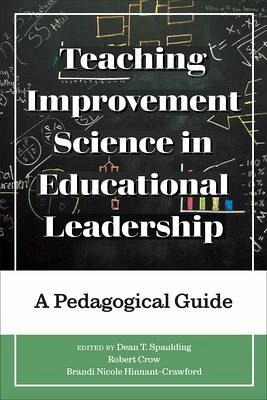
Teaching Improvement Science: A Pedagogical Guide is written for faculty who teach research or leadership courses and want to integrate IS into the curriculum. Specific pedagogies will be shared that provide insights into methods of attaining maximum student learning. Written by faculty in graduate leadership programs, common and unique pedagogical practices will contribute to knowledge-building around strategies to enhance one’s own instructional repertoire for teaching and learning improvement science.
Teaching Improvement Science: A Pedagogical Guide is written for faculty who teach research or leadership courses and want to integrate IS into the curriculum. Specific pedagogies will be shared that provide insights into methods of attaining maximum student learning. Written by faculty in graduate leadership programs, common and unique pedagogical practices will contribute to knowledge-building around strategies to enhance one’s own instructional repertoire for teaching and learning improvement science.
Dean T. Spaulding is the Vice President and Director of Grant Writng and Program Evaluation with Z Score Inc. He is also former chair of the Teaching Evaluation SIG for the American Evaluation Association. Dr. Spaulding has conducted research for New York State Department of Education, New York State Department of Public Health, and the New York State Office of Mental Health (OMH). He has had experience serving as external evaluator on technology-related projects such as state and federal technology catalyst grants PT3: Preparing Tomorrow's Teachers to Use Technology and several Title III Technology Literacy Challenge Grants. He currently serves as external evaluator on a National Science Foundation and a Howard Hughes Foundation grant. Dr. Spaulding is one of the authors of Methods in Educational Research: From Theory to Practice (2010, 2nd edition), Jossey-Bass Wiley, and the author of Program Evaluation in Practice: Core Concepts and Examples for Discussion and Analysis (2014, 2nd edition) Jossey-Bass Wiley. He is also the co-author of Action Research for School Leaders (2012) Pearson, Instructional Coaches and the Instructional Leadership Team (2012) Corwin, and What Does Your School Data Team Sound Like? Strategies to Improve the Conversation Around Data (August, 2018) Corwin. Robert Crow, PhD, is an associate professor of educational research at Western Carolina University. His expertise in assessment and evaluation has led to collaborations with other 4-year institutions, community colleges, PK-12 schools, and institutional accreditation agencies such as SACS-COC. Dr. Crow's research interests include assessment and evaluation of student learning and of learning environments. Brandi Hinnant-Crawford, PhD, is an Associate Professor of Educational Research at Western Carolina University. As a mixed-methods methodologist, she believes in the complementary nature of quantitative and qualitative research, and seeks to use research in transformative ways (such as with improvement science). Dr. Hinnant-Crawford's work has been published in diverse venues such as Urban Education, the Journal for Multicultural Education, and Black Theology. She holds a PhD from Emory University in Educational Studies, a master's degree in Urban Education Policy from Brown University, and bachelor's degrees in English and Communication (media concentration) from North Carolina State University. While she loves research and teaching, her first priority is being the mother of her seven-year-old twins, Elizabeth Freedom and Elijah Justice Crawford.
Inhaltsangabe
* Dedication * Acknowledgments * Introduction The Need for Curating a Repertoire of Improvement Science Pedagogies Dean T. Spaulding, Brandi Nicole Hinnant-Crawford, & Robert Crow * Chapter 1. A Pedagogy for Introducing the Improvement Science Method: The Personal Improvement Project Robert Crow * Chapter 2. Who Is Involved? Who Is Impacted? Teaching Improvement Science for Educational Justice Brandi Nicole Hinnant-Crawford, Ricardo Nazario y Colón, & Tacquice Wiggan Davis * Chapter 3. Finding Problems, Asking Questions, and Implementing Solutions: Improvement Science and the EdD Jill Alexa Perry & Debby Zambo * Chapter 4. Teaching the Design of Plan-Do-Study-Act Cycles Using Improvement Cases Chad R. Lochmiller * Chapter 5. Embedding Improvement Science in One Principal Licensure Course: Principal Leadership for Equity and Inclusion Susan P. Carlile & Deborah S. Peterson * Chapter 6 Embedding Improvement Science in Principal Leadership Licensure Courses: Program Designs Deborah S. Peterson, Susan P. Carlile, Maria Eugenia Olivar, & Cassandra Thonstad * >Emma Parkerson, Kelly McMahon, & Barbara Shreve * >Segun C. Eubanks, Margaret McLaughlin,Jean L. Snell, & Charoscar Coleman * >Jacqueline Hawkins & Monica Martens * >Ryan Carpenter & Kathleen Oropallo * >LaRena Heath, Barbara Shreve, Louis M. Gomez, & Paul G. LeMahieu * About the Authors Index * NOTE: Table of contents subject to change up until publication date.
* Dedication * Acknowledgments * Introduction The Need for Curating a Repertoire of Improvement Science Pedagogies Dean T. Spaulding, Brandi Nicole Hinnant-Crawford, & Robert Crow * Chapter 1. A Pedagogy for Introducing the Improvement Science Method: The Personal Improvement Project Robert Crow * Chapter 2. Who Is Involved? Who Is Impacted? Teaching Improvement Science for Educational Justice Brandi Nicole Hinnant-Crawford, Ricardo Nazario y Colón, & Tacquice Wiggan Davis * Chapter 3. Finding Problems, Asking Questions, and Implementing Solutions: Improvement Science and the EdD Jill Alexa Perry & Debby Zambo * Chapter 4. Teaching the Design of Plan-Do-Study-Act Cycles Using Improvement Cases Chad R. Lochmiller * Chapter 5. Embedding Improvement Science in One Principal Licensure Course: Principal Leadership for Equity and Inclusion Susan P. Carlile & Deborah S. Peterson * Chapter 6 Embedding Improvement Science in Principal Leadership Licensure Courses: Program Designs Deborah S. Peterson, Susan P. Carlile, Maria Eugenia Olivar, & Cassandra Thonstad * >Emma Parkerson, Kelly McMahon, & Barbara Shreve * >Segun C. Eubanks, Margaret McLaughlin,Jean L. Snell, & Charoscar Coleman * >Jacqueline Hawkins & Monica Martens * >Ryan Carpenter & Kathleen Oropallo * >LaRena Heath, Barbara Shreve, Louis M. Gomez, & Paul G. LeMahieu * About the Authors Index * NOTE: Table of contents subject to change up until publication date.
Es gelten unsere Allgemeinen Geschäftsbedingungen: www.buecher.de/agb
Impressum
www.buecher.de ist ein Internetauftritt der buecher.de internetstores GmbH
Geschäftsführung: Monica Sawhney | Roland Kölbl | Günter Hilger
Sitz der Gesellschaft: Batheyer Straße 115 - 117, 58099 Hagen
Postanschrift: Bürgermeister-Wegele-Str. 12, 86167 Augsburg
Amtsgericht Hagen HRB 13257
Steuernummer: 321/5800/1497
USt-IdNr: DE450055826