Teaching Interpreting and Live Subtitling: Contexts, Modes and Technologies provides a cross section of multinational perspectives on teaching various dimensions of interpreting and live subtitling, both within dedicated programmes and as part of individual modules on interpreting and/or live subtitling-adjacent programmes. Interpreting training and live subtitling training have been undergoing rapid and far-reaching transformations in recent years because of technological advances and the sweeping shifts in the contexts within which they seek to mediate, ultimately bringing about new…mehr
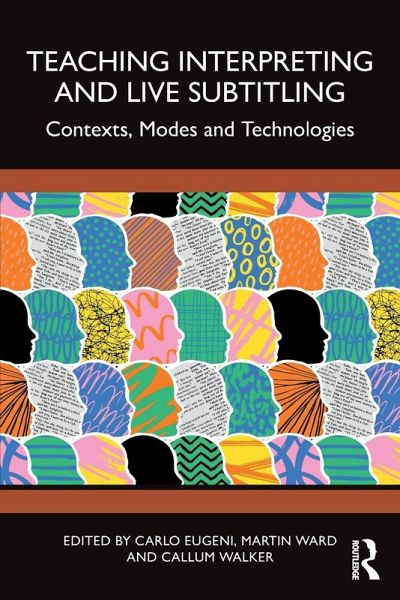
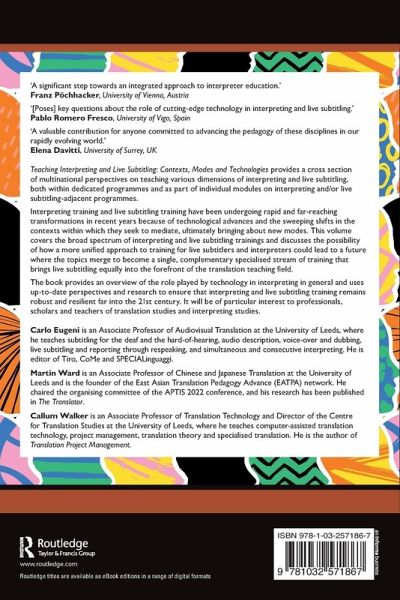
Teaching Interpreting and Live Subtitling: Contexts, Modes and Technologies provides a cross section of multinational perspectives on teaching various dimensions of interpreting and live subtitling, both within dedicated programmes and as part of individual modules on interpreting and/or live subtitling-adjacent programmes.
Interpreting training and live subtitling training have been undergoing rapid and far-reaching transformations in recent years because of technological advances and the sweeping shifts in the contexts within which they seek to mediate, ultimately bringing about new modes. This volume covers the broad spectrum of interpreting and live subtitling trainings and discusses the possibility of how a more unified approach to training for live subtitlers and interpreters could lead to a future where the topics merge to become a single, complementary specialised stream of training that brings live subtitling equally into the forefront of the translation teaching field.
The book provides an overview of the role played by technology in interpreting in general and uses up-to-date perspectives and research to ensure that interpreting and live subtitling training remains robust and resilient far into the 21st century. It will be of particular interest to professionals, scholars and teachers of translation studies and interpreting studies.
Carlo Eugeni is an Associate Professor of Audiovisual Translation at the University of Leeds, where he teaches subtitling for the deaf and the hard-of-hearing, audio description, voice-over and dubbing, live subtitling and reporting through respeaking, and simultaneous and consecutive interpreting. He is editor of Tiro, CoMe and SPECIALinguaggi. Martin Ward is an Associate Professor of Chinese and Japanese Translation at the University of Leeds and is the founder of the East Asian Translation Pedagogy Advance (EATPA) network. He chaired the organising committee of the APTIS 2022 conference, and his research has been published in The Translator. Callum Walker is an Associate Professor of Translation Technology and Director of the Centre for Translation Studies at the University of Leeds, where he teaches computer-assisted translation technology, project management, translation theory and specialised translation. He is the author of Translation Project Management.
Inhaltsangabe
List of contributors 1. Introduction Carlo Eugeni Part I. Interpreting training and the classroom 2. Challenges in conference interpreting training: how to bridge the gap between academia and the professional booth? Fanny Chouc 3. The Importance of vision in interpreter training Jenny Wong 4. Does an implicit learning environment always lead to successful interpreter training? Students' procedural learning abilities and interpreting skill types can have the con Yinghua Wang Part II. Interpreting training and the profession 5. An Experimental study on interpreters' experience of RSI: Implications for post-pandemic research and practice Clarissa Guarini 6. Interpreting for minors in legal encounters in Ireland during the COVID-19 pandemic: patterns of practice and implications Eddie López-Pelén 7. The Importance of implementing higher education training opportunities for interpreters in schools Letizia Leonardi Part III. Live subtitling training, the classroom and the profession 8. Redefining respeakers' training: A Practical approach to diamesic translation tactics and respeaking skills Martina A. Bruno 9. Reaching MARS: How to increase speed and accuracy in formal and informal training in live subtitling Carlo Eugeni and Alessio Popoli 10. Intralingual and interlingual respeaking didactics: redefining human-machine interaction challenges into opportunities Alice Pagano 11. Teaching live subtitling through mock conferences Faruk Mardan 12. Professional training in Valencian live subtitling: navigating diglossia and language variation Luz Belenguer Cortés Index
List of contributors 1. Introduction Carlo Eugeni Part I. Interpreting training and the classroom 2. Challenges in conference interpreting training: how to bridge the gap between academia and the professional booth? Fanny Chouc 3. The Importance of vision in interpreter training Jenny Wong 4. Does an implicit learning environment always lead to successful interpreter training? Students' procedural learning abilities and interpreting skill types can have the con Yinghua Wang Part II. Interpreting training and the profession 5. An Experimental study on interpreters' experience of RSI: Implications for post-pandemic research and practice Clarissa Guarini 6. Interpreting for minors in legal encounters in Ireland during the COVID-19 pandemic: patterns of practice and implications Eddie López-Pelén 7. The Importance of implementing higher education training opportunities for interpreters in schools Letizia Leonardi Part III. Live subtitling training, the classroom and the profession 8. Redefining respeakers' training: A Practical approach to diamesic translation tactics and respeaking skills Martina A. Bruno 9. Reaching MARS: How to increase speed and accuracy in formal and informal training in live subtitling Carlo Eugeni and Alessio Popoli 10. Intralingual and interlingual respeaking didactics: redefining human-machine interaction challenges into opportunities Alice Pagano 11. Teaching live subtitling through mock conferences Faruk Mardan 12. Professional training in Valencian live subtitling: navigating diglossia and language variation Luz Belenguer Cortés Index
Es gelten unsere Allgemeinen Geschäftsbedingungen: www.buecher.de/agb
Impressum
www.buecher.de ist ein Internetauftritt der buecher.de internetstores GmbH
Geschäftsführung: Monica Sawhney | Roland Kölbl | Günter Hilger
Sitz der Gesellschaft: Batheyer Straße 115 - 117, 58099 Hagen
Postanschrift: Bürgermeister-Wegele-Str. 12, 86167 Augsburg
Amtsgericht Hagen HRB 13257
Steuernummer: 321/5800/1497
USt-IdNr: DE450055826