Featuring essays by an international array of literature scholars, this volume examines the challenges and opportunities of teaching literature at Open and Virtual Universities in a wide range of national, cultural and linguistic contexts. It presents cutting-edge explorations of seminal issues, including: literature pedagogy and curriculum building; canon and theory debates; the uses of hypertext and other digital tools for literary instruction; the writing and evaluation of educational material; and the teaching of digital literature. These issues are addressed from various critical and…mehr
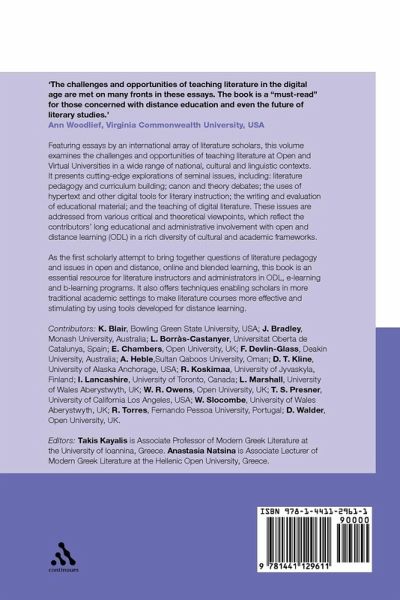
Featuring essays by an international array of literature scholars, this volume examines the challenges and opportunities of teaching literature at Open and Virtual Universities in a wide range of national, cultural and linguistic contexts. It presents cutting-edge explorations of seminal issues, including: literature pedagogy and curriculum building; canon and theory debates; the uses of hypertext and other digital tools for literary instruction; the writing and evaluation of educational material; and the teaching of digital literature. These issues are addressed from various critical and theoretical viewpoints, which reflect the contributors' long educational and administrative involvement with open and distance learning (ODL) in a rich diversity of cultural and academic frameworks. As the first scholarly attempt to bring together questions of literature pedagogy and issues in open and distance, online and blended learning, this book is an essential resource for literature instructors and administrators in ODL, e-learning and b-learning programs. It offers techniques enabling scholars in more traditional academic settings to make literature courses more effective and stimulating by using tools developed for distance learning.
Takis Kayalis is Associate Professor of Modern Greek Literature at the University of Ioannina, Greece. Anastasia Natsina is Associate Lecturer of Modern Greek Literature at The Hellenic Open University, Greece.
Inhaltsangabe
Introduction \ Part I: Open and Distance Learning: Curricula and Pedagogies \ 1. Tendencies and Stakes of Literary Studies in European Open and Distance Learning Universities Anastasia Natsina \ 2. Teaching First-year Students in Open and Distance Education: Aims and Methods Ellie Chambers \3. Masters-level Study in Literature at The Open University: Pedagogic Challenges and Solutions W.R. Owens \ 4. Decolonizing the distance curriculum Dennis Walder \ 5. The Need for a Community: A Case for World Literature in Open and Distance Learning Takis Kayalis \ Part II: Pedagogical challenges in online and blended learning \ 6. Delivering Literary Studies in the 21st Century: The Relevance of Online Pedagogies Kris L. Blair \7. Digital Pedagogy: Taming the Palantíri Ian Lancashire \ 8. Teaching Literature in a Virtual Campus: Uses of hypertext Laura Borràs-Castanyer \ 9. From Passive to Active Voices: Technology, Community, and Literary Studies Louis Marshall and Will Slocombe \ 10. Using Technology to Overcome Cultural Restrictions: A case study of teaching English literature online to Arab students Ayesha Heble \ Part III: Digital tools and Web applications \ 11. Literature in Digital Culture: Pedagogical Possibilities Raine Koskimaa \ 12. Teaching Poetry with New Media Rui Torres \13. Metamedievalism, Videogaming, and Teaching Medieval Literature in the Digital Age Daniel T. Kline \ 14. From Virtuality to Actuality: Representations and Enactments of Critical Theory on the World Wide Web Anastasia Natsina and Takis Kayalis \ 15. HyperCities: Building a Web 2.0 Learning Platform Todd Samuel Presner \ 16. Affect and Narrative Encoding: The Problematics of Representing and Teaching Yanyuwa Narratives in Cyberspace John Bradley and Frances Devlin-Glass \ Notes on contributors \ Index
Es gelten unsere Allgemeinen Geschäftsbedingungen: www.buecher.de/agb
Impressum
www.buecher.de ist ein Internetauftritt der buecher.de internetstores GmbH
Geschäftsführung: Monica Sawhney | Roland Kölbl | Günter Hilger
Sitz der Gesellschaft: Batheyer Straße 115 - 117, 58099 Hagen
Postanschrift: Bürgermeister-Wegele-Str. 12, 86167 Augsburg
Amtsgericht Hagen HRB 13257
Steuernummer: 321/5800/1497
USt-IdNr: DE450055826