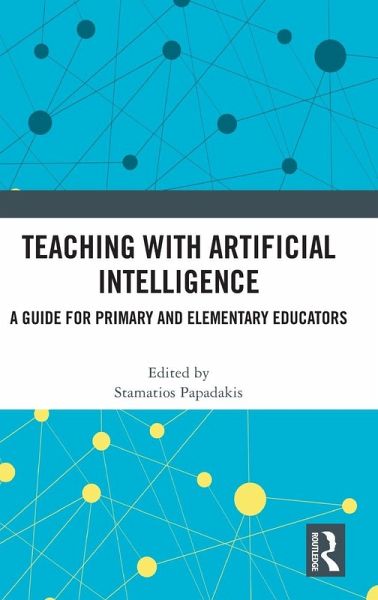
This book brings together global experts to explore the transformative potential of artificial intelligence (AI) in early childhood and primary education.
This book brings together global experts to explore the transformative potential of artificial intelligence (AI) in early childhood and primary education.
Stamatios Papadakis is an assistant professor at the University of Crete, Greece. His research interests include educational technology, computational thinking, educational robotics, and the pedagogical integration of generative artificial intelligence.
Inhaltsangabe
Part I Foundations & Ethics: Historical Context, Ethical framing, and Why AI Matters for Young Learners 1. Developing Minds, Smart Classrooms and Artificial Intelligence:A Present-Future Merger 2. Starting Early: Ethics and AI in Education 3. Empowering Literacy with AI: Implications for Teaching, Ethics, and Policy Part II Building Educator Capacity & AI Literacy: Equipping Teachers with AI lLiteracy, Prompt-Engineering Skills, and Equitable Training 4. Fostering AI Literacy in Primary Education with LearningML: Practical Classroom Examples Using Machine Learning 5. The AI-Ready Educator: Prompt Engineering for Empowerment in Early Childhood Education and Care 6. Evaluating AI Teacher-Training Curricula through a Lens of Equity, Ethics, and Justice 7. AI in Early and Primary Education: Societal, Classroom, and Teacher Perspectives on Ethical and Pedagogical Integration Part III Classroom Tools & Assessment Practices: Hands-on AI Tutors, Chatbots, Generative-AI Question Design, and Assessment Pipelines 8. AI Tutors and Multilingual Development: A Literature-Based Analysis 9. AI Tutors: From Promise to Practice in Primary and Early Education 10. AI-Driven Chatbots in Flipped-Classroom Mathematics Education: Enhancing Learning Achievement and Self-Efficacy in Pre-Service Primary Teachers 11. Designing Classroom Assessments with Generative AI: A Teacher-in-the-Loop Framework Part IV Policy, Implementation & Future Directions: System-Level Governance, Adaptive-Learning Policy, and Visionary Outlook 12. AI-Driven Assessment in Early and Primary Education: Tools, Strategies, and Ethical Considerations 13. Generative AI in Primary Education: Policies, Practices, and Adaptive-Learning Innovations 14. Nurturing the Future: AI's Role in Shaping Early and Primary Education
Part I Foundations & Ethics: Historical Context, Ethical framing, and Why AI Matters for Young Learners 1. Developing Minds, Smart Classrooms and Artificial Intelligence:A Present-Future Merger 2. Starting Early: Ethics and AI in Education 3. Empowering Literacy with AI: Implications for Teaching, Ethics, and Policy Part II Building Educator Capacity & AI Literacy: Equipping Teachers with AI lLiteracy, Prompt-Engineering Skills, and Equitable Training 4. Fostering AI Literacy in Primary Education with LearningML: Practical Classroom Examples Using Machine Learning 5. The AI-Ready Educator: Prompt Engineering for Empowerment in Early Childhood Education and Care 6. Evaluating AI Teacher-Training Curricula through a Lens of Equity, Ethics, and Justice 7. AI in Early and Primary Education: Societal, Classroom, and Teacher Perspectives on Ethical and Pedagogical Integration Part III Classroom Tools & Assessment Practices: Hands-on AI Tutors, Chatbots, Generative-AI Question Design, and Assessment Pipelines 8. AI Tutors and Multilingual Development: A Literature-Based Analysis 9. AI Tutors: From Promise to Practice in Primary and Early Education 10. AI-Driven Chatbots in Flipped-Classroom Mathematics Education: Enhancing Learning Achievement and Self-Efficacy in Pre-Service Primary Teachers 11. Designing Classroom Assessments with Generative AI: A Teacher-in-the-Loop Framework Part IV Policy, Implementation & Future Directions: System-Level Governance, Adaptive-Learning Policy, and Visionary Outlook 12. AI-Driven Assessment in Early and Primary Education: Tools, Strategies, and Ethical Considerations 13. Generative AI in Primary Education: Policies, Practices, and Adaptive-Learning Innovations 14. Nurturing the Future: AI's Role in Shaping Early and Primary Education
Es gelten unsere Allgemeinen Geschäftsbedingungen: www.buecher.de/agb
Impressum
www.buecher.de ist ein Internetauftritt der buecher.de internetstores GmbH
Geschäftsführung: Monica Sawhney | Roland Kölbl | Günter Hilger
Sitz der Gesellschaft: Batheyer Straße 115 - 117, 58099 Hagen
Postanschrift: Bürgermeister-Wegele-Str. 12, 86167 Augsburg
Amtsgericht Hagen HRB 13257
Steuernummer: 321/5800/1497
USt-IdNr: DE450055826