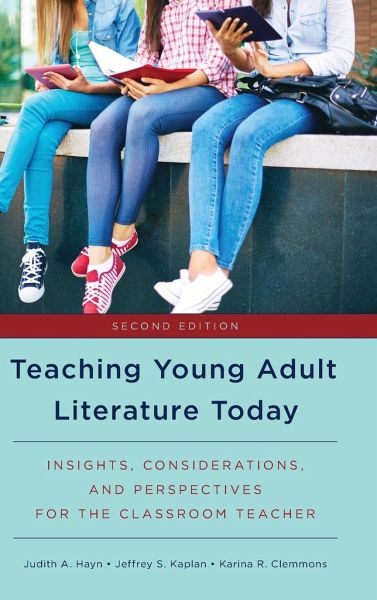
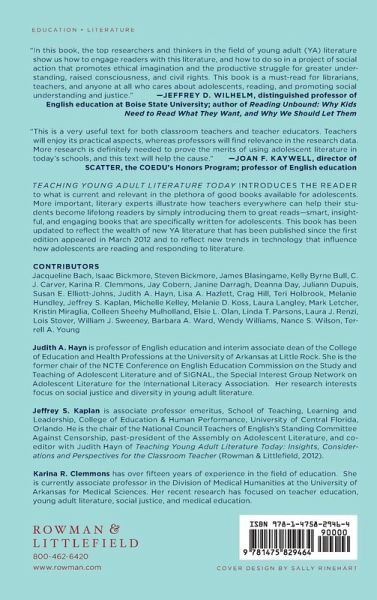
Teaching Young Adult Literature Today introduces the reader to what is current and relevant in the plethora of good books available for adolescents. More importantly, literary experts illustrate how teachers everywhere can help their students become lifelong readers by simply introducing them to great reads-smart, insightful, and engaging books that are specifically written for adolescents. Hayn, Kaplan, and their contributors address a wide range of topics: how to avoid common obstacles to using YAL; selecting quality YAL for classrooms while balancing these with curriculum requirements;…mehr
Teaching Young Adult Literature Today introduces the reader to what is current and relevant in the plethora of good books available for adolescents. More importantly, literary experts illustrate how teachers everywhere can help their students become lifelong readers by simply introducing them to great reads-smart, insightful, and engaging books that are specifically written for adolescents. Hayn, Kaplan, and their contributors address a wide range of topics: how to avoid common obstacles to using YAL; selecting quality YAL for classrooms while balancing these with curriculum requirements; engaging disenfranchised readers; pairing YAL with technology as an innovative way to teach curriculum standards across all content areas. Contributors also discuss more theoretical subjects, such as the absence of lesbian, gay, bisexual, transgender and questioning (LGBTQ) young adult literature in secondary classrooms; and contemporary YAL that responds to the changing expectations of digital generation readers who want to blur the boundaries between page and screen. This book has been updated to reflect the wealth of new YA literature that has been published since the first edition appeared in March 2012, and to reflect new trends in technology that influences how adolescents are reading and responding to literature.
Judith A. Hayn is associate professor of English education at the University of Arkansas at Little Rock. She is the chair of the NCTE Conference on English Education Commission on the Study and Teaching of Adolescent Literature and of SIGNAL, the Special Interest Group Network on Adolescent Literature for the International Reading Association. Hayn began her career in education as a middle and high school English language arts. Jeffrey S. Kaplan is associate professor of English education at the University of Central Florida in Orlando. Kaplan is President-Elect for ALAN, the Assembly for the Study of Literature for Adolescents. He is also the Research Connections Editor for the ALAN Review, a leading peer-reviewed journal on the study and teaching of young adult literature. Kaplan is a former middle and high school English Language Arts teacher. Karina Clemmons, is an assistant professor of secondary education at the University of Arkansas at Little Rock. She has taught English for Speakers of Other Languages to middle school, high school and adult students in the United States and abroad.
Inhaltsangabe
Preface Acknowledgements Section I: Where Has YAL Been? Young Adult Literature: Updating the Role of ResearchJudith A. Hayn and Jay Cobern Young Adult Literature Today: The Many Faces, Changes, and Challenges for Teachers and Researchers in the 21st CenturyJeffrey S. Kaplan and Elsie Olan Literacy Teacher Education Today and the Teaching of Young Adult Literature: Perspectives on Research and Implications for PracticeSusan E. Elliott-Johns Section II: Where is YAL Now? Young Adult Literature as the Sustaining Force: An Interdisciplinary Approach to Teaching EnvironmentalismKelly Byrne Bull and Jill Dupuis Avid Readers in High School: Are They Reading for Pleasure?Nance S. Wilson and Michelle J. Kelley Is Poverty the Result of Poor Decisions? What Young Adult Literature Contributes to the ConversationCrag Hill and Janine Darragh Crossing Boundaries: Exploring the Fluidity of Sexuality and Gender in Young Adult LiteratureLaura J. Renzi, Mark Letcher, and Kristin Miraglia The Literary Community's Definition: Balancing Creating and Updating Young Adult Literature Reading Lists While Retaining Quality TitlesLisa A. Hazlett and William J. Sweeney Civil Rights and Social Justice: Then and Now-How Much Progress Have We Made?Barbara A. Ward, Deanna Day, and Terrell A. Young Music and the Young Adult Novel: Assessing How Adolescents "Read" the Music of Their LivesSteven T. Bickmore and Isaac Bickmore Activism, Service-Learning, Social Awareness, and Young Adult LiteratureLois T. Stover, Jacqueline Back, and CJ Carver Fat Female Protagonists in YAL and in Classrooms: Exploring the Impact of Anti-fat Bias on IdentityLinda T. Parsons YAL and English Learners: Activating Funds of KnowledgeKarina R. Clemmons Celebrating All Voices: Assuring Diversity in Young Adult LiteratureJames Blasingame and Wendy Williams Section III: Where is YAL Going? Exploding the Page: Digital, Multimodal, and Transmedia Young Adult LiteratureMelanie Hundley and Teri Holbrook Pushing the Edge of Possibility: A New Look at Integrating Technologies with Young Adult Literature Across Content AreasColleen Sheehy Mulholland The Influence of the Internet and Social Media on Teens' Engagement with Young Adult LiteratureMelanie D. Koss
Preface Acknowledgements Section I: Where Has YAL Been? Young Adult Literature: Updating the Role of ResearchJudith A. Hayn and Jay Cobern Young Adult Literature Today: The Many Faces, Changes, and Challenges for Teachers and Researchers in the 21st CenturyJeffrey S. Kaplan and Elsie Olan Literacy Teacher Education Today and the Teaching of Young Adult Literature: Perspectives on Research and Implications for PracticeSusan E. Elliott-Johns Section II: Where is YAL Now? Young Adult Literature as the Sustaining Force: An Interdisciplinary Approach to Teaching EnvironmentalismKelly Byrne Bull and Jill Dupuis Avid Readers in High School: Are They Reading for Pleasure?Nance S. Wilson and Michelle J. Kelley Is Poverty the Result of Poor Decisions? What Young Adult Literature Contributes to the ConversationCrag Hill and Janine Darragh Crossing Boundaries: Exploring the Fluidity of Sexuality and Gender in Young Adult LiteratureLaura J. Renzi, Mark Letcher, and Kristin Miraglia The Literary Community's Definition: Balancing Creating and Updating Young Adult Literature Reading Lists While Retaining Quality TitlesLisa A. Hazlett and William J. Sweeney Civil Rights and Social Justice: Then and Now-How Much Progress Have We Made?Barbara A. Ward, Deanna Day, and Terrell A. Young Music and the Young Adult Novel: Assessing How Adolescents "Read" the Music of Their LivesSteven T. Bickmore and Isaac Bickmore Activism, Service-Learning, Social Awareness, and Young Adult LiteratureLois T. Stover, Jacqueline Back, and CJ Carver Fat Female Protagonists in YAL and in Classrooms: Exploring the Impact of Anti-fat Bias on IdentityLinda T. Parsons YAL and English Learners: Activating Funds of KnowledgeKarina R. Clemmons Celebrating All Voices: Assuring Diversity in Young Adult LiteratureJames Blasingame and Wendy Williams Section III: Where is YAL Going? Exploding the Page: Digital, Multimodal, and Transmedia Young Adult LiteratureMelanie Hundley and Teri Holbrook Pushing the Edge of Possibility: A New Look at Integrating Technologies with Young Adult Literature Across Content AreasColleen Sheehy Mulholland The Influence of the Internet and Social Media on Teens' Engagement with Young Adult LiteratureMelanie D. Koss
Es gelten unsere Allgemeinen Geschäftsbedingungen: www.buecher.de/agb
Impressum
www.buecher.de ist ein Internetauftritt der buecher.de internetstores GmbH
Geschäftsführung: Monica Sawhney | Roland Kölbl | Günter Hilger
Sitz der Gesellschaft: Batheyer Straße 115 - 117, 58099 Hagen
Postanschrift: Bürgermeister-Wegele-Str. 12, 86167 Augsburg
Amtsgericht Hagen HRB 13257
Steuernummer: 321/5800/1497
USt-IdNr: DE450055826