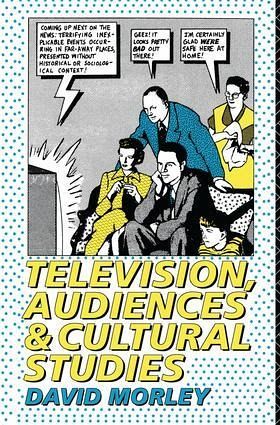
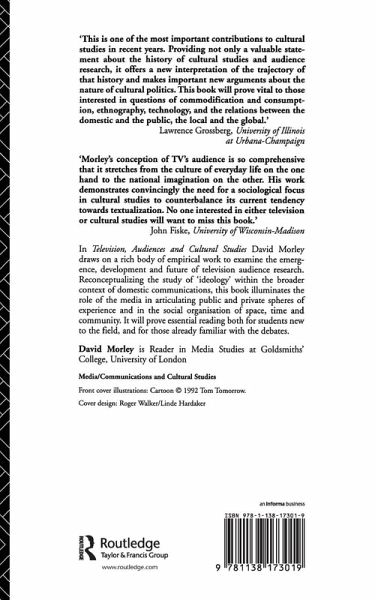
A multi-faceted exploration of audience research, in which Morley draws on a rich body of empirical work to examine the emergence, development and future of audience research.
A multi-faceted exploration of audience research, in which Morley draws on a rich body of empirical work to examine the emergence, development and future of audience research.
Acknowledgements Introduction Section One: Theoretical Frameworks 1. Television audience research: a critical history 2. Psychoanalytic theories: texts, readers and subjects Section Two: Class, Ideology and Interpretation 3. Interpreting television: the Nationwide Audience 4. The Nationwide Audience: a critical postscript Section Three: Gender, Domestic Leisure and Viewing Practices 5. Research development: from `decoding' to viewing context 6. The gendered framework of family viewing 7. From ` Family Viewing ' to a sociology of media consumption Section Four: Methodological Issues 8. Towards an ethnography of the television audience Section Five: Television, Technology and Consumption 9. Domestic communication: technologies and meanings (with Roger Silverstone ) 10. The consumption of television as a commodity 11. Private worlds and gendered technologies Section Six: Between the Private and the Public 12. The construction of everyday life: political communication and domestic media 13. Where the global meets the local: notes from the sitting room Notes Bibliography
Acknowledgements Introduction Section One: Theoretical Frameworks 1. Television audience research: a critical history 2. Psychoanalytic theories: texts, readers and subjects Section Two: Class, Ideology and Interpretation 3. Interpreting television: the Nationwide Audience 4. The Nationwide Audience: a critical postscript Section Three: Gender, Domestic Leisure and Viewing Practices 5. Research development: from `decoding' to viewing context 6. The gendered framework of family viewing 7. From ` Family Viewing ' to a sociology of media consumption Section Four: Methodological Issues 8. Towards an ethnography of the television audience Section Five: Television, Technology and Consumption 9. Domestic communication: technologies and meanings (with Roger Silverstone ) 10. The consumption of television as a commodity 11. Private worlds and gendered technologies Section Six: Between the Private and the Public 12. The construction of everyday life: political communication and domestic media 13. Where the global meets the local: notes from the sitting room Notes Bibliography
Acknowledgements Introduction Section One: Theoretical Frameworks 1. Television audience research: a critical history 2. Psychoanalytic theories: texts, readers and subjects Section Two: Class, Ideology and Interpretation 3. Interpreting television: the Nationwide Audience 4. The Nationwide Audience: a critical postscript Section Three: Gender, Domestic Leisure and Viewing Practices 5. Research development: from `decoding' to viewing context 6. The gendered framework of family viewing 7. From ` Family Viewing ' to a sociology of media consumption Section Four: Methodological Issues 8. Towards an ethnography of the television audience Section Five: Television, Technology and Consumption 9. Domestic communication: technologies and meanings (with Roger Silverstone ) 10. The consumption of television as a commodity 11. Private worlds and gendered technologies Section Six: Between the Private and the Public 12. The construction of everyday life: political communication and domestic media 13. Where the global meets the local: notes from the sitting room Notes Bibliography
Acknowledgements Introduction Section One: Theoretical Frameworks 1. Television audience research: a critical history 2. Psychoanalytic theories: texts, readers and subjects Section Two: Class, Ideology and Interpretation 3. Interpreting television: the Nationwide Audience 4. The Nationwide Audience: a critical postscript Section Three: Gender, Domestic Leisure and Viewing Practices 5. Research development: from `decoding' to viewing context 6. The gendered framework of family viewing 7. From ` Family Viewing ' to a sociology of media consumption Section Four: Methodological Issues 8. Towards an ethnography of the television audience Section Five: Television, Technology and Consumption 9. Domestic communication: technologies and meanings (with Roger Silverstone ) 10. The consumption of television as a commodity 11. Private worlds and gendered technologies Section Six: Between the Private and the Public 12. The construction of everyday life: political communication and domestic media 13. Where the global meets the local: notes from the sitting room Notes Bibliography
Es gelten unsere Allgemeinen Geschäftsbedingungen: www.buecher.de/agb
Impressum
www.buecher.de ist ein Internetauftritt der buecher.de internetstores GmbH
Geschäftsführung: Monica Sawhney | Roland Kölbl | Günter Hilger
Sitz der Gesellschaft: Batheyer Straße 115 - 117, 58099 Hagen
Postanschrift: Bürgermeister-Wegele-Str. 12, 86167 Augsburg
Amtsgericht Hagen HRB 13257
Steuernummer: 321/5800/1497
USt-IdNr: DE450055826