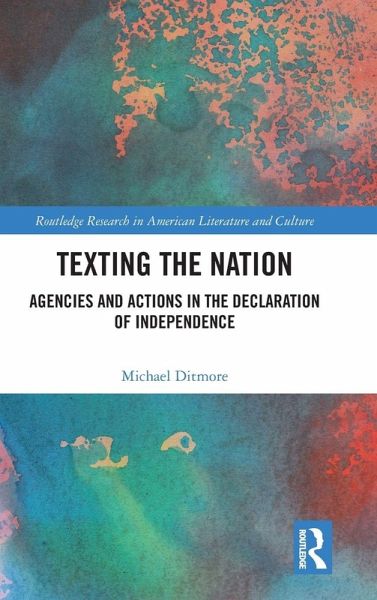
Texting the Nation analyzes rhetorical and grammatical patterns of agency in the Declaration's text and three-part logical argument, in the contexts of political and literal slavery, the deleted slavery clause, and the heavily edited conclusion, including slavery background, composition history, and later critical reputation.
Texting the Nation analyzes rhetorical and grammatical patterns of agency in the Declaration's text and three-part logical argument, in the contexts of political and literal slavery, the deleted slavery clause, and the heavily edited conclusion, including slavery background, composition history, and later critical reputation.
Michael Ditmore is Professor of English specializing in early American literature and Great Books at Pepperdine University, Malibu, CA, where he has also served as Director of American Studies and Dean of the Humanities/Teacher Education Division. He has previously published on William Bradford, John Winthrop, Anne Hutchinson, Anne Bradstreet, Elizabeth Ashbridge, Jonathan Edwards, Crèvecoeur, and Benjamin Franklin.
Inhaltsangabe
Preface List of Acronyms Introduction: The Declaration of Independence and Criticism Finding "the" Declaration of Independence: Notes on the Text(s) 1. Agent(s)/Agency, Slavery and Slavery in Eighteenth-Century British North America as Rhetoric (and Some Reality) 2. The Major Premise: Ambiguating The Human Condition, Government, and Divine Passivity 3. The Minor Premise: The Omnipotent Potentate, the Grievances, and Slavery (and the Virginia Constitution, 1776-1903) 4. Authorizing and Accomplishing Independence: Jefferson's Double-Columned Conclusion, the Return (or Not) of God, and the Multiplying/Dividing Declaration Conclusion: There's Something About the Declaration of Independence (But What Is It?) Index
Preface List of Acronyms Introduction: The Declaration of Independence and Criticism Finding "the" Declaration of Independence: Notes on the Text(s) 1. Agent(s)/Agency, Slavery and Slavery in Eighteenth-Century British North America as Rhetoric (and Some Reality) 2. The Major Premise: Ambiguating The Human Condition, Government, and Divine Passivity 3. The Minor Premise: The Omnipotent Potentate, the Grievances, and Slavery (and the Virginia Constitution, 1776-1903) 4. Authorizing and Accomplishing Independence: Jefferson's Double-Columned Conclusion, the Return (or Not) of God, and the Multiplying/Dividing Declaration Conclusion: There's Something About the Declaration of Independence (But What Is It?) Index
Es gelten unsere Allgemeinen Geschäftsbedingungen: www.buecher.de/agb
Impressum
www.buecher.de ist ein Internetauftritt der buecher.de internetstores GmbH
Geschäftsführung: Monica Sawhney | Roland Kölbl | Günter Hilger
Sitz der Gesellschaft: Batheyer Straße 115 - 117, 58099 Hagen
Postanschrift: Bürgermeister-Wegele-Str. 12, 86167 Augsburg
Amtsgericht Hagen HRB 13257
Steuernummer: 321/5800/1497
USt-IdNr: DE450055826