
Andere Kunden interessierten sich auch für
 The Theory and Criticism of Virtual Texts78,99 €
 Literary Criticism and Theory17,99 €
 Historia de la Lengua y Crítica Textual25,99 €
 The Statutes of Sir Walter Mildmay42,99 €
 The Cambridge History of Libraries in Britain and Ireland183,99 €
 American Fiction, 1901 1925 2 Part Set62,99 €
 Adam Smith's Library42,99 €



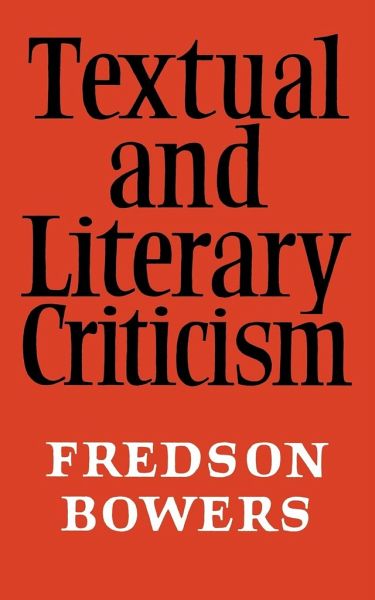
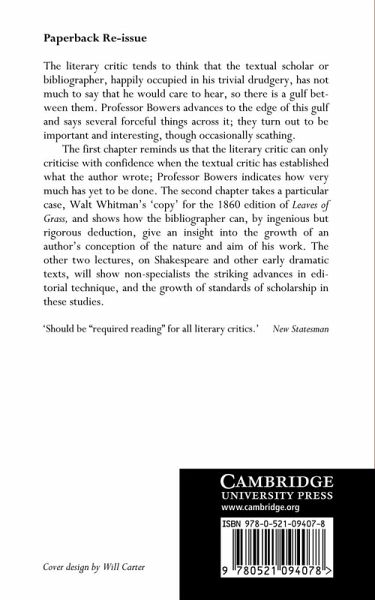
The literary critic tends to think that the textual scholar or bibliographer, happily occupied in his travel drudgery, has not much to say that he would care to hear, so there is a gulf between them. Professor Bowers advances to the edge of this gulf and says several forceful things across it; they turn out to be important and interesting, though occasionally scathing. The first chapter reminds us that the literary critic can only criticise with confidence when the textual critic has established what the author wrote; Professor Bowers indicates how very much has yet to be done. The second chapter takes a particular case, Walt Whitman's copy' for the 1860 edition of Leaves of Grass, and shows how the bibliographer can, by ingenious but rigorous deduction, give an insight into the growth of an author's conception of the nature and aim of his work. The other two lectures, on Shakespeare and other early dramatic texts, will show non-specialists the striking advances in editorial technique, and the growth of standards of scholarship in these studies.