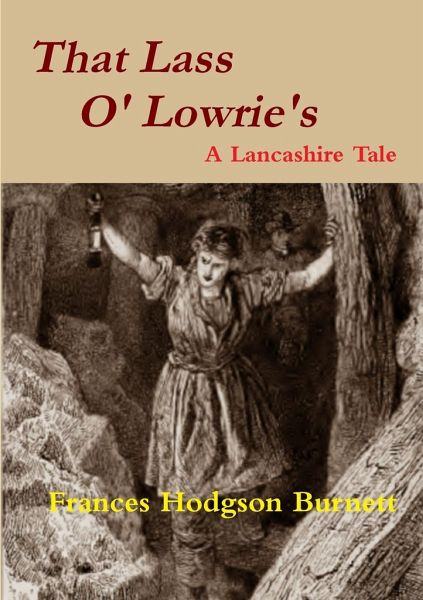
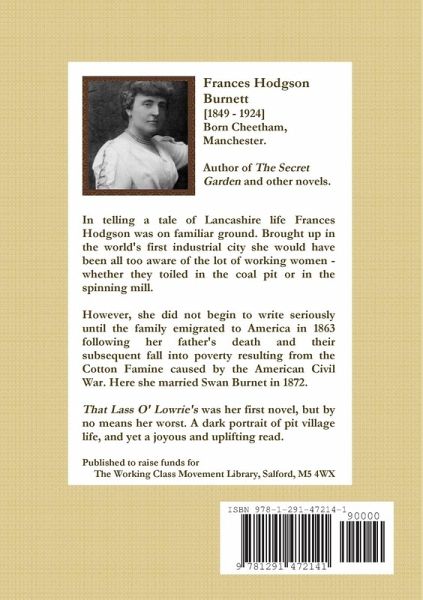
In telling a tale of Lancashire life Frances Hodgson was on familiar ground. Brought up in the world's first industrial city she would have been all too aware of the lot of working women - whether they toiled in the coal pit or a spinning mill. However, she did not begin to write until the family migrated to America following her father's death and their subsequent fall into poverty as a result of the Lancashire Cotton Famine caused by the American Civil War. Here she married Swan Burnet in 1872. That Lass O' Lowrie's was her first novel, but by no means her worst. A dark portrait of pit…mehr
In telling a tale of Lancashire life Frances Hodgson was on familiar ground. Brought up in the world's first industrial city she would have been all too aware of the lot of working women - whether they toiled in the coal pit or a spinning mill. However, she did not begin to write until the family migrated to America following her father's death and their subsequent fall into poverty as a result of the Lancashire Cotton Famine caused by the American Civil War. Here she married Swan Burnet in 1872. That Lass O' Lowrie's was her first novel, but by no means her worst. A dark portrait of pit village life and yet a joyous and uplifting read. Published to raise funds for the Working Class Movement Library, Salford, M5 4WX.
Frances Hodgson Burnett (1849-1924) was a British-American novelist and playwright who made lasting contributions to children's literature. She was born in Manchester, England, and faced hardship early on when her father died in 1854. Her family emigrated to the United States in 1865, settling in Tennessee, where Burnett began writing to support them, quickly gaining recognition in popular magazines.Burnett's literary success took off with Little Lord Fauntleroy in 1886, a novel that captivated both children and adults. This success was followed by other beloved works, including A Little Princess (1905) and The Secret Garden (1911), now considered timeless classics. Her stories often explore themes of resilience, transformation, and the healing power of nature, resonating with generations of readers.Beyond her writing, Burnett was a trailblazer for authors' rights. She won a landmark lawsuit in 1888 over the dramatic rights to Little Lord Fauntleroy, setting an important precedent in British copyright law. Despite personal challenges, including the loss of her son Lionel in 1890, Burnett continued writing prolifically, leaving an enduring legacy in literature.
Es gelten unsere Allgemeinen Geschäftsbedingungen: www.buecher.de/agb
Impressum
www.buecher.de ist ein Internetauftritt der buecher.de internetstores GmbH
Geschäftsführung: Monica Sawhney | Roland Kölbl | Günter Hilger
Sitz der Gesellschaft: Batheyer Straße 115 - 117, 58099 Hagen
Postanschrift: Bürgermeister-Wegele-Str. 12, 86167 Augsburg
Amtsgericht Hagen HRB 13257
Steuernummer: 321/5800/1497
USt-IdNr: DE450055826