
Andere Kunden interessierten sich auch für
 Communicating with families in the light of person-centered medicine36,99 €
 Person-organization fit, commitment and the organizational context24,99 €
 Intensive Care Unit Syndrome30,99 €
 Tantra The Source Code for All Psychological Solutions Volume-565,99 €
 An Integration of Spiritual Beliefs into the Transtheoretical Model32,99 €
 The Three E's of Occupational Wellbeing33,99 €
 Breaking the cycle45,99 €





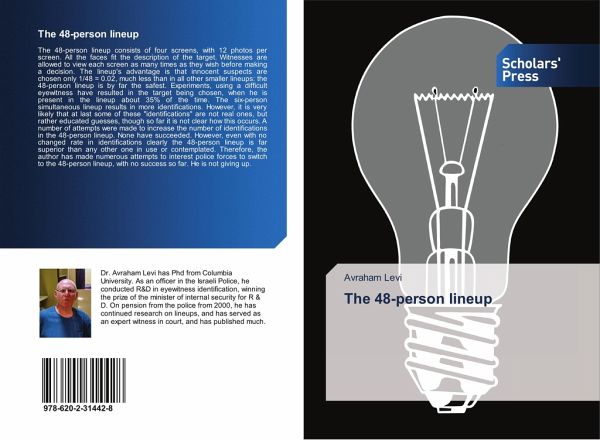
The 48-person lineup consists of four screens, with 12 photos per screen. All the faces fit the description of the target. Witnesses are allowed to view each screen as many times as they wish before making a decision. The lineup's advantage is that innocent suspects are chosen only 1/48 = 0.02, much less than in all other smaller lineups: the 48-person lineup is by far the safest. Experiments, using a difficult eyewitness have resulted in the target being chosen, when he is present in the lineup about 35% of the time. The six-person simultaneous lineup results in more identifications. However, it is very likely that at last some of these "identifications" are not real ones, but rather educated guesses, though so far it is not clear how this occurs. A number of attempts were made to increase the number of identifications in the 48-person lineup. None have succeeded. However, even with no changed rate in identifications clearly the 48-person lineup is far superior than any other one in use or contemplated. Therefore, the author has made numerous attempts to interest police forces to switch to the 48-person lineup, with no success so far. He is not giving up.