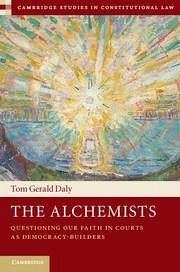
Can courts really build democracy in a state emerging from authoritarian rule? This book presents a searching critique of the contemporary global model of democracy-building for post-authoritarian states, arguing that it places excessive reliance on courts. Since 1945, both constitutional courts and international human rights courts have been increasingly perceived as alchemists, capable of transmuting the base materials of a nascent democracy into the gold of a functioning democratic system. By charting the development of this model, and critically analysing the evidence and claims for courts…mehr
Can courts really build democracy in a state emerging from authoritarian rule? This book presents a searching critique of the contemporary global model of democracy-building for post-authoritarian states, arguing that it places excessive reliance on courts. Since 1945, both constitutional courts and international human rights courts have been increasingly perceived as alchemists, capable of transmuting the base materials of a nascent democracy into the gold of a functioning democratic system. By charting the development of this model, and critically analysing the evidence and claims for courts as democracy-builders, this book argues that the decades-long trend toward ever greater reliance on courts is based as much on faith as fact, and can often be counter-productive. Offering a sustained corrective to unrealistic perceptions of courts as democracy-builders, the book points the way toward a much needed rethinking of democracy-building models and a re-evaluation of how we employ courts in this role.
Tom Gerald Daly is a Fellow of Melbourne Law School, Associate Director of the Edinburgh Centre for Constitutional Law at Edinburgh Law School, and a consultant on public law, human rights, and democracy-building. He has previously clerked for the Chief Justice of Ireland, and has worked at the Judicial Studies Institute and Edinburgh University's Global Justice Academy. As a consultant, he has worked on Council of Europe, European Union, International IDEA (Institute for Democracy and Electoral Assistance), and Irish government projects.
Inhaltsangabe
Preface: our court obsession Acknowledgments Table of cases List of abbreviations Introduction: an onerous role for courts as democracy-builders 1. The core concept: democratisation 2. The rise and limits of constitutional courts as democracy-builders 3. The rise and limits of human rights courts as democracy-builders 4. 'Democratisation jurisprudence': framing courts' democracy-building roles 5. Domestic democratisation jurisprudence in action: Brazil since 1988 6. Regional democratisation jurisprudence: shaping democracy from outside 7. What should courts do in a young democracy? Rethinking our approach Concluding thoughts: moving beyond our court obsession Bibliography Index.
Preface: our court obsession Acknowledgments Table of cases List of abbreviations Introduction: an onerous role for courts as democracy-builders 1. The core concept: democratisation 2. The rise and limits of constitutional courts as democracy-builders 3. The rise and limits of human rights courts as democracy-builders 4. 'Democratisation jurisprudence': framing courts' democracy-building roles 5. Domestic democratisation jurisprudence in action: Brazil since 1988 6. Regional democratisation jurisprudence: shaping democracy from outside 7. What should courts do in a young democracy? Rethinking our approach Concluding thoughts: moving beyond our court obsession Bibliography Index.
Es gelten unsere Allgemeinen Geschäftsbedingungen: www.buecher.de/agb
Impressum
www.buecher.de ist ein Internetauftritt der buecher.de internetstores GmbH
Geschäftsführung: Monica Sawhney | Roland Kölbl | Günter Hilger
Sitz der Gesellschaft: Batheyer Straße 115 - 117, 58099 Hagen
Postanschrift: Bürgermeister-Wegele-Str. 12, 86167 Augsburg
Amtsgericht Hagen HRB 13257
Steuernummer: 321/5800/1497
USt-IdNr: DE450055826