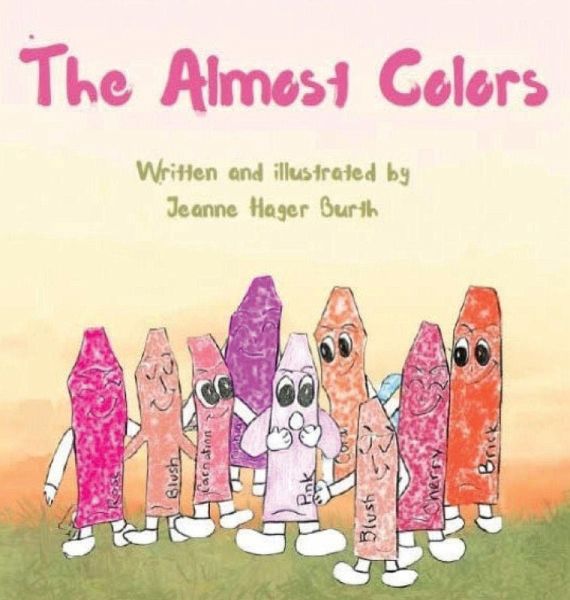
The Almost Colors brings crayons to life, as they discuss their dilemmas as almost colors. The primary colors, being the only true colors, strive to convince the 'almost' colors of their own uniqueness as well as their relationships to each other. Some of the examples include the following: Pink is almost red, Baby Blue will never have his own name even when he grows up, and Tangerine is named after a fruit. Black and White join the discussion and tell of their all or nothingness as related to wavelengths of light. Together, the crayons learn that they are all needed. Though the dialogue makes…mehr
The Almost Colors brings crayons to life, as they discuss their dilemmas as almost colors. The primary colors, being the only true colors, strive to convince the 'almost' colors of their own uniqueness as well as their relationships to each other. Some of the examples include the following: Pink is almost red, Baby Blue will never have his own name even when he grows up, and Tangerine is named after a fruit. Black and White join the discussion and tell of their all or nothingness as related to wavelengths of light. Together, the crayons learn that they are all needed. Though the dialogue makes this a truly fictional story, science topics include color mixing and wavelengths of visible light. Further, the story may be used to relate feelings and emotions that colors provoke, such as the yellow embracing others with a 'warm' hug and red racing to find a solution. The author sees this as an opportunity for teachers to ask students to write poetry with emotions triggered by colors, do activities that are related to self-reflection based on colors, as well as study wavelengths of light and experiment with the mixing of colors.
Jeanne Hager Burth, EdD is a retired professor of Teacher Education from the University of Pittsburgh with a distinguished career in education. She served as an elementary school principal and taught in public schools across elementary and middle grades, specializing in Special Education, Elementary Education, and Gifted Support. Dr. Burth has published extensively on topics including education for students with disabilities, high-quality professional development, and innovative curriculum through Open Educational Resources. She is the author of Transitioning from School to Adulthood: Practical Activities for Youth with Autism Spectrum Disorder (ASD) and Other Disabilities and several children's books, including I Go High, It Makes Me Feel Good, The Awakening, I Married a Donkey, The Tooth Fairy's Castle, The Almost Colors, and Gramps and Me.
Es gelten unsere Allgemeinen Geschäftsbedingungen: www.buecher.de/agb
Impressum
www.buecher.de ist ein Internetauftritt der buecher.de internetstores GmbH
Geschäftsführung: Monica Sawhney | Roland Kölbl | Günter Hilger
Sitz der Gesellschaft: Batheyer Straße 115 - 117, 58099 Hagen
Postanschrift: Bürgermeister-Wegele-Str. 12, 86167 Augsburg
Amtsgericht Hagen HRB 13257
Steuernummer: 321/5800/1497
USt-IdNr: DE450055826