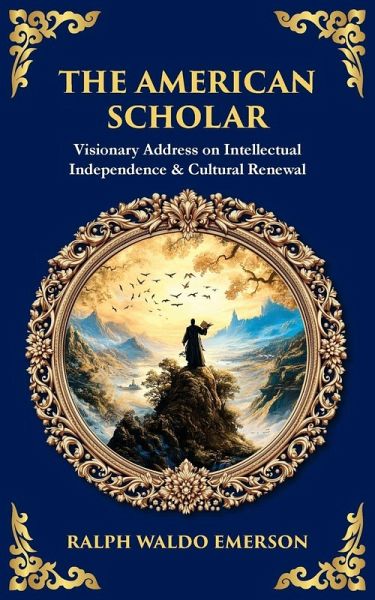
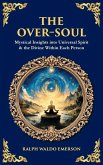
Have you ever wondered why true genius resists imitation? Ralph Waldo Emerson's legendary oration The American Scholar is a stirring invitation to intellectual freedom and self-reliance. More than just a historical address, this bold message to young minds continues to ignite a cultural revolution of the soul. At its core, Emerson's work is a passionate defense of the scholar's role in society-not as a passive recipient of second-hand knowledge, but as a dynamic force of originality, intuition, and action. In this modernized edition, Emerson's insights remain razor-sharp and relevant. He…mehr
Have you ever wondered why true genius resists imitation? Ralph Waldo Emerson's legendary oration The American Scholar is a stirring invitation to intellectual freedom and self-reliance. More than just a historical address, this bold message to young minds continues to ignite a cultural revolution of the soul. At its core, Emerson's work is a passionate defense of the scholar's role in society-not as a passive recipient of second-hand knowledge, but as a dynamic force of originality, intuition, and action. In this modernized edition, Emerson's insights remain razor-sharp and relevant. He dismantles the dependence on tradition, institutions, and authority, and instead champions the individual as the true source of enlightenment and progress. The scholar, according to Emerson, must turn to nature, history, and personal experience as the great educators. Only by doing so can humanity rise above mechanical routine and embrace its divine potential. Whether you're a student, a writer, an educator, or a lifelong learner, The American Scholar will challenge you to rethink your relationship with knowledge, creativity, and the world itself. What You'll Discover in This Modern Edition:The Scholar's Sacred Role - Learn why Emerson believed intellectuals must become leaders of moral and cultural renewal. Self-Reliance as a Virtue - Discover the profound spiritual power of thinking independently, boldly, and authentically. The Book of Nature - Explore Emerson's belief that true wisdom comes from direct experience with the natural world. The Dangers of Overeducation - Understand why blindly imitating the past stifles progress and weakens the human spirit. A Blueprint for Cultural Rebirth - Uncover how Emerson's vision laid the foundation for a uniquely American intellectual identity. This edition makes Emerson's ideas deeply accessible while honoring the strength and beauty of his prose. If you've ever questioned your purpose as a thinker or creator, The American Scholar will light the way forward.
Ralph Waldo Emerson (May 25, 1803 - April 27, 1882)[5] was an American essayist, lecturer, philosopher, and poet who led the transcendentalist movement of the mid-19th century. He was seen as a champion of individualism and a prescient critic of the countervailing pressures of society, and he disseminated his thoughts through dozens of published essays and more than 1,500 public lectures across the United States. Emerson gradually moved away from the religious and social beliefs of his contemporaries, formulating and expressing the philosophy of transcendentalism in his 1836 essay "Nature". Following this work, he gave a speech entitled "The American Scholar" in 1837, which Oliver Wendell Holmes Sr. considered to be America's "intellectual Declaration of Independence."[6] Emerson wrote most of his important essays as lectures first and then revised them for print. His first two collections of essays, Essays: First Series (1841) and Essays: Second Series (1844), represent the core of his thinking. They include the well-known essays "Self-Reliance",[7] "The Over-Soul", "Circles", "The Poet", and "Experience." Together with "Nature",[8] these essays made the decade from the mid-1830s to the mid-1840s Emerson's most fertile period. Emerson wrote on a number of subjects, never espousing fixed philosophical tenets, but developing certain ideas such as individuality, freedom, the ability for mankind to realize almost anything, and the relationship between the soul and the surrounding world. Emerson's "nature" was more philosophical than naturalistic: "Philosophically considered, the universe is composed of Nature and the Soul." Emerson is one of several figures who "took a more pantheist or pandeist approach by rejecting views of God as separate from the world. He remains among the linchpins of the American romantic movement,[10] and his work has greatly influenced the thinkers, writers and poets that followed him. "In all my lectures," he wrote, "I have taught one doctrine, namely, the infinitude of the private man."[11]Emerson is also well known as a mentor and friend of Henry David Thoreau, a fellow transcendentalist.
Es gelten unsere Allgemeinen Geschäftsbedingungen: www.buecher.de/agb
Impressum
www.buecher.de ist ein Internetauftritt der buecher.de internetstores GmbH
Geschäftsführung: Monica Sawhney | Roland Kölbl | Günter Hilger
Sitz der Gesellschaft: Batheyer Straße 115 - 117, 58099 Hagen
Postanschrift: Bürgermeister-Wegele-Str. 12, 86167 Augsburg
Amtsgericht Hagen HRB 13257
Steuernummer: 321/5800/1497
USt-IdNr: DE450055826