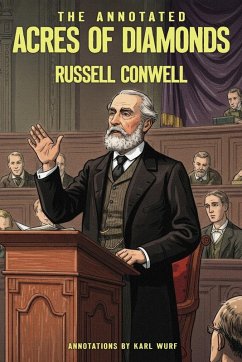
This classic lecture argues that the resources for success lie close to home. Drawing on parables, real anecdotes, and economic philosophy, Russell Conwell shows how opportunities are often overlooked in favor of distant dreams. Delivered countless times during Russell Conwell's career, the speech blends wit, personal experience, and moral conviction to challenge conventional thinking about poverty and prosperity. The central metaphor-"acres of diamonds"- urges readers to dig where they stand, recognizing the value in their own communities, talents, and circumstances. With examples from…mehr
This classic lecture argues that the resources for success lie close to home. Drawing on parables, real anecdotes, and economic philosophy, Russell Conwell shows how opportunities are often overlooked in favor of distant dreams. Delivered countless times during Russell Conwell's career, the speech blends wit, personal experience, and moral conviction to challenge conventional thinking about poverty and prosperity. The central metaphor-"acres of diamonds"- urges readers to dig where they stand, recognizing the value in their own communities, talents, and circumstances. With examples from historical figures, labor movements, and common professions, the lecture emphasizes self-education, observation, and practical faith. Rooted in 19th-century values but relevant today, the work champions character, initiative, and resourcefulness over speculation or inheritance. It remains a cornerstone of motivational literature. Includes new annotations on the text by Karl Wurf..
Russell Herman Conwell (February 15, 1843 - December 6, 1925) was an American Baptist minister, orator, philanthropist, author, lawyer, and writer. He is best remembered as the founder and first president of Temple University in Philadelphia, as the Pastor of The Baptist Temple, and for his inspirational lecture, "Acres of Diamonds". He was born in South Worthington, Massachusetts.The son of Massachusetts farmers, Conwell left home to attend the Wilbraham Wesleyan Academy and later Yale University. In 1862, before graduating from Yale, he enlisted in the Union Army during the American Civil War. Conwell desired to enlist in the war effort shortly after its outbreak in 1861, but could not initially gain the approval of his father, Martin Conwell. His abolitionist father ultimately changed his mind, allowing Conwell to enlist in Company "F" of the 27th Massachusetts Volunteers, better known as the "Mountain Boys".¿ Conwell and the Mountain Boys served in North Carolina and first engaged the opposition at Kinston, North Carolina.¿ There Conwell gained a reputation for self-sacrifice.
Es gelten unsere Allgemeinen Geschäftsbedingungen: www.buecher.de/agb
Impressum
www.buecher.de ist ein Internetauftritt der buecher.de internetstores GmbH
Geschäftsführung: Monica Sawhney | Roland Kölbl | Günter Hilger
Sitz der Gesellschaft: Batheyer Straße 115 - 117, 58099 Hagen
Postanschrift: Bürgermeister-Wegele-Str. 12, 86167 Augsburg
Amtsgericht Hagen HRB 13257
Steuernummer: 321/5800/1497
USt-IdNr: DE450055826