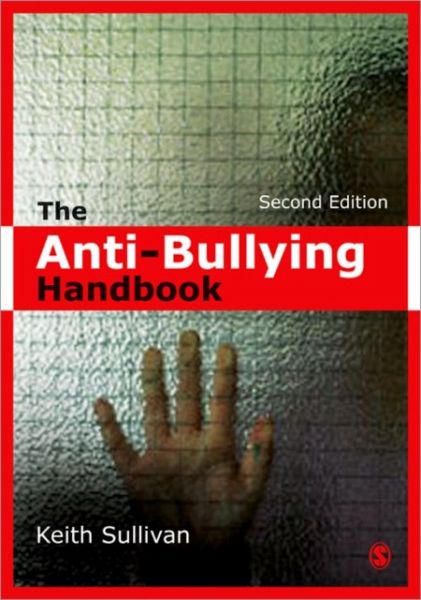
Keith Sullivan
The Anti-Bullying Handbook
Keith Sullivan
The Anti-Bullying Handbook
- Broschiertes Buch
- Merkliste
- Auf die Merkliste
- Bewerten Bewerten
- Teilen
- Produkt teilen
- Produkterinnerung
- Produkterinnerung
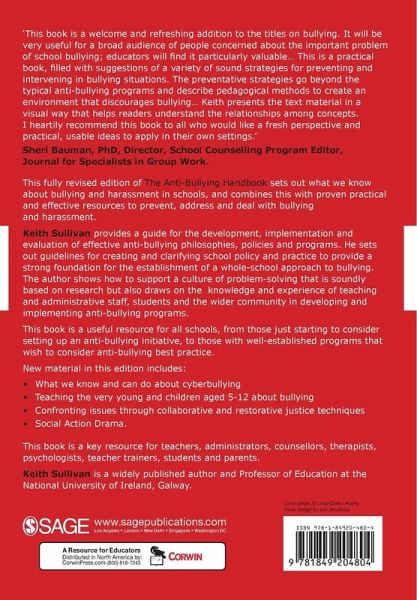
Comprehensive user-friendly overview of all aspects of bullying in schools, and the recognised techniques to counter this
Andere Kunden interessierten sich auch für
Char RyanThe Pbis Team Handbook49,99 €
Kieran O'MahonyThe Brain-Based Classroom28,99 €
David Copp (ed.)The Oxford Handbook of Ethical Theory63,99 €
Sue JenningsThe Handbook of Dramatherapy39,99 €
Patricia A. Jennings (University of Virginia)The Trauma-Sensitive Classroom43,99 €
David O. Faulkner / Andrew Campbell (eds.)The Oxford Handbook of Strategy104,99 €
Lynn V. Foster (Hispanic Studies Department Adjunct Faculty MemberThe Handbook to Life in the Ancient Maya World31,99 €-
-
-
Comprehensive user-friendly overview of all aspects of bullying in schools, and the recognised techniques to counter this
Produktdetails
- Produktdetails
- Verlag: SAGE Publications Ltd
- Artikelnr. des Verlages: B04798P
- 2 Revised edition
- Seitenzahl: 282
- Erscheinungstermin: 9. November 2010
- Englisch
- Abmessung: 244mm x 170mm x 15mm
- Gewicht: 490g
- ISBN-13: 9781849204804
- ISBN-10: 1849204802
- Artikelnr.: 30180119
- Herstellerkennzeichnung
- Libri GmbH
- Europaallee 1
- 36244 Bad Hersfeld
- gpsr@libri.de
- Verlag: SAGE Publications Ltd
- Artikelnr. des Verlages: B04798P
- 2 Revised edition
- Seitenzahl: 282
- Erscheinungstermin: 9. November 2010
- Englisch
- Abmessung: 244mm x 170mm x 15mm
- Gewicht: 490g
- ISBN-13: 9781849204804
- ISBN-10: 1849204802
- Artikelnr.: 30180119
- Herstellerkennzeichnung
- Libri GmbH
- Europaallee 1
- 36244 Bad Hersfeld
- gpsr@libri.de
Keith Sullivan is a widely published author. He is professor of Education at the National University of Ireland, Galway.
PART ONE: DEFINING AND DESCRIBING BULLYING
Introduction
What We Know about Bullying
The Bullying Triangle and the Bullying Dynamic
Types of Bullying 1: Racist Bullying, Bullying of Special Educational Needs
Children, Homophobic Bullying and Sexual Bullying
Types of Bullying 2: Cyberbullying
PART TWO: PHILOSOPHY, PLANNING AND POLICY
How to Create an Anti-Bullying Initiative
Developing a Philosophy About Bullying
Planning and Information Gathering
Creating a School Anti-Bullying Policy
PART THREE: PREVENTATIVE STRATEGIES
Strategies for Teachers: Practice, Pedagogy and Learning
Strategies for Teachers: Understanding Social Relationships, Creating Safe
Classrooms
Interactive and Experiential Strategies
Harnessing the Power of the Peer Group
The School Environment
PART FOUR: INTERVENTIONS
Peer Mentoring and Peer Mediation
The Support Group Method
A Circle of Friends
The Pikas Method of Shared Concern
CPR: Collaborative Problem-solving and Resolution
PART FIVE: FOLLOW-UP AND CONCLUSION
Follow-up and Conclusion
APPENDICES
Appendix 1 A School Anti-Bullying Policy
Appendix 2 Using Bullying Scenarios
Appendix 3 Ethics and Confidentiality
Appendix 4 Ice Breakers
Introduction
What We Know about Bullying
The Bullying Triangle and the Bullying Dynamic
Types of Bullying 1: Racist Bullying, Bullying of Special Educational Needs
Children, Homophobic Bullying and Sexual Bullying
Types of Bullying 2: Cyberbullying
PART TWO: PHILOSOPHY, PLANNING AND POLICY
How to Create an Anti-Bullying Initiative
Developing a Philosophy About Bullying
Planning and Information Gathering
Creating a School Anti-Bullying Policy
PART THREE: PREVENTATIVE STRATEGIES
Strategies for Teachers: Practice, Pedagogy and Learning
Strategies for Teachers: Understanding Social Relationships, Creating Safe
Classrooms
Interactive and Experiential Strategies
Harnessing the Power of the Peer Group
The School Environment
PART FOUR: INTERVENTIONS
Peer Mentoring and Peer Mediation
The Support Group Method
A Circle of Friends
The Pikas Method of Shared Concern
CPR: Collaborative Problem-solving and Resolution
PART FIVE: FOLLOW-UP AND CONCLUSION
Follow-up and Conclusion
APPENDICES
Appendix 1 A School Anti-Bullying Policy
Appendix 2 Using Bullying Scenarios
Appendix 3 Ethics and Confidentiality
Appendix 4 Ice Breakers
PART ONE: DEFINING AND DESCRIBING BULLYING
Introduction
What We Know about Bullying
The Bullying Triangle and the Bullying Dynamic
Types of Bullying 1: Racist Bullying, Bullying of Special Educational Needs
Children, Homophobic Bullying and Sexual Bullying
Types of Bullying 2: Cyberbullying
PART TWO: PHILOSOPHY, PLANNING AND POLICY
How to Create an Anti-Bullying Initiative
Developing a Philosophy About Bullying
Planning and Information Gathering
Creating a School Anti-Bullying Policy
PART THREE: PREVENTATIVE STRATEGIES
Strategies for Teachers: Practice, Pedagogy and Learning
Strategies for Teachers: Understanding Social Relationships, Creating Safe
Classrooms
Interactive and Experiential Strategies
Harnessing the Power of the Peer Group
The School Environment
PART FOUR: INTERVENTIONS
Peer Mentoring and Peer Mediation
The Support Group Method
A Circle of Friends
The Pikas Method of Shared Concern
CPR: Collaborative Problem-solving and Resolution
PART FIVE: FOLLOW-UP AND CONCLUSION
Follow-up and Conclusion
APPENDICES
Appendix 1 A School Anti-Bullying Policy
Appendix 2 Using Bullying Scenarios
Appendix 3 Ethics and Confidentiality
Appendix 4 Ice Breakers
Introduction
What We Know about Bullying
The Bullying Triangle and the Bullying Dynamic
Types of Bullying 1: Racist Bullying, Bullying of Special Educational Needs
Children, Homophobic Bullying and Sexual Bullying
Types of Bullying 2: Cyberbullying
PART TWO: PHILOSOPHY, PLANNING AND POLICY
How to Create an Anti-Bullying Initiative
Developing a Philosophy About Bullying
Planning and Information Gathering
Creating a School Anti-Bullying Policy
PART THREE: PREVENTATIVE STRATEGIES
Strategies for Teachers: Practice, Pedagogy and Learning
Strategies for Teachers: Understanding Social Relationships, Creating Safe
Classrooms
Interactive and Experiential Strategies
Harnessing the Power of the Peer Group
The School Environment
PART FOUR: INTERVENTIONS
Peer Mentoring and Peer Mediation
The Support Group Method
A Circle of Friends
The Pikas Method of Shared Concern
CPR: Collaborative Problem-solving and Resolution
PART FIVE: FOLLOW-UP AND CONCLUSION
Follow-up and Conclusion
APPENDICES
Appendix 1 A School Anti-Bullying Policy
Appendix 2 Using Bullying Scenarios
Appendix 3 Ethics and Confidentiality
Appendix 4 Ice Breakers