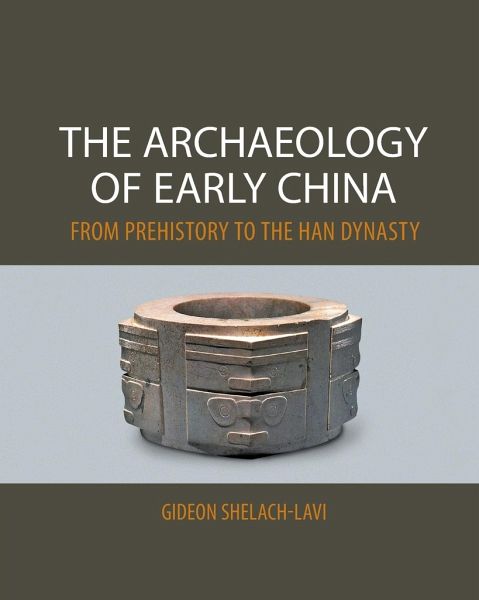
This book covers Chinese archaeology from the first people to the unification of the empire. Particular emphasis is placed on the great cultural variations that existed among the different regions and the development of interregional contacts among those societies.
This book covers Chinese archaeology from the first people to the unification of the empire. Particular emphasis is placed on the great cultural variations that existed among the different regions and the development of interregional contacts among those societies.
Gideon Shelach-Lavi is the Louis Freiberg Professor of East Asian Studies at the Hebrew University of Jerusalem. He has conducted archaeological fieldwork in northeast China since 1995. He is currently heading the Fuxin Regional Archaeological Project. Shelach-Lavi has published many articles in leading academic journals. His most recent books include Prehistoric Societies on the Northern Frontiers of China: Archaeological Perspectives on Identity Formation and Economic Change during the First Millennium BCE (2009); Chifeng International Collaborative Archaeological Project (co-author, 2011); and The Birth of Empire: The State of Qin Revisited (co-editor, 2013).
Inhaltsangabe
1. The geographic and environmental background; 2. Before cultivation: human origins and the incipient development of human culture in China; 3. The transition to food production: variability and processes; 4. The development of agriculture and sedentary life in north China; 5. The shift to agriculture and sedentism in central and south China; 6. The emergence and development of sociopolitical complexity; 7. Stepping into history; 8. The Shang dynasty: the emergence of the state in China; 9. Regional variation and interregional interactions during the Bronze Age: 'center and periphery' or 'interaction spheres'?; 10. The societies and cultures of the Zhou period: processes of globalization and the genesis of local identities; 11. The son of heaven and the creation of a bureaucratic empire.
1. The geographic and environmental background; 2. Before cultivation: human origins and the incipient development of human culture in China; 3. The transition to food production: variability and processes; 4. The development of agriculture and sedentary life in north China; 5. The shift to agriculture and sedentism in central and south China; 6. The emergence and development of sociopolitical complexity; 7. Stepping into history; 8. The Shang dynasty: the emergence of the state in China; 9. Regional variation and interregional interactions during the Bronze Age: 'center and periphery' or 'interaction spheres'?; 10. The societies and cultures of the Zhou period: processes of globalization and the genesis of local identities; 11. The son of heaven and the creation of a bureaucratic empire.
Rezensionen
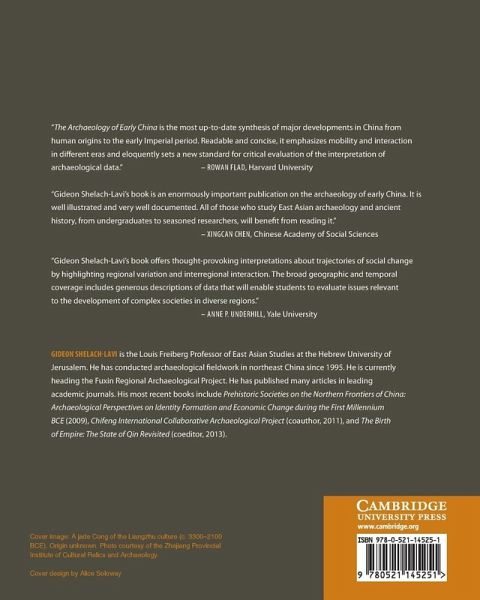
'The Archaeology of Early China is the most up-to-date synthesis of major developments in China from human origins to the early Imperial period. Readable and concise, it emphasizes mobility and interaction in different eras and eloquently sets a new standard for critical evaluation of the interpretation of archaeological data.' Rowan Flad, Harvard University, Massachusetts
Es gelten unsere Allgemeinen Geschäftsbedingungen: www.buecher.de/agb
Impressum
www.buecher.de ist ein Internetauftritt der buecher.de internetstores GmbH
Geschäftsführung: Monica Sawhney | Roland Kölbl | Günter Hilger
Sitz der Gesellschaft: Batheyer Straße 115 - 117, 58099 Hagen
Postanschrift: Bürgermeister-Wegele-Str. 12, 86167 Augsburg
Amtsgericht Hagen HRB 13257
Steuernummer: 321/5800/1497
USt-IdNr: DE450055826