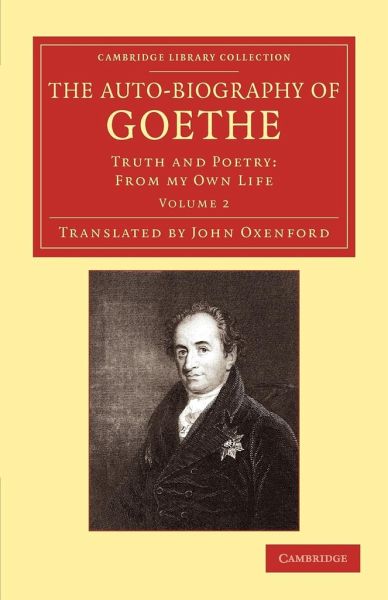
The playwright and critic John Oxenford (1812-77) had an acute aptitude for languages. Although he translated both Molière and Calderón into English, he specialised in German translations and set high standards, not least with his rendering of several works by Johann Wolfgang von Goethe (1749-1832). Among the greatest literary figures of his day, Goethe combined considerable achievements as a poet, novelist and playwright with his diverse interests in natural science and politics. This two-volume translation of his autobiography first appeared in 1848-9. In Volume 2, Goethe recalls how he…mehr
The playwright and critic John Oxenford (1812-77) had an acute aptitude for languages. Although he translated both Molière and Calderón into English, he specialised in German translations and set high standards, not least with his rendering of several works by Johann Wolfgang von Goethe (1749-1832). Among the greatest literary figures of his day, Goethe combined considerable achievements as a poet, novelist and playwright with his diverse interests in natural science and politics. This two-volume translation of his autobiography first appeared in 1848-9. In Volume 2, Goethe recalls how he first arrived in the small city of Weimar, which grew into an important cultural centre, due in no small part to his extended residence there. Also included are letters from Switzerland along with notes from the time he spent in Italy during the 1880s. Goethe's Italian travels would be highly significant for his artistic development and outlook.
JOHANN WOLFGANG VON GOETHE (1749-1832) was a German poet, writer, scientist, statesman, and one of the greatest German literary figures. Goethe, the eldest of seven children born in a wealthy Frankfurt family, studied law at the universities of Leipzig and Strasbourg. He wrote novels and poetry, dramas, treatises on botany and literary criticism, among which his successful novels The Sorrows of Young Werther (1774) and Wilhelm Meister's Apprenticeship (1795). Early in his life, Goethe was a member of the Sturm und Drang literary movement, emphasizing free expression of emotions over the restraints of rationalism. Later, Goethe, together with Friedrich Schiller, initiated the Weimar Classicism, a cultural movement based on a synthesis of Romanticism, Classicism and the Enlightenment.
Inhaltsangabe
Advertisement Fourteenth book Fifteenth book Sixteenth book Seventeenth book Eighteenth book Nineteenth book Twentieth book Letters from Switzerland: First part Second part Letters from Italy: From Carlsbad to the Brenner From the Brenner to Verona From Verona to Venice Venice From Ferrara to Rome Rome Naples Sicily.
Advertisement Fourteenth book Fifteenth book Sixteenth book Seventeenth book Eighteenth book Nineteenth book Twentieth book Letters from Switzerland: First part Second part Letters from Italy: From Carlsbad to the Brenner From the Brenner to Verona From Verona to Venice Venice From Ferrara to Rome Rome Naples Sicily.
Es gelten unsere Allgemeinen Geschäftsbedingungen: www.buecher.de/agb
Impressum
www.buecher.de ist ein Internetauftritt der buecher.de internetstores GmbH
Geschäftsführung: Monica Sawhney | Roland Kölbl | Günter Hilger
Sitz der Gesellschaft: Batheyer Straße 115 - 117, 58099 Hagen
Postanschrift: Bürgermeister-Wegele-Str. 12, 86167 Augsburg
Amtsgericht Hagen HRB 13257
Steuernummer: 321/5800/1497
USt-IdNr: DE450055826