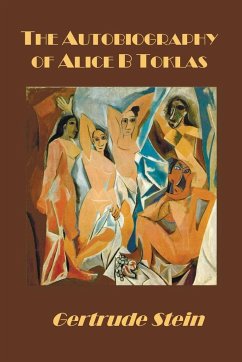
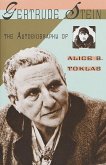
The Autobiography of Alice B. Toklas was written in 1933 by Gertrude Stein in the guise of an autobiography authored by Alice B. Toklas, who was her lover. It is a fascinating insight into the art scene in Paris as the couple were friends with Paul Cézanne, Henri Matisse and Pablo Picasso. They begin the war years in England but return to France, volunteering for the American Fund for the French Wounded, driving around France, helping the wounded and homeless. After the war Gertrude has an argument with T. S. Eliot after he finds one of her writings inappropriate. They become friends with…mehr
The Autobiography of Alice B. Toklas was written in 1933 by Gertrude Stein in the guise of an autobiography authored by Alice B. Toklas, who was her lover. It is a fascinating insight into the art scene in Paris as the couple were friends with Paul Cézanne, Henri Matisse and Pablo Picasso. They begin the war years in England but return to France, volunteering for the American Fund for the French Wounded, driving around France, helping the wounded and homeless. After the war Gertrude has an argument with T. S. Eliot after he finds one of her writings inappropriate. They become friends with Sherwood Anderson and Ernest Hemingway. It was written to make money and was indeed a commercial success. However, it attracted criticism, especially from those who appeared in the book and didn't like the way they were depicted.
Gertrude Stein (1874 - 1946) was an American novelist, poet, playwright and art collector. Born in the Allegheny West neighborhood of Pittsburgh, Pennsylvania and raised in Oakland, California, Stein moved to Paris in 1903 and made France her home for the remainder of her life. She hosted a Paris salon, where the leading figures of modernism in literature and art, such as Pablo Picasso, Ernest Hemingway, F. Scott Fitzgerald, Sinclair Lewis, Ezra Pound, Sherwood Anderson and Henri Matisse, would meet. In 1933, Stein published a quasi-memoir of her Paris years, The Autobiography of Alice B. Toklas, written in the voice of Alice B. Toklas, her life partner and an American-born member of the Parisian avant-garde. The book became a literary bestseller and vaulted Stein from the relative obscurity of the cult-literature scene into the limelight of mainstream attention. Two quotes from her works have become widely known: "Rose is a rose is a rose is a rose" and "there is no there there", with the latter often taken to be a reference to her childhood home of Oakland, California. Her books include Q.E.D. (Quod Erat Demonstrandum) (1903), about a lesbian romantic affair involving several of Stein's female friends, Fernhurst, a fictional story about a romantic affair, Three Lives (1905-06) and The Making of Americans (1902-1911). In Tender Buttons (1914), Stein commented on lesbian sexuality. Her activities during World War II have been the subject of analysis and commentary. As a Jew living in Nazi-occupied France, Stein may have only been able to sustain her lifestyle as an art collector and indeed to ensure her physical safety, through the protection of the powerful Vichy government official and Nazi collaborator Bernard Faÿ. After the war ended, Stein expressed admiration for another Nazi collaborator, Vichy leader Marshal Pétain.
Es gelten unsere Allgemeinen Geschäftsbedingungen: www.buecher.de/agb
Impressum
www.buecher.de ist ein Internetauftritt der buecher.de internetstores GmbH
Geschäftsführung: Monica Sawhney | Roland Kölbl | Günter Hilger
Sitz der Gesellschaft: Batheyer Straße 115 - 117, 58099 Hagen
Postanschrift: Bürgermeister-Wegele-Str. 12, 86167 Augsburg
Amtsgericht Hagen HRB 13257
Steuernummer: 321/5800/1497
USt-IdNr: DE450055826