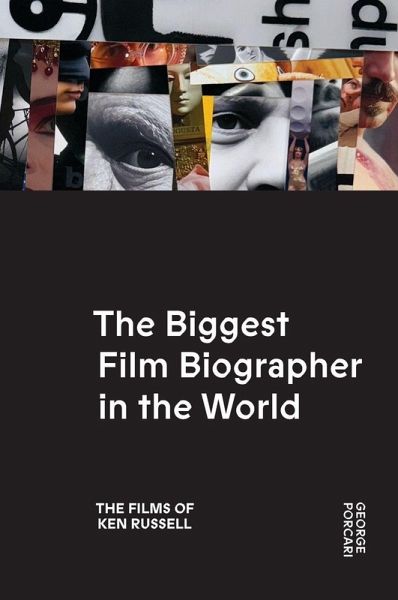
The Biggest Film Biographer in the World: The Films of Ken Russell is a study of Ken Russell's film work from his early days at the BBC in the 1960's to his later, sometimes controversial, independent work covering his whole career until Boudica Bites Back his final film from 2009. The book explores his films in depth, with close readings of early black & white works such as Pop Goes the Easel, Dante's Inferno and Elgar to later color films such as Dance of the Seven Veils: a Comic Strip in 7 Episodes on the Life of Richard Strauss, The Devils and Mahler. The book also contains an expansive…mehr
The Biggest Film Biographer in the World: The Films of Ken Russell is a study of Ken Russell's film work from his early days at the BBC in the 1960's to his later, sometimes controversial, independent work covering his whole career until Boudica Bites Back his final film from 2009. The book explores his films in depth, with close readings of early black & white works such as Pop Goes the Easel, Dante's Inferno and Elgar to later color films such as Dance of the Seven Veils: a Comic Strip in 7 Episodes on the Life of Richard Strauss, The Devils and Mahler. The book also contains an expansive introduction that summarizes Russell's biography, explains Russell's working method, introduces the main themes of the work and lays out the various periods in his vast filmography that includes operas and music videos. The main body of the book concentrates on Russell's obsessive fascination with artists, composers, dancers and poets and how those biographies, starting in the 1960's, transformed the way we think of the biographical film. Russell's whole body of work was informed by a second Renaissance that took place in England in the 1960's and the book explores that time/place and the context in which the films came into being.
George Porcari was born in Lima, Peru in 1952. He attended Catholic school, becoming an altar boy, which he very much disliked. He and his parents lived in San Isidro, which was then a well-to-do neighborhood between Miraflores and central Lima. His favorite activities were going to the nearby beaches, making art and watching television. In 1962 the family emigrated to Gardena, a working class suburb in the South Bay section of Los Angeles. The family arrived at the same moment as the Cuban missile crisis that Porcari watched on television without much interest, preferring The Rifleman, Lost In Space, Dobie Gillis and The Twilight Zone.Porcari attended Gardena High School, which was then a Vo-Tech (vocational-technical) school where one could major in various trades - Porcari's major was auto repair. After graduating in 1970 Porcari got various jobs, unloading trucks - where he joined the teamsters union - in factories or in garages. His worst job was picking up dead birds from the no-man's-land area just beyond the runways at LAX. In this time he was taking pictures, in the style of Garry Winnogrand and Robert Frank but in color, using slide film. He also made a short Super-8mm film, Greetings From LA, 1978! before moving to New York City the following year.In New York Porcari first lived at the Empire Hotel for a few months, which was then a youth hostel, but he eventually found an apartment on Delancey Street near the Williamsburg Bridge. He worked briefly as a waiter, a guy Friday, a clerk for a firm that imported chandeliers, and a telephone operator for a jewelry company. His first real job was working for the Strand Bookstore on Broadway, eventually helping the book buyer. In 1984 Porcari returned to Los Angeles to attend the Art Center College of Design in Pasadena where he received his MFA and also got a job as the book-buyer for the library - he retired as Acquisitions Librarian after 29 years at the age of 65.Porcari has been exhibiting his photography and collage work since his first exhibit at the Laurie Rubin Gallery in New York City in 1988. The most recent exhibit of his art in 2024 was at the As Is Gallery in Los Angeles: Still Lifes with Books. In 2021 the Tif Sigfrids Gallery exhibited color photographs of Los Angeles taken in the seventies. In 2016 the Haphazard Gallery in Los Angeles published a catalog for an exhibit of his photo work and collages titled Greetings From LA: 24 Frames and Fifty Years. Porcari published his first essay - on the photography of Richard Prince - in Arts magazine in 1987. Over the years he consistently published essays on films and photography in various small journals while working as a librarian. In 1999 he started writing regularly for CineAction magazine, based in Canada, and in 2018 he published a book on the work of Michelangelo Antonioni titled The Antonioni Adventure. The following year he published a book, in collaboration with the poet Bruna Mori, titled Beige, that incorporated photographs of suburbia with poetry and memoirs. In 2024 he published a collection of essays on film and photography titled One Second to Live: Photography, Film and the Corporeal in an Age of Extremes - these two books, like the one on Russell, were designed by Jessica D'Elena-Tweed.In January of 2024 Porcari moved back to Lima, Peru with his 96 year old mother. He lives in the same San Isidro neighborhood that he grew up with (now very changed) with his girlfriend Erika and her son Alejandro. In 2025 CineAction magazine published his essay on Godard: The Odyssey at Cinecitta: Alberto Moravia's Desprezzo and Jean-Luc Godard's Le Mepris. The same year VuelaPluma, an academic journal based in Lima, published (in Spanish) his essay: Under a Real Sky: Photographic Adventures With Edgar Degas. He is currently at work on a book on the photography of Edward Weston and Tina Modotti.
Es gelten unsere Allgemeinen Geschäftsbedingungen: www.buecher.de/agb
Impressum
www.buecher.de ist ein Internetauftritt der buecher.de internetstores GmbH
Geschäftsführung: Monica Sawhney | Roland Kölbl | Günter Hilger
Sitz der Gesellschaft: Batheyer Straße 115 - 117, 58099 Hagen
Postanschrift: Bürgermeister-Wegele-Str. 12, 86167 Augsburg
Amtsgericht Hagen HRB 13257
Steuernummer: 321/5800/1497
USt-IdNr: DE450055826