
Andere Kunden interessierten sich auch für
 Pellagra and Pellagrous Insanity During the Long Nineteenth Century31,99 €
 Pellagra and Pellagrous Insanity During the Long Nineteenth Century38,99 €
 Woodrow Wilson and the Press38,99 €
 Lost Worlds of 186334,99 €
 The Age of Lincoln and Cavour38,99 €
 Transatlantic Spiritualism and Nineteenth-Century American Literature38,99 €
 The History of Discrimination in U.S. Education38,99 €







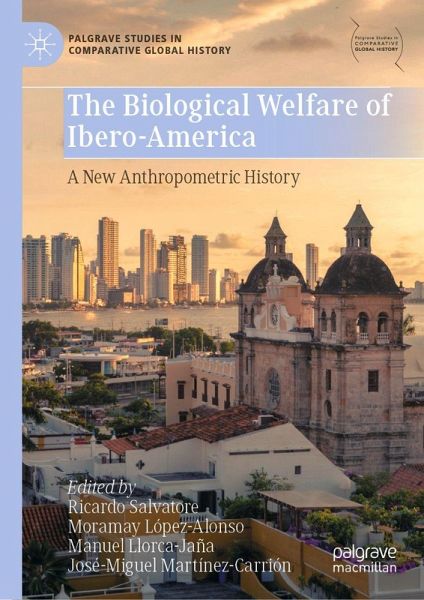
This book summarizes three decades of research in Iberian and Latin American anthropometric history, employing the most up-to-date methodologies in the field. Through a comparative and interdisciplinary approach, it examines the evolution of biological living standards in several Iberian and Latin American populations during the contemporary era, drawing on anthropometric data and its key determinants. The volume comprises nine long-term country studies Argentina, Brazil, Chile, Colombia, Guatemala, Mexico, Peru, Portugal, and Spain alongside an introduction and a comparative analysis. Being recognized experts on this field of study, the authors collectively display the knowledge gained in Anthropometric History in last twenty years.
This edited collection highlights the value of anthropometric indicators for analyzing living standards and human well-being from a historical perspective and demonstrates the importance of interdisciplinary research in understanding human growth and biological welfare. Its findings explore the determinants of human physical development through various historical transitions, including nation-state formation, economic growth, and the expansion of public goods, as well as the long-term evolution of inequality in biological living standards across Iberian and Latin American contexts.
This edited collection highlights the value of anthropometric indicators for analyzing living standards and human well-being from a historical perspective and demonstrates the importance of interdisciplinary research in understanding human growth and biological welfare. Its findings explore the determinants of human physical development through various historical transitions, including nation-state formation, economic growth, and the expansion of public goods, as well as the long-term evolution of inequality in biological living standards across Iberian and Latin American contexts.