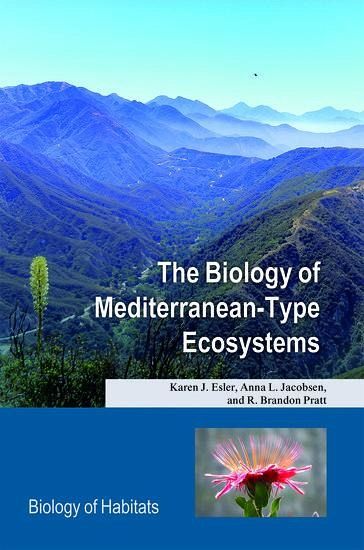
This book provides a concise but comprehensive introduction to Mediterranean-type ecosystems with the emphasis being on the organisms that dominate these regions although their management, conservation, and restoration will also be considered.
This book provides a concise but comprehensive introduction to Mediterranean-type ecosystems with the emphasis being on the organisms that dominate these regions although their management, conservation, and restoration will also be considered.
In her research, Professor Karen J. Esler simultaneously navigates disciplinary depths in ecology to work across disciplines, allowing her to contribute to inter-disciplinary and applied spaces. Her goal is to understand how drivers of change influence population and community structure and processes in mediterranean-type ecosystems, arid ecosystems, and riparian vegetation. The applied aspect of this work has been to develop and translate best-practice advice for management, restoration, and conservation. She is head of the Department of Conservation Ecology & Entomology at Stellenbosch University and a core team member of the DST-NRF Centre of Excellence for Invasion Biology. Professor Esler is the South African representative on the International Society for Mediterranean Ecology, and a member of the International Cooperative for the Management of Mediterranean-Climate Ecosystems (INCOMME) Dr. Anna L. Jacobsen's research examines plant structure and function, with a focus on woody plant anatomy and hydraulic transport. She has conducted research in arid and semi-arid shrub communities in both California and South Africa, with much of her research examining mediterranean-type plants and their responses to both drought and fire. As part of her research and as an active attendee of MEDECOS meetings, she has visited all five global MTEs and has participated in several global collaborative research projects. She has published numerous scholarly articles in her areas of expertise. Dr. Brandon Pratt is a plant ecophysiologist whose work focuses on mediterranean-type ecosystems. He has worked in both California and South Africa studying adaptations of shrub species to drought, fire, and the unique mediterranean-type environment. His work has been funded by the Andrew Mellon Foundation and the National Science Foundation, USA. As a professor, he teaches plant ecophysiology, ecosystems ecology, California natural history, and general botany at California State University, Bakersfield. He has regularly attended the mediterranean-ecosystems (MEDECOS) conferences since 2004.
Inhaltsangabe
1: Introduction 2: Characteristics of Mediterranean-Type Ecosystems 3: Organisms and their Interactions 4: Diversity and Community Structure 5: Evolution and Diversity 6: Form and Function of Mediterranean Shrublands 7: Ecosystems Processes 8: Transformation 9: Planning for the Future
1: Introduction 2: Characteristics of Mediterranean-Type Ecosystems 3: Organisms and their Interactions 4: Diversity and Community Structure 5: Evolution and Diversity 6: Form and Function of Mediterranean Shrublands 7: Ecosystems Processes 8: Transformation 9: Planning for the Future
Es gelten unsere Allgemeinen Geschäftsbedingungen: www.buecher.de/agb
Impressum
www.buecher.de ist ein Internetauftritt der buecher.de internetstores GmbH
Geschäftsführung: Monica Sawhney | Roland Kölbl | Günter Hilger
Sitz der Gesellschaft: Batheyer Straße 115 - 117, 58099 Hagen
Postanschrift: Bürgermeister-Wegele-Str. 12, 86167 Augsburg
Amtsgericht Hagen HRB 13257
Steuernummer: 321/5800/1497
USt-IdNr: DE450055826