
Andere Kunden interessierten sich auch für
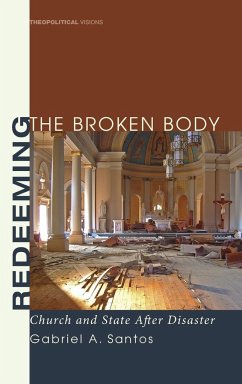
 Redeeming the Broken Body54,99 €
 His Broken Body33,99 €
 The Rebuilding Your Broken World16,99 €
 The Broken Bones Diary29,99 €
 Debt Freedom Belongs To The Body Of Christ17,99 €
 Strong at the Broken Places19,99 €
 The Son Still Shines Through Broken Windows19,99 €



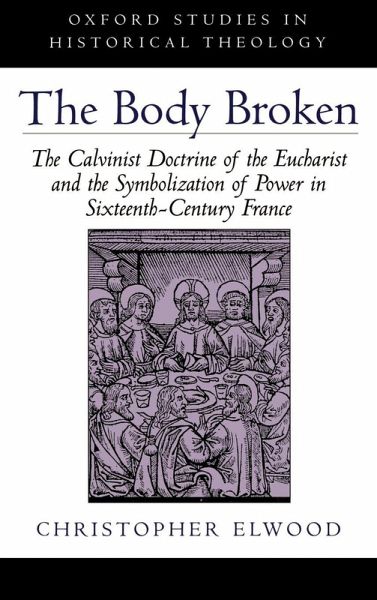
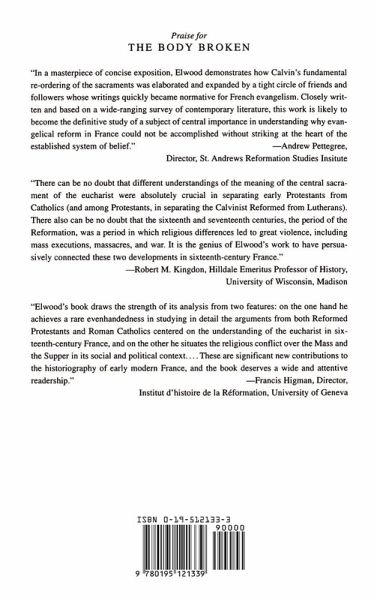
This study of controversy over the eucharist in sixteenth-century France argues that Calvinist interpretations of the Lord's Supper played a crucial role in the development of early modern revolutionary politics. Focusing on new understandings of signs and symbols conveyed in Protestant eucharistic writings, Elwood shows how eucharistic doctrine facilitated new conceptions of the nature of power and the relation between society and the sacred and contributed to the development of the divergent religious, social, and political ideals that threatened to destroy France in the second half of the sixteenth century.
This book examines the disputes about the eucharist that were carried out in the popular press in 16th-century France. Elwood's focus is on the way in which power is symbolized in eucharist doctrine, and how representations of power in the context of theological discussion influenced understandings of power in other spheres of life. By concentrating on writings that were accessible to and likely read by a popular lay audience, Elwood seeks to discover what ideas concerning the eucharist were actually conveyed by readers. His central argument is that the Calvinist eucharist theory propounded in the 16th century included a way on construing power and the relation between the sacred and society that contributed in a very significant way to the ideological social, and political unrest that characterized the Reformation period.
This book examines the disputes about the eucharist that were carried out in the popular press in 16th-century France. Elwood's focus is on the way in which power is symbolized in eucharist doctrine, and how representations of power in the context of theological discussion influenced understandings of power in other spheres of life. By concentrating on writings that were accessible to and likely read by a popular lay audience, Elwood seeks to discover what ideas concerning the eucharist were actually conveyed by readers. His central argument is that the Calvinist eucharist theory propounded in the 16th century included a way on construing power and the relation between the sacred and society that contributed in a very significant way to the ideological social, and political unrest that characterized the Reformation period.