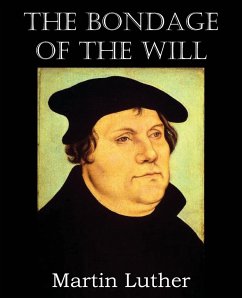
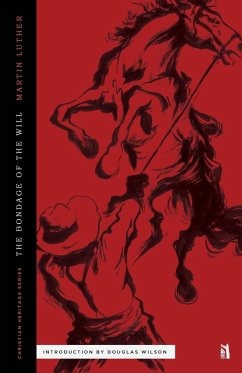
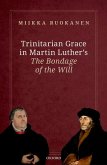
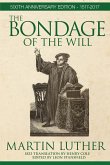
THIS EXCELLENT WORK of that eminent servant of God, Martin Luther - one of the noble Reformers is acknowledged to be one of the greatest, if not the greatest of Luther's productions. Luther himself considered it his best publication. Although Luther used certain words that I should not employ, yet I have adhered faithfully to his own phraseology as translated by Cole. Luther speaks for himself. This book is most needful at the present day. The teachings of many so-called Protestants are more in accordance with the Dogmas of the Papists, or the ideas of Erasmus, than with the Principles of the…mehr
THIS EXCELLENT WORK of that eminent servant of God, Martin Luther - one of the noble Reformers is acknowledged to be one of the greatest, if not the greatest of Luther's productions. Luther himself considered it his best publication. Although Luther used certain words that I should not employ, yet I have adhered faithfully to his own phraseology as translated by Cole. Luther speaks for himself. This book is most needful at the present day. The teachings of many so-called Protestants are more in accordance with the Dogmas of the Papists, or the ideas of Erasmus, than with the Principles of the Reformers; they are more in harmony with the Canons and Decrees of the Council of Trent than with any Protestant or Reformed Confessions of Faith. If the Lord should be pleased to open the eyes and understanding of some of these so-called Protestants to whom I have referred - through the perusal of this work of the great Reformer - Luther - enabling them to see that they are at present believing and teaching awful delusions contrary to the Word of God, and the Protestant Reformed Religion, and causing them to return to The Old Paths, the labours of "THE SOVEREIGN GRACE UNION" will not have been in vain.
Martin Luther was a German clergyman, theologian, author, hymnwriter, professor, and Augustinian friar who lived from 10 November 1483 to 18 February 1546. He was a pivotal player in the Protestant Reformation, and his theological convictions served as the foundation for Lutheranism. In 1507, Luther became ordained as a member of the clergy. He began to criticize various Roman Catholic Church teachings and practices, particularly the perspective on indulgences. In his Ninety-five Theses of 1517, Luther urged an academic examination of the practice and efficacy of indulgences. His refusal to disavow all of his publications at the request of Pope Leo X in 1520 and the Holy Roman Emperor Charles V at the Diet of Worms in 1521 ended in his excommunication by the pope and the Holy Roman Emperor's sentencing as an outlaw. Luther died in 1546, with Pope Leo X still excommunicating him. Luther preached that redemption, and hence eternal life, are not won through good works, but are only gained as a free gift of God's grace through the believer's faith in Jesus Christ, the redeemer from sin.
Es gelten unsere Allgemeinen Geschäftsbedingungen: www.buecher.de/agb
Impressum
www.buecher.de ist ein Internetauftritt der buecher.de internetstores GmbH
Geschäftsführung: Monica Sawhney | Roland Kölbl | Günter Hilger
Sitz der Gesellschaft: Batheyer Straße 115 - 117, 58099 Hagen
Postanschrift: Bürgermeister-Wegele-Str. 12, 86167 Augsburg
Amtsgericht Hagen HRB 13257
Steuernummer: 321/5800/1497
USt-IdNr: DE450055826