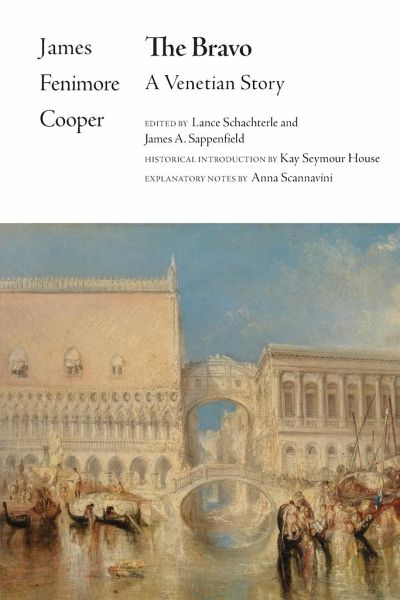
A novel of early eighteenth-century Venice that Cooper called "in spirit, the most American book I ever wrote." The Bravo (1831) takes place in early eighteenth-century Venice, when the "Serene Republic" had lost much of its glory, leaving its oligarchs struggling to hold on to their family wealth by manipulating the government and people through secret councils and a figure-head doge. In 1844, Cooper called it "in spirit, the most American book I ever wrote" because of its depiction of the masses duped by demagoguery and the attempts of Congress to rein in President Jackson, who Cooper saw as…mehr
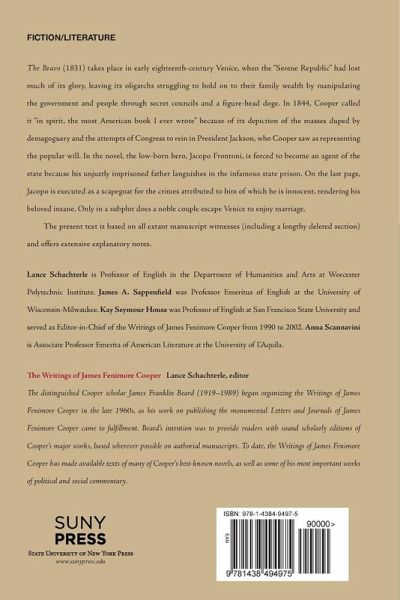
A novel of early eighteenth-century Venice that Cooper called "in spirit, the most American book I ever wrote." The Bravo (1831) takes place in early eighteenth-century Venice, when the "Serene Republic" had lost much of its glory, leaving its oligarchs struggling to hold on to their family wealth by manipulating the government and people through secret councils and a figure-head doge. In 1844, Cooper called it "in spirit, the most American book I ever wrote" because of its depiction of the masses duped by demagoguery and the attempts of Congress to rein in President Jackson, who Cooper saw as representing the popular will. In the novel, the low-born hero, Jacopo Frontoni, is forced to become an agent of the state because his unjustly imprisoned father languishes in the infamous state prison. On the last page, Jacopo is executed as a scapegoat for the crimes attributed to him of which he is innocent, rendering his beloved insane. Only in a subplot does a noble couple escape Venice to enjoy marriage. The present text is based on all extant manuscript witnesses (including a lengthy deleted section) and offers extensive explanatory notes.
James Fenimore Cooper was born on September 15, 1789, was an American author. He wrote authentic romantic stories portraying colonist and Native characters from the seventeenth to the nineteenth centuries. His most popular work is The Last of the Mohicans, often regarded as a masterpiece. James Fenimore Cooper was the 11th offspring of William Cooper and Elizabeth (Fenimore) Cooper. He wedded Susan Augusta de Lancey at Mamaroneck, Westchester Area, New York on January 1, 1811. The Coopers had seven children, but only five of them live to adulthood. The Last of the Mohicans (1826) was written in New York City where Cooper and his family resided. It became one of the most-read American books of the nineteenth century. The series includes the racial friendship of Natty Bumppo with the Delaware Indians. In 1826, Cooper moved his family to Europe to acquire more income from his books. He became friends with painters Samuel Morse and Gilbert du Motier and Marquis de Lafayette. In 1832, he entered the list as a political writer in a series of letters to Le National.
Es gelten unsere Allgemeinen Geschäftsbedingungen: www.buecher.de/agb
Impressum
www.buecher.de ist ein Internetauftritt der buecher.de internetstores GmbH
Geschäftsführung: Monica Sawhney | Roland Kölbl | Günter Hilger
Sitz der Gesellschaft: Batheyer Straße 115 - 117, 58099 Hagen
Postanschrift: Bürgermeister-Wegele-Str. 12, 86167 Augsburg
Amtsgericht Hagen HRB 13257
Steuernummer: 321/5800/1497
USt-IdNr: DE450055826