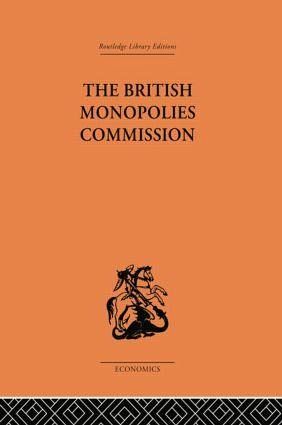
This book is a key example of the emergence of public choice theory by an economist who was to become one of its major exponents. It combines a detailed, critical study of the Monopolies Commission, with an analysis of the economic issues involved in monopoly supervision and control.
This book is a key example of the emergence of public choice theory by an economist who was to become one of its major exponents. It combines a detailed, critical study of the Monopolies Commission, with an analysis of the economic issues involved in monopoly supervision and control.
Author's Preface PART I: THE HISTORICAL APPROACH 1. Historical Background 1914-48 2. The Common Law Background PART 2: THE MONOPOLIES COMMISSION 3. The Structure and Constitution of the Monopolies Commission 4. The Scope and Authority of the Monopolies Commission 5. The Investigating Procedure of the Monopolies Commission PART 3: TRADE ASSOCIATION INQUIRIES 6. The Monopolies Commission and Price Agreements 7. Trade Associations and the Competitive Process 8. Trade Association Agreements and Barriers to Inter-Member Competition 9. Trade Association Agreements and Barriers to Independent Competition 10. The Trade Association and Public Policy PART 4: THE DOMINANT FIRM 11. The Dominant Firm and Oligopoly 12. The Dominant Firm and the Competitive Process 13. The Dominant Firm and Barriers to Independent Competition 14. Dominant Firm Activities and the Public Interest 15. The Dominant Firm and Public Policy PART 5: STATISTICAL MEASURES OF ECONOMIC PERFORMANCE 16. Unit Production Costs and Prices 17. The Calculation of Rate of Return on Capital as a Public Interest Indicator 18. Rate of Return on Capital and the Public Interest PART 6: GOVERNMENT ACTION: ECONOMIC CONSEQUENCES 19. The Implementation of Monopolies Commission Recommendations 20. Economic Consequences of Monopolies Commission Reports PART 7: CONCLUSIONS AND RECOMMENDATIONS 21. The Monopolies Commission and Future Developments APPENDICES 1. Members of the Monopolies Commission 1949-64 2. A Case Study of the Procedure of Inquiry CLASSIFIED BIBLIOGRAPHY INDEX
Author's Preface PART I: THE HISTORICAL APPROACH 1. Historical Background 1914-48 2. The Common Law Background PART 2: THE MONOPOLIES COMMISSION 3. The Structure and Constitution of the Monopolies Commission 4. The Scope and Authority of the Monopolies Commission 5. The Investigating Procedure of the Monopolies Commission PART 3: TRADE ASSOCIATION INQUIRIES 6. The Monopolies Commission and Price Agreements 7. Trade Associations and the Competitive Process 8. Trade Association Agreements and Barriers to Inter-Member Competition 9. Trade Association Agreements and Barriers to Independent Competition 10. The Trade Association and Public Policy PART 4: THE DOMINANT FIRM 11. The Dominant Firm and Oligopoly 12. The Dominant Firm and the Competitive Process 13. The Dominant Firm and Barriers to Independent Competition 14. Dominant Firm Activities and the Public Interest 15. The Dominant Firm and Public Policy PART 5: STATISTICAL MEASURES OF ECONOMIC PERFORMANCE 16. Unit Production Costs and Prices 17. The Calculation of Rate of Return on Capital as a Public Interest Indicator 18. Rate of Return on Capital and the Public Interest PART 6: GOVERNMENT ACTION: ECONOMIC CONSEQUENCES 19. The Implementation of Monopolies Commission Recommendations 20. Economic Consequences of Monopolies Commission Reports PART 7: CONCLUSIONS AND RECOMMENDATIONS 21. The Monopolies Commission and Future Developments APPENDICES 1. Members of the Monopolies Commission 1949-64 2. A Case Study of the Procedure of Inquiry CLASSIFIED BIBLIOGRAPHY INDEX
Es gelten unsere Allgemeinen Geschäftsbedingungen: www.buecher.de/agb
Impressum
www.buecher.de ist ein Internetauftritt der buecher.de internetstores GmbH
Geschäftsführung: Monica Sawhney | Roland Kölbl | Günter Hilger
Sitz der Gesellschaft: Batheyer Straße 115 - 117, 58099 Hagen
Postanschrift: Bürgermeister-Wegele-Str. 12, 86167 Augsburg
Amtsgericht Hagen HRB 13257
Steuernummer: 321/5800/1497
USt-IdNr: DE450055826