The Nazi-Soviet War was the largest and most brutal theatre of the Second World War, fought between two of the most ruthless states ever to exist. Bringing together twenty-four of the most accomplished authors in both German and Soviet history, this Cambridge Companion provides the most authoritative, and yet highly accessible, guide to the conflict. Each chapter examines a key aspect of the war from war planning, the opposing forces and the campaigns to criminality and occupation, alliances, the home fronts and postwar legacies and myth-making. The authors demonstrate that the Nazi-Soviet war…mehr
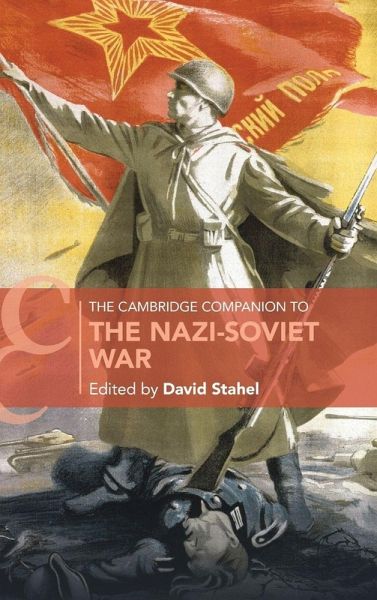
The Nazi-Soviet War was the largest and most brutal theatre of the Second World War, fought between two of the most ruthless states ever to exist. Bringing together twenty-four of the most accomplished authors in both German and Soviet history, this Cambridge Companion provides the most authoritative, and yet highly accessible, guide to the conflict. Each chapter examines a key aspect of the war from war planning, the opposing forces and the campaigns to criminality and occupation, alliances, the home fronts and postwar legacies and myth-making. The authors demonstrate that the Nazi-Soviet war was both a conventional clash of arms in which millions of soldiers fought in titanic battles, but also a non-conventional war in which soldiers and security forces murdered countless non-combatants. It was a war of resources, industry, mobilisation, administration, and popular support, with implications that still drive European security debates today.
David Stahel is Associate Professor of History at the University of New South Wales. He has authored ten previous works about aspects of the Nazi-Soviet War, including Operation Barbarossa and Germany's Defeat in the East (2009), Joining Hitler's Crusade (2016), Retreat from Moscow (2019) and Hitler's Panzer's Generals (2023).
Inhaltsangabe
List of figures List of contributors Introduction David Stahel Part I. Conceptions of War: 1. German-Soviet relations and military collaboration in the inter-war period Ian Ona Johnson 2. Political thinking and strategic planning for Hitler's lebensraum in the east Ben Shepherd 3. Stalin's political delusions and military preparations for war with Nazi Germany Hiroaki Kuromiya Part II. Opposing Forces: 4. The Ostheer: leadership, command, motivation and experience Jeff Rutherford and David Harrisville 5. The Red Army: leadership and command Alexander Hill 6. The Red Army: motivation and experience Roger Reese Part III. Campaigns: 7. Operation Barbarossa, 1941 David Stahel 8. Stalingrad and the eastern Front, 1942 Adrian E. Wettstein 9. Kursk, 1943 Roman Töppel 10. The Siege of Leningrad, 1941-1944 Evan Mawdsley 11. Operation Bagration, 1944 David R. Stone 12. The soviet conquest and occupation of Germany, 1945 Alexander Statiev Part IV. Criminality and Occupation: 13. German occupation and mass murder in the east, 1941-1944 Alex J. Kay 14. Soviet crimes at times of war, 1941-1945 Mark Edele Part V. Home Fronts: 15. The German home front Bastiaan Willems 16. The soviet war effort Wendy Z. Goldman Part VI. Comrades in Arms: 17. Germany and the axis in the east Oleg Beyda, Grant T. Harward, Richard Carrier and Henrik Meinander 18. The big three and the eastern front Geoffery Roberts Part VII. Post-War Legacies and Myth Making: 19. Germany's selective memory of the eastern front Jörg Echternkamp 20. The politics of war memory in the USSR and post-Soviet Russia Jonathan Brunstedt A guide to further reading Index.
Es gelten unsere Allgemeinen Geschäftsbedingungen: www.buecher.de/agb
Impressum
www.buecher.de ist ein Internetauftritt der buecher.de internetstores GmbH
Geschäftsführung: Monica Sawhney | Roland Kölbl | Günter Hilger
Sitz der Gesellschaft: Batheyer Straße 115 - 117, 58099 Hagen
Postanschrift: Bürgermeister-Wegele-Str. 12, 86167 Augsburg
Amtsgericht Hagen HRB 13257
Steuernummer: 321/5800/1497
USt-IdNr: DE450055826