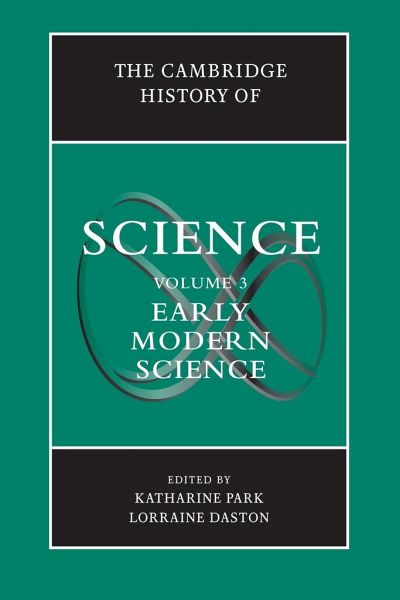
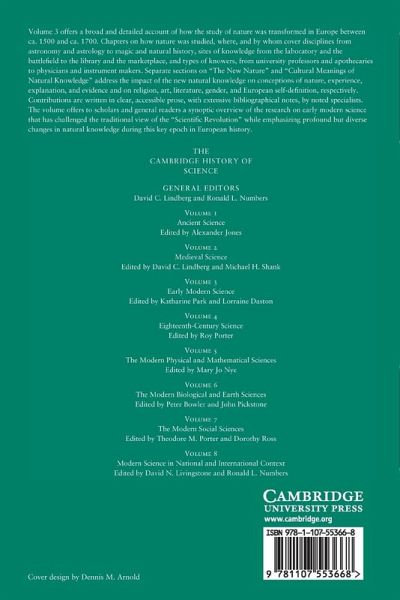
This book provides a comprehensive account of knowledge of the natural world in Europe, c.1500-1700. Often referred to as the Scientific Revolution, this period saw major transformations in fields as diverse as anatomy and astronomy, natural history and mathematics. Articles by leading specialists describe in clear, accessible prose supplemented by extensive bibliographies, how new ideas, discoveries, and institutions shaped the ways in which nature came to be studied, understood, and used. Part I frames the study of 'The New Nature' in the sixteenth and seventeenth centuries. Part II surveys…mehr
This book provides a comprehensive account of knowledge of the natural world in Europe, c.1500-1700. Often referred to as the Scientific Revolution, this period saw major transformations in fields as diverse as anatomy and astronomy, natural history and mathematics. Articles by leading specialists describe in clear, accessible prose supplemented by extensive bibliographies, how new ideas, discoveries, and institutions shaped the ways in which nature came to be studied, understood, and used. Part I frames the study of 'The New Nature' in the sixteenth and seventeenth centuries. Part II surveys the 'Personae and Sites of Natural Knowledge'. Part III treats the study of nature by discipline, following the classification of the sciences current in early modern Europe. Part IV takes up the implications of the new natural knowledge for religion, literature, art, gender, and European identity.
List of illustrations Notes on contributors General editors' preface Acknowledgments 1. Introduction: the age of the new Katharine Park and Lorraine Daston Part I. The New Nature: 2. Physics and foundations Daniel Garber 3. Scientific explanation Lynn S. Joy 4. The meanings of experience Peter Dear 5. Proof and persuasion Richard W. Serjeantson Part II. Personae and Sites of Natural Knowledge: 6. The man of science Steven Shapin 7. Women of natural knowledge Londa Schiebinger 8. Markets, piazzas, and villages William Eamon 9. Homes and households Alix Cooper 10. Libraries and lecture halls Anthony Grafton 11. Courts and academies Bruce T. Moran 12. Anatomy theaters, botanical gardens, and natural history collections Paula Findlen 13. Laboratories Pamela H. Smith 14. Sites of military science and technology Kelly DeVries 15. Coffeehouses and print shops Adrian Johns 16. Networks of travel, correspondence, and exchange Steven J. Harris Part III. Dividing the Study of Nature: 17. Natural philosophy Ann Blair 18. Medicine Harold J. Cook 19. Natural history Paula Findlen 20. Cosmography Klaus A. Vogel (translated by Alisha Rankin) 21. From alchemy to 'chymistry' William R. Newman 22. Magic Brian P. Copenhaver 23. Astrology H. Darrel Rutkin 24. Astronomy William Donahue 25. Acoustics and optics Paolo Mancosu 26. Mechanics Domenico Beroloni Meli 27. The mechanical arts Jim Bennett 28. Pure mathematics Kirsti Andersen and Henk J. M. Bos Part IV. Cultural Meanings of Natural Knowledge: 29. Religion Rivka Feldhay 30. Literature Mary Baine Campbell 31. Art Carmen Niekrasz and Claudia Swan 32. Gender Dorinda Outram 33. European expansion and self-definition Klaus A. Vogel (translated by Alisha Rankin) Index.
Es gelten unsere Allgemeinen Geschäftsbedingungen: www.buecher.de/agb
Impressum
www.buecher.de ist ein Internetauftritt der buecher.de internetstores GmbH
Geschäftsführung: Monica Sawhney | Roland Kölbl | Günter Hilger
Sitz der Gesellschaft: Batheyer Straße 115 - 117, 58099 Hagen
Postanschrift: Bürgermeister-Wegele-Str. 12, 86167 Augsburg
Amtsgericht Hagen HRB 13257
Steuernummer: 321/5800/1497
USt-IdNr: DE450055826