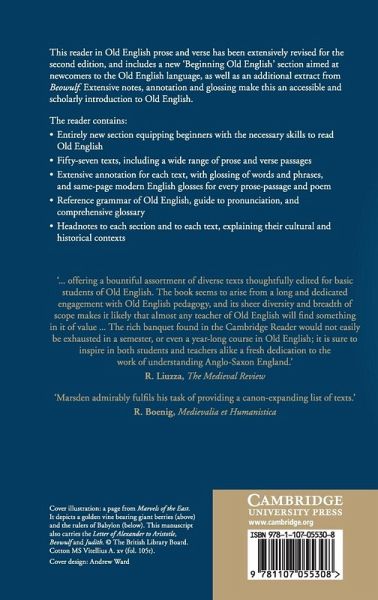
This reader remains the only major new reader of Old English prose and verse in the past forty years. The second edition is extensively revised throughout, with the addition of a new 'Beginning Old English' section for newcomers to the Old English language, along with a new extract from Beowulf. The fifty-seven individual texts include established favourites such as The Battle of Maldon and Wulfstan's Sermon of the Wolf, as well as others not otherwise readily available, such as an extract from Apollonius of Tyre. Modern English glosses for every prose-passage and poem are provided on the same…mehr
This reader remains the only major new reader of Old English prose and verse in the past forty years. The second edition is extensively revised throughout, with the addition of a new 'Beginning Old English' section for newcomers to the Old English language, along with a new extract from Beowulf. The fifty-seven individual texts include established favourites such as The Battle of Maldon and Wulfstan's Sermon of the Wolf, as well as others not otherwise readily available, such as an extract from Apollonius of Tyre. Modern English glosses for every prose-passage and poem are provided on the same page as the text, along with extensive notes. A succinct reference grammar is appended, along with guides to pronunciation and to grammatical terminology. A comprehensive glossary lists and analyses all the Old English words that occur in the book. Headnotes to each of the six text sections, and to every individual text, establish their literary and historical contexts, and illustrate the rich cultural variety of Anglo-Saxon England. This second edition is an accessible and scholarly introduction to Old English.
Richard Marsden is Emeritus Professor of Old English at the University of Nottingham. In addition to numerous articles on Old English literature and language and the history of the Latin Bible, he has published The Text of the Old Testament in Anglo-Saxon England (Cambridge, 1995) and an edition of The Old English Heptateuch for the Early English Text Society (2008).
Inhaltsangabe
Preface to the second edition Preface to the first edition List of abbreviations Introduction Beginning Old English 1. Getting started 2. Practice sentences 3. Practice texts 4. Keys to test sentences and texts 5. Beginning poetry The Texts: Part I. Teaching and Learning: 1. In the Schoolroom (from Ælfric's Colloquy) 2. A Personal Miscellany (from Ælfwine's Prayerbook) 3. Medicinal Remedies (from Bald's Leechbook) 4. Learning Latin (from Ælfric's Excerptiones de arte grammatica anglice) 5. A New Beginning (Alfred's 'preface' to his translation of Gregory's Cura pastoralis) 6. The Wagonwheel of Fate (from Alfred's translation of Boethius's De consolatione Philosophiae) Part II. Keeping a Record: 7. Laws of the Anglo-Saxon Kings 8. England under Attack (from the Anglo-Saxon Chronicle: annals for 981-93, 995-8 and 1002-3) 9. Bede's Ecclesiastical History of the English People 10. The Battle of Brunanburh 11. The Will of Ælfgifu 12. The Fonthill Letter Part III. Spreading the Word: 13. After the Flood (from the Old English Hexateuch: Gen 8.6-18 and 9.8-13) 14. The Crucifixion (from the Old English Gospels: Mt 27.11-54) 15. King Alfred's Psalms 16. A Translator's Problems (Ælfric's preface to his translation of Genesis) 17. Satan's Challenge (Genesis B, lines 338-441) 18. The Drowning of Pharaoh's Army (Exodus, lines 447-564) 19. Judith Part IV. Example and Exhortation: 20. Bede's Death Song 21. Two Holy Women 22. A Homily for Easter Sunday (from Ælfric's Sermones catholicae) 23. The Dream of the Rood 24. On False Gods (Wulfstan's De falsis deis) 25. The Sermon of the Wolf (Wulfstan's Sermo Lupi) 26. The Seafarer Part V. Telling Tales: 27. Falling in Love (from Apollonius of Tyre) 28. The Trees of the Sun and the Moon (from The Letter of Alexander) 29. Cynewulf and Cyneheard (from the Anglo-Saxon Chronicle: annal for 755) 30. The Battle of Maldon 31. Beowulf 32. The Fight at Finnsburh Part VI. Reflection and Lament: 33. Truth is Trickiest (Maxims II) 34. The Durham Proverbs 35. Five Anglo-Saxon Riddles 36. Deor 37. The Ruin 38. The Wanderer 39. Wulf and Eadwacer 40. The Wife's Lament Manuscripts and textual emendations The writing and pronunciation of Old English Reference grammar of Old English Glossary Guide to terms Index.
Preface to the second edition Preface to the first edition List of abbreviations Introduction Beginning Old English 1. Getting started 2. Practice sentences 3. Practice texts 4. Keys to test sentences and texts 5. Beginning poetry The Texts: Part I. Teaching and Learning: 1. In the Schoolroom (from Ælfric's Colloquy) 2. A Personal Miscellany (from Ælfwine's Prayerbook) 3. Medicinal Remedies (from Bald's Leechbook) 4. Learning Latin (from Ælfric's Excerptiones de arte grammatica anglice) 5. A New Beginning (Alfred's 'preface' to his translation of Gregory's Cura pastoralis) 6. The Wagonwheel of Fate (from Alfred's translation of Boethius's De consolatione Philosophiae) Part II. Keeping a Record: 7. Laws of the Anglo-Saxon Kings 8. England under Attack (from the Anglo-Saxon Chronicle: annals for 981-93, 995-8 and 1002-3) 9. Bede's Ecclesiastical History of the English People 10. The Battle of Brunanburh 11. The Will of Ælfgifu 12. The Fonthill Letter Part III. Spreading the Word: 13. After the Flood (from the Old English Hexateuch: Gen 8.6-18 and 9.8-13) 14. The Crucifixion (from the Old English Gospels: Mt 27.11-54) 15. King Alfred's Psalms 16. A Translator's Problems (Ælfric's preface to his translation of Genesis) 17. Satan's Challenge (Genesis B, lines 338-441) 18. The Drowning of Pharaoh's Army (Exodus, lines 447-564) 19. Judith Part IV. Example and Exhortation: 20. Bede's Death Song 21. Two Holy Women 22. A Homily for Easter Sunday (from Ælfric's Sermones catholicae) 23. The Dream of the Rood 24. On False Gods (Wulfstan's De falsis deis) 25. The Sermon of the Wolf (Wulfstan's Sermo Lupi) 26. The Seafarer Part V. Telling Tales: 27. Falling in Love (from Apollonius of Tyre) 28. The Trees of the Sun and the Moon (from The Letter of Alexander) 29. Cynewulf and Cyneheard (from the Anglo-Saxon Chronicle: annal for 755) 30. The Battle of Maldon 31. Beowulf 32. The Fight at Finnsburh Part VI. Reflection and Lament: 33. Truth is Trickiest (Maxims II) 34. The Durham Proverbs 35. Five Anglo-Saxon Riddles 36. Deor 37. The Ruin 38. The Wanderer 39. Wulf and Eadwacer 40. The Wife's Lament Manuscripts and textual emendations The writing and pronunciation of Old English Reference grammar of Old English Glossary Guide to terms Index.
Es gelten unsere Allgemeinen Geschäftsbedingungen: www.buecher.de/agb
Impressum
www.buecher.de ist ein Internetauftritt der buecher.de internetstores GmbH
Geschäftsführung: Monica Sawhney | Roland Kölbl | Günter Hilger
Sitz der Gesellschaft: Batheyer Straße 115 - 117, 58099 Hagen
Postanschrift: Bürgermeister-Wegele-Str. 12, 86167 Augsburg
Amtsgericht Hagen HRB 13257
Steuernummer: 321/5800/1497
USt-IdNr: DE450055826