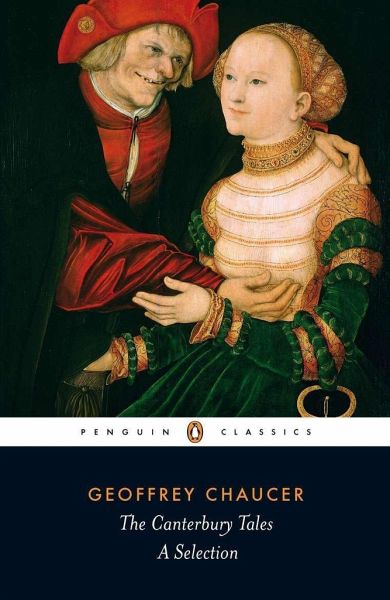
A selection of the "Chaucer's Canterbury Tales" that provides an introduction to one of the cornerstones of English literature. It offers character sketches of the colourful band of pilgrims who gather at a London inn on their way to Canterbury. It contains an introduction examining Chaucer's life and work and the literary influences on the Tales.
A selection of the "Chaucer's Canterbury Tales" that provides an introduction to one of the cornerstones of English literature. It offers character sketches of the colourful band of pilgrims who gather at a London inn on their way to Canterbury. It contains an introduction examining Chaucer's life and work and the literary influences on the Tales.
Geoffrey Chaucer was born in London, the son of a wine-merchant, in about 1342, and as he spent his life in royal government service his career happens to be unusually well documented. By 1357 Chaucer was a page to the wife of Prince Lionel, second son of Edward III, and it was while in the prince's service that Chaucer was ransomed when captured during the English campaign in France in 1359-60. Chaucer's wife Philippa, whom he married c. 1365, was the sister of Katherine Swynford, the mistress (c. 1370) and third wife (1396) of John of Gaunt, Duke of Lancaster, whose first wife Blanche (d. 1368) is commemorated in Chaucer's ealrist major poem, The Book of the Duchess.From 1374 Chaucer worked as controller of customs on wool in the port of London, but between 1366 and 1378 he made a number of trips abroad on official business, including two trips to Italy in 1372-3 and 1378. The influence of Chaucer's encounter with Italian literature is felt in the poems he wrote in the late 1370's and early 1380s – The House of Fame, The Parliament of Fowls and a version of The Knight's Tale – and finds its fullest expression in Troilus and Criseyde. In 1386 Chaucer was member of parliament for Kent, but in the same year he resigned his customs post, although in 1389 he was appointed Clerk of the King's Works (resigning in 1391). After finishing Troilus and his translation into English prose of Boethius' De consolatione philosophiae, Chaucer started his Legend of Good Women. In the 1390s he worked on his most ambitious project, The Canterbury Tales, which remained unfinished at his death. In 1399 Chaucer leased a house in the precincts of Westminster Abbey but died in 1400 and was buried in the Abbey. Colin Wilcockson is Emeritus Fellow and Former Director of Studies in English and in Anglo-Saxon, Norse and Celtic, Pembroke College at the University of Cambridge.
Inhaltsangabe
The Canterbury Tales: A SelectionAcknowledgements Chronology Introduction Further Reading A Note on the Translation, Text and Illustrations The Canterbury Tales The General Prologue The Knight's Tale The Miller's Prologue and Tale The Reeve's Prologue and Tale The Wife of Bath's Prologue and Tale The Clerk's Prologue and Tale The Merchant's Prologue, Tale and Epilogue The Franklin's Prologue and Tale The Pardoner's Prologue and Tale The Nun's Priest's Tale
The Canterbury Tales: A SelectionAcknowledgements Chronology Introduction Further Reading A Note on the Translation, Text and Illustrations The Canterbury Tales The General Prologue The Knight's Tale The Miller's Prologue and Tale The Reeve's Prologue and Tale The Wife of Bath's Prologue and Tale The Clerk's Prologue and Tale The Merchant's Prologue, Tale and Epilogue The Franklin's Prologue and Tale The Pardoner's Prologue and Tale The Nun's Priest's Tale
Es gelten unsere Allgemeinen Geschäftsbedingungen: www.buecher.de/agb
Impressum
www.buecher.de ist ein Internetauftritt der buecher.de internetstores GmbH
Geschäftsführung: Monica Sawhney | Roland Kölbl | Günter Hilger
Sitz der Gesellschaft: Batheyer Straße 115 - 117, 58099 Hagen
Postanschrift: Bürgermeister-Wegele-Str. 12, 86167 Augsburg
Amtsgericht Hagen HRB 13257
Steuernummer: 321/5800/1497
USt-IdNr: DE450055826