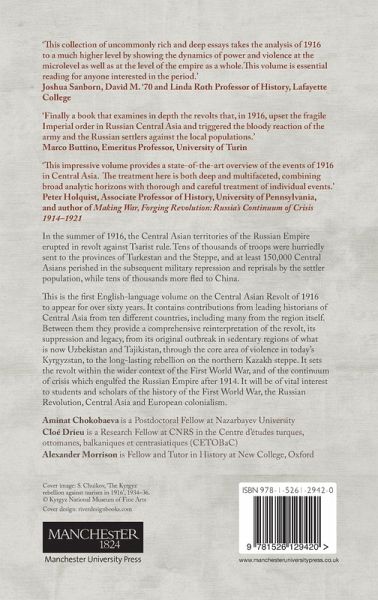
This volume provides a comprehensive reinterpretation of the 1916 Central Asian Revolt - a key event in the history of Central Asia, the Russian Empire and the First World War.
This volume provides a comprehensive reinterpretation of the 1916 Central Asian Revolt - a key event in the history of Central Asia, the Russian Empire and the First World War.
Aminat Chokobaeva is a Postdoctoral Fellow at Nazarbayev University Cloé Drieu is a Research Fellow at CNRS in the Centre d'études turques, ottomanes, balkaniques et centrasiatiques (CETOBaC) Alexander Morrison is a Fellow and Tutor in History at New College, Oxford
Inhaltsangabe
Note on translation, transliteration and dates Glossary and abbreviations Editors' introduction Aminat Chokobaeva, Cloé Drieu and Alexander Morrison 1 Why in Central Asia, why in 1916? The revolt as an interface of the Russian colonial crisis and the World War Tomohiko Uyama 2 The exemption of peoples of Turkestan from universal military service as an antecedent to the 1916 revolt. Tatiana Kotiukova 3 The 1916 uprisings in Jizzakh: economic background and political rationales Akmal Bazarbaev and Cloé Drieu 4 The "virtual reality" of colonial Turkestan: how Russian officials viewed and represented the participation of the Local population in the 1916 revolt Oybek Mahmudov 5 Fears, rumours, violence: the Tsarist regime and the revolt of the nomads in Central Asia, 1916 Jörn Happel 6 When the nomads went to war: the uprising of 1916 in Semirech'e Aminat Chokobaeva 7 Scales of violence: the 1916 Central Asian uprising in the context of wars and revolutions (1914-1923) Niccolò Pianciola 8 Violent acculturation: Alexei Kuropatkin, the Central Asian Revolt, and the long Shadow of conquest Ian W. Campbell 9 Refugees, resettlement and revolutionary violence in Semirech'e after the 1916 revolt Alexander Morrison 10 Links across time: Taranchis during the uprising of 1916 in Semirech'e and the "Atu" massacre of 1918 Ablet Kamalov 11 Making political rebellion "primitive": the 1916 rebellion in the Kazakh steppe in long-term perspective (ca.1840-1930) Xavier Hallez and Isabelle Ohayon 12 From Rebels to refugees: memorialising the revolt of 1916 in oral poetry Jipar Duishembieva 13 A Qirghiz verse narrative of rebellion and exile by Musa Chaghatay uulu Daniel Prior 14 Domesticating 1916: the evolution of Amangeldi Imanov and the creation of a foundation myth for the Kazakh Soviet Socialist Republic (1916-1939) Danielle Ross Select bibliography Index
Note on translation, transliteration and dates Glossary and abbreviations Editors' introduction Aminat Chokobaeva, Cloé Drieu and Alexander Morrison 1 Why in Central Asia, why in 1916? The revolt as an interface of the Russian colonial crisis and the World War Tomohiko Uyama 2 The exemption of peoples of Turkestan from universal military service as an antecedent to the 1916 revolt. Tatiana Kotiukova 3 The 1916 uprisings in Jizzakh: economic background and political rationales Akmal Bazarbaev and Cloé Drieu 4 The "virtual reality" of colonial Turkestan: how Russian officials viewed and represented the participation of the Local population in the 1916 revolt Oybek Mahmudov 5 Fears, rumours, violence: the Tsarist regime and the revolt of the nomads in Central Asia, 1916 Jörn Happel 6 When the nomads went to war: the uprising of 1916 in Semirech'e Aminat Chokobaeva 7 Scales of violence: the 1916 Central Asian uprising in the context of wars and revolutions (1914-1923) Niccolò Pianciola 8 Violent acculturation: Alexei Kuropatkin, the Central Asian Revolt, and the long Shadow of conquest Ian W. Campbell 9 Refugees, resettlement and revolutionary violence in Semirech'e after the 1916 revolt Alexander Morrison 10 Links across time: Taranchis during the uprising of 1916 in Semirech'e and the "Atu" massacre of 1918 Ablet Kamalov 11 Making political rebellion "primitive": the 1916 rebellion in the Kazakh steppe in long-term perspective (ca.1840-1930) Xavier Hallez and Isabelle Ohayon 12 From Rebels to refugees: memorialising the revolt of 1916 in oral poetry Jipar Duishembieva 13 A Qirghiz verse narrative of rebellion and exile by Musa Chaghatay uulu Daniel Prior 14 Domesticating 1916: the evolution of Amangeldi Imanov and the creation of a foundation myth for the Kazakh Soviet Socialist Republic (1916-1939) Danielle Ross Select bibliography Index
Es gelten unsere Allgemeinen Geschäftsbedingungen: www.buecher.de/agb
Impressum
www.buecher.de ist ein Internetauftritt der buecher.de internetstores GmbH
Geschäftsführung: Monica Sawhney | Roland Kölbl | Günter Hilger
Sitz der Gesellschaft: Batheyer Straße 115 - 117, 58099 Hagen
Postanschrift: Bürgermeister-Wegele-Str. 12, 86167 Augsburg
Amtsgericht Hagen HRB 13257
Steuernummer: 321/5800/1497
USt-IdNr: DE450055826