

Andere Kunden interessierten sich auch für
 Research, Innovation and Entrepreneurship in Saudi Arabia40,99 €
 Real Estate Investment in Saudi Arabia40,99 €
 Deglobalization, Financial Inequality, and the Green Economy41,99 €
 Clean Surplus46,99 €
 Causal Relationships in Economic Growth: The Case of Saudi Arabia59,99 €
 The Future of Aid23,99 €
 The Routledge Handbook of Integrated Reporting44,99 €
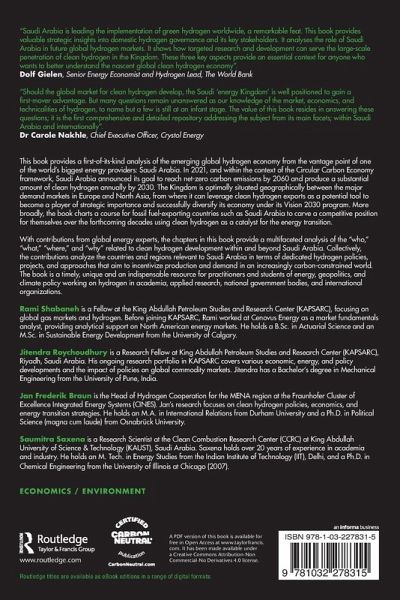
This book provides a first-of-its-kind analysis of the emerging global hydrogen economy from the vantage point of one of the world's biggest energy providers: Saudi Arabia. In 2021, and within the context of the Circular Carbon Economy framework, Saudi Arabia announced its goal to reach net-zero carbon emissions by 2060 and produce a substantial amount of clean hydrogen annually by 2030. The Kingdom is optimally situated geographically between the major demand markets in Europe and North Asia, from where it can leverage clean hydrogen exports as a potential tool to become a player of strategic importance and successfully diversify its economy under its Vision 2030 program. More broadly, the book charts a course for fossil fuel-exporting countries such as Saudi Arabia to carve a competitive position for themselves over the forthcoming decades using clean hydrogen as a catalyst for the energy transition.
With contributions from global energy experts, the chapters in thisbook provide a multifaceted analysis of the "who," "what," "where," and "why" related to clean hydrogen development within and beyond Saudi Arabia. Collectively, the contributions analyze the countries and regions relevant to Saudi Arabia in terms of dedicated hydrogen policies, projects, and approaches that aim to incentivize production and demand in an increasingly carbon-constrained world. The book is a timely, unique and an indispensable resource for practitioners and students of energy, geopolitics, and climate policy working on hydrogen in academia, applied research, national government bodies, and international organizations.
The Open Access version of this book, available at www.taylorfrancis.com, has been made available under a Creative Commons Attribution-Non Commercial-No Derivatives (CC-BY-NC-ND) 4.0 license.
With contributions from global energy experts, the chapters in thisbook provide a multifaceted analysis of the "who," "what," "where," and "why" related to clean hydrogen development within and beyond Saudi Arabia. Collectively, the contributions analyze the countries and regions relevant to Saudi Arabia in terms of dedicated hydrogen policies, projects, and approaches that aim to incentivize production and demand in an increasingly carbon-constrained world. The book is a timely, unique and an indispensable resource for practitioners and students of energy, geopolitics, and climate policy working on hydrogen in academia, applied research, national government bodies, and international organizations.
The Open Access version of this book, available at www.taylorfrancis.com, has been made available under a Creative Commons Attribution-Non Commercial-No Derivatives (CC-BY-NC-ND) 4.0 license.
"Saudi Arabia is leading the implementation of green hydrogen worldwide, a remarkable feat. This book provides valuable strategic insights into domestic hydrogen governance and its key stakeholders. It analyses the role of Saudi Arabia in future global hydrogen markets. It also shows how targeted research and development can serve the large-scale penetration of clean hydrogen in the Kingdom. These three key aspects provide an essential context for anyone who wants to better understand the nascent global clean hydrogen economy".
-Dolf Gielen, Senior Energy Economist and Hydrogen Lead, The World Bank-
"Should the global market for clean hydrogen develop, the Saudi 'energy Kingdom' is well positioned to gain a first-mover advantage. But many questions remain unanswered as our knowledge of the market, economics, and technicalities of hydrogen, to name but a few is still at an infant stage. The value of this book resides in answering these questions; it is the first comprehensive and detailed repository addressing the subject from its main facets; within Saudi Arabia and internationally".
-Dr Carole Nakhle, Chief Executive Officer, Crystol Energy-
-Dolf Gielen, Senior Energy Economist and Hydrogen Lead, The World Bank-
"Should the global market for clean hydrogen develop, the Saudi 'energy Kingdom' is well positioned to gain a first-mover advantage. But many questions remain unanswered as our knowledge of the market, economics, and technicalities of hydrogen, to name but a few is still at an infant stage. The value of this book resides in answering these questions; it is the first comprehensive and detailed repository addressing the subject from its main facets; within Saudi Arabia and internationally".
-Dr Carole Nakhle, Chief Executive Officer, Crystol Energy-