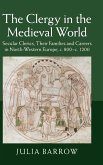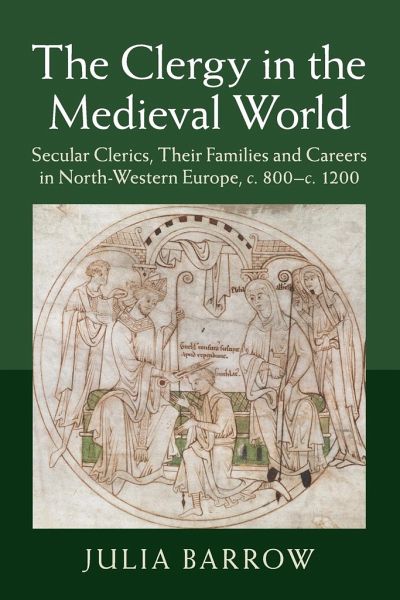
Unlike monks and nuns, clergy have hitherto been sidelined in accounts of the Middle Ages, but they played an important role in medieval society. This first broad-ranging study in English of the secular clergy examines how ordination provided a framework for clerical life cycles and outlines the influence exerted on secular clergy by monastic ideals before tracing typical career paths for clerics. Concentrating on northern France, England and Germany in the period c.800-c.1200, Julia Barrow explores how entry into the clergy usually occurred in childhood, with parents making decisions for…mehr
Unlike monks and nuns, clergy have hitherto been sidelined in accounts of the Middle Ages, but they played an important role in medieval society. This first broad-ranging study in English of the secular clergy examines how ordination provided a framework for clerical life cycles and outlines the influence exerted on secular clergy by monastic ideals before tracing typical career paths for clerics. Concentrating on northern France, England and Germany in the period c.800-c.1200, Julia Barrow explores how entry into the clergy usually occurred in childhood, with parents making decisions for their sons, although other relatives, chiefly clerical uncles, were also influential. By comparing two main types of family structure, Barrow supplies an explanation of why Gregorian reformers faced little serious opposition in demanding an end to clerical marriage in the eleventh and twelfth centuries. Changes in educational provision c.1100 also help to explain growing social and geographical mobility among clerics.
Julia Barrow has been Professor of Medieval Studies and Director of the Institute for Medieval Studies at the University of Leeds since November 2012. Before this, she taught for many years at the University of Nottingham. She is a specialist in the institutional history of the church in western Europe in the earlier and high middle ages. Her research interests concentrate on bishops and episcopal administration, charters and the medieval clergy, but also range across forgeries and their relationship to the writing of history, change and continuity in ecclesiastical institutions across the tenth and eleventh centuries and the role of the church in the urban landscape; she is currently developing an interest in the concept of reform across the period 900-1150. Her publications include English Episcopal Acta, vii: Hereford 1079-1234; St Davids Episcopal Acta 1085-1280; English Episcopal Acta, 35: Hereford 1234-1275; St Wulfstan and his World (co-edited with Nicholas Brooks) and Myth, Rulership, Church and Charters (co-edited with Andrew Wareham), as well as many articles and book chapters on the medieval clergy and other aspects of her research.
Inhaltsangabe
1. Introduction 2. The clerical office, grades of ordination and clerical careers 3. Rules for life: monastic influence on the secular clergy 4. Clergy as family men: uncles and nephews, fathers and sons among the clergy 5. The fostering of child clerics: commendation and nutritio 6. The education of the cleric, I: schools 7. The education of the cleric, II: schoolmasters, curricula and the role of education in clerical careers 8. Household service and patronage 9. Clergy of cathedral and collegiate churches 10. Clergy serving local churches, 800-1200: the emergence of parish clergy Conclusion.
Es gelten unsere Allgemeinen Geschäftsbedingungen: www.buecher.de/agb
Impressum
www.buecher.de ist ein Internetauftritt der buecher.de internetstores GmbH
Geschäftsführung: Monica Sawhney | Roland Kölbl | Günter Hilger
Sitz der Gesellschaft: Batheyer Straße 115 - 117, 58099 Hagen
Postanschrift: Bürgermeister-Wegele-Str. 12, 86167 Augsburg
Amtsgericht Hagen HRB 13257
Steuernummer: 321/5800/1497
USt-IdNr: DE450055826