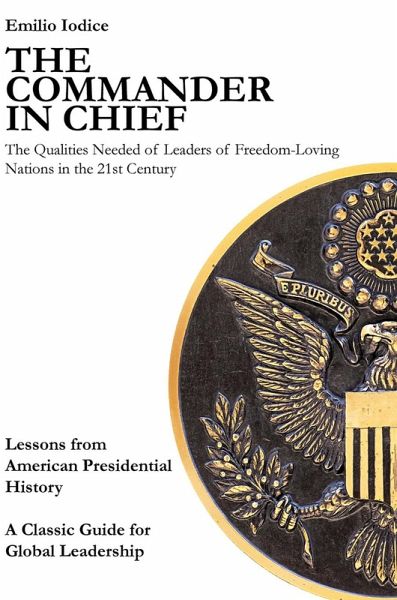
What qualities should the President of the United States have? What leadership traits should the head of a democracy possess to succeed in times of war, peace, and national emergencies? In The Commander in Chief, Emilio Iodice describes, through the lens of American Presidential history, what it takes to be a successful world leader in the 21 st century. He examines the character, actions, strengths, and weaknesses of US Presidents and identifies values essential for effective leadership, and the maintenance of a strong democracy. Along with well-known traits like sound decision making,…mehr
What qualities should the President of the United States have? What leadership traits should the head of a democracy possess to succeed in times of war, peace, and national emergencies? In The Commander in Chief, Emilio Iodice describes, through the lens of American Presidential history, what it takes to be a successful world leader in the 21 st century. He examines the character, actions, strengths, and weaknesses of US Presidents and identifies values essential for effective leadership, and the maintenance of a strong democracy. Along with well-known traits like sound decision making, courage, the ability to communicate and character, special emphasis is on humanistic values like empathy, humility, and respect for diversity. These traits are put to the test by a critical, bi-partisan examination of scenarios where Presidents used these attributes to lead, like Lincoln's determination to emancipate the slaves, or Truman's controversial decision to use the atomic bomb. The result is a holistic examination of presidential character. It helps us in the critical task of choosing the next President, Prime Minister, Governor or Mayor or leader of any institution in a nation that loves freedom and human rights.
AWARD WINNING AUTHOR, PRESIDENTIAL HISTORIAN, EXECUTIVE, DECORATED AMERICAN DIPLOMAT AND PROFESSOR Professor Iodice spent over three decades as a senior executive in the public and private sectors, as an educator and as a university administrator. Those thirty years of experience include being a key official in Washington working for several Administrations, reaching the top ranks of the civil service and the diplomatic corps. He remains among the most decorated officers in American history with a gold medal for heroism, a gold medal and silver medal for exemplary service, nominations for the Bronze Medal and numerous commendations and citations. He served as Minister in key US missions abroad including Brasilia, Mexico City, Rome, Madrid, and Paris and departed after being named to the list of future Ambassadors. Among his honors are being knighted by the former king of Italy. He received Medals of Honor from Spain and Italy. At age 33, he was named by the President of the United States to the prestigious Senior Executive Service as a Charter Member. He was the youngest career public official to reach this distinction. After the Foreign Service he was named Vice President of Lucent Technologies in charge of operations in numerous countries and later taught full time a Trinity College in Washington, DC. In 2007, he was named Director and Professor of Leadership of the John Felice Rome Center (JFRC) of Loyola University Chicago. He served as Director until 2016. During that time, the JFRC acquired its permanent home in Rome and was modernized to be an American university with state-of-the-art technology and a world class roster of professors. Alumni from the Rome Center contributed to its operation and to the creation of a new building, inaugurated in 2019. In 2012 his bestselling book on tenor Mario Lanza was published entitled, A Kid from Philadelphia, Mario Lanza: The Voice of the Poets. In 2013 his second book, Profiles in Leadership from Caesar to Modern Times was published." In 2014 he published Sisters, the story of two extraordinary people, his mother and aunt as well as Future Shock 2.0, The Dragon Brief 2020 a work of fiction based on fact looking at the future of the world. In 2014, he published Reflections, Stories of Love, Leadership, Courage and Passion. Two award winning books were launched recently, When Courage Was the Essence of Leadership: Lessons from History and Across Time and Space: Chronicles of Courage, Hope, Love, Persistence and Leadership. Professor Iodice sits on the Boards of Marymount International School and Istituto Marymount, in Rome Italy. He is a member of the Editorial Board of the Journal of Values Based Leadership and is a regular contributor of articles and editorials. In Italian, he writes regularly for Ponza Racconta which is a web site for the island of Ponza in Italy, the hometown of Professor Iodice's parents and grandparents.jos de Dios "
Inhaltsangabe
Preface 1 Introduction 5 The Achilles Heel of Leadership: The Human Dimension 9 Part One: The American Presidency 13 Chapter One: Presidential Power 13 The Global Leader 13 The Roles of the President of the United States 14 We Elect a Government when we Elect a President 17 Select and not Settle for our Leaders 18 Chapter Two: What to Look For? 21 Past and Present words and actions matter 22 Personal Presence 31 The Blackmail Factor 32 Chapter Three: A Great Country Needs Great Leaders 33 Technology and Creativity 35 Diversity, Tolerance, Individualism 35 Economy and Entrepreneurship 35 Our System of Law 36 Education 36 Music and Entertainment 36 A Nation of Beauty 36 Cities 36 Sense of Morality and Social Consciousness 36 Remember the Greatest Generation 36 Resilience 36 Part Two: Leadership Qualities of The Commander in Chief 39 Chapter One: Reformer 39 Theodore Roosevelt: Civil Service, Campaign and Economic Reform 41 Abraham Lincoln and the Emancipation Proclamation 47 Chapter Two: Experience 53 The Presidency is not a Position for Trainees 54 The Governors 54 James Buchanan: Considered one of our Worst Leaders 56 The Value of Business Experience 57 Abraham Lincoln 57 Warren G. Harding 58 Herbert Hoover 58 Franklin Delano Roosevelt 59 Harry Truman 61 George W. Bush 62 George H.W. Bush 62 Jimmy Carter 63 Wendell Willkie: First Major Business Leader to Run for President 63 The Concept of "Unfiltered Leaders" 68 Chapter Three: Communicator 71 Abraham Lincoln: The Gettysburg Address and the Second Inaugural Address 73 Ronald Reagan: The Great Communicator 76 John F. Kennedy: The Berlin Wall 79 Franklin Delano Roosevelt: The Fireside Chats 82 Social Media and the Presidency 83 Chapter Four: The Brain Trust and the Understanding of Collaboration 87 The President's Cabinet 89 FDR's Brain Trust 91 George Washington and the first "Team of Rivals" 97 President Lincoln's Cabinet 99 George H. W. Bush's International Coalition in the Gulf War 102 The Ability to Work with the Congress 104 Woodrow Wilson's "New Freedom" 105 FDR and the Congress 108 Lyndon Baines Johnson: Man of the Congress 109 Chapter Five: Character, integrity, ethical behavior, and trustworthiness 113 Theodore Roosevelt: Attempted Assassination 115 The Altruism of William McKinley 121 Presidential Temperaments 123 Guardian 123 Idealists 124 Artisans 124 Rational 124 Calvin Coolidge: Example of A Guardian President 127 The Fall of Edmond Muskie 129 The Resignation of Spiro Agnew 130 Gerald Ford: Vice President 132 Richard Nixon: Watergate 133 The Impeachment of Bill Clinton 135 Chapter Six: Visionary 141 John F. Kennedy: A Man on the Moon 143 Ronald Reagan's Vision for America 145 Theodore Roosevelt and the Square Deal 148 Chapter Seven: Emotional Intelligence 153 The Components of Emotional Intelligence 154 Self-Awareness 154 Self-Regulation 154 Internal Motivation 155 Empathy 155 Social Skills 155 Lincoln's Strength, Empathy, Compassion and Moral Compass 157 Thomas Jefferson: A Model of Presidential Leadership 160 The Self Confidence of George Washington 162 The Resilience of FDR 163 The Optimism of Ronald Reagan 163 IKE's Ability to Persuade without Dominating 164 Theodore Roosevelt: Powerful Emotional Intelligence 165 Truman: Unafraid to Decide 166 Jimmy Carter and Camp David 167 Franklin Roosevelt's Fatal Secret 168 Chapter Eight: Courage and Wisdom 173 Gerald Ford and the Nixon Pardon 175 Franklin Roosevelt and Polio 177 FDR and the Holocaust 183 Lincoln and Slavery 186 Chapter Nine: Decision Maker 191 The Presidency: The Buck Stops Here 193 John Adams: Keeping us out of War with France 198 Abraham Lincoln and the Attack on Fort Sumter 199 Woodrow Wilson: The Decision to Go to War 202 The Manhattan Project 204 Franklin Delano Roosevelt and the Attack on Pearl Harbor 207 The Internment of Japanese Americans 210 Harry Truman: Judgement at Nuremberg 212 The Decision to Drop the Atomic Bomb 220 Thoughts Over the Use of the Atomic Bomb to End the War with Japan 223 The Firing of General Douglas MacArthur 227 Chapter Ten: Humility 233 The Humility of Abraham Lincoln 235 Chapter Eleven: Passionate and Energetic 243 Presidential Styles 245 Active/Negative 245 Active/Positive 245 Passive/Positive: 246 Passive/Negative: 246 Theodore Roosevelt: The First Modern President 247 Chapter Twelve: Flexible and Comfortable with Change 253 Eisenhower and the National Security Council 255 Chapter Thirteen: Loves Learning 265 Abraham Lincoln: Technology and Shakespeare 267 FDR: Avid Reader and Collector 269 Chapter Fourteen: Respects Diversity 273 Lincoln and the Jews 274 Chapter Fiveteen: Trust 277 The Vietnam War 278 The Watergate Scandal 281 FDR: Gaining the Public Trust 284 Conclusion 289 Bibliography 291 About the Author 297 Index 301
Preface 1 Introduction 5 The Achilles Heel of Leadership: The Human Dimension 9 Part One: The American Presidency 13 Chapter One: Presidential Power 13 The Global Leader 13 The Roles of the President of the United States 14 We Elect a Government when we Elect a President 17 Select and not Settle for our Leaders 18 Chapter Two: What to Look For? 21 Past and Present words and actions matter 22 Personal Presence 31 The Blackmail Factor 32 Chapter Three: A Great Country Needs Great Leaders 33 Technology and Creativity 35 Diversity, Tolerance, Individualism 35 Economy and Entrepreneurship 35 Our System of Law 36 Education 36 Music and Entertainment 36 A Nation of Beauty 36 Cities 36 Sense of Morality and Social Consciousness 36 Remember the Greatest Generation 36 Resilience 36 Part Two: Leadership Qualities of The Commander in Chief 39 Chapter One: Reformer 39 Theodore Roosevelt: Civil Service, Campaign and Economic Reform 41 Abraham Lincoln and the Emancipation Proclamation 47 Chapter Two: Experience 53 The Presidency is not a Position for Trainees 54 The Governors 54 James Buchanan: Considered one of our Worst Leaders 56 The Value of Business Experience 57 Abraham Lincoln 57 Warren G. Harding 58 Herbert Hoover 58 Franklin Delano Roosevelt 59 Harry Truman 61 George W. Bush 62 George H.W. Bush 62 Jimmy Carter 63 Wendell Willkie: First Major Business Leader to Run for President 63 The Concept of "Unfiltered Leaders" 68 Chapter Three: Communicator 71 Abraham Lincoln: The Gettysburg Address and the Second Inaugural Address 73 Ronald Reagan: The Great Communicator 76 John F. Kennedy: The Berlin Wall 79 Franklin Delano Roosevelt: The Fireside Chats 82 Social Media and the Presidency 83 Chapter Four: The Brain Trust and the Understanding of Collaboration 87 The President's Cabinet 89 FDR's Brain Trust 91 George Washington and the first "Team of Rivals" 97 President Lincoln's Cabinet 99 George H. W. Bush's International Coalition in the Gulf War 102 The Ability to Work with the Congress 104 Woodrow Wilson's "New Freedom" 105 FDR and the Congress 108 Lyndon Baines Johnson: Man of the Congress 109 Chapter Five: Character, integrity, ethical behavior, and trustworthiness 113 Theodore Roosevelt: Attempted Assassination 115 The Altruism of William McKinley 121 Presidential Temperaments 123 Guardian 123 Idealists 124 Artisans 124 Rational 124 Calvin Coolidge: Example of A Guardian President 127 The Fall of Edmond Muskie 129 The Resignation of Spiro Agnew 130 Gerald Ford: Vice President 132 Richard Nixon: Watergate 133 The Impeachment of Bill Clinton 135 Chapter Six: Visionary 141 John F. Kennedy: A Man on the Moon 143 Ronald Reagan's Vision for America 145 Theodore Roosevelt and the Square Deal 148 Chapter Seven: Emotional Intelligence 153 The Components of Emotional Intelligence 154 Self-Awareness 154 Self-Regulation 154 Internal Motivation 155 Empathy 155 Social Skills 155 Lincoln's Strength, Empathy, Compassion and Moral Compass 157 Thomas Jefferson: A Model of Presidential Leadership 160 The Self Confidence of George Washington 162 The Resilience of FDR 163 The Optimism of Ronald Reagan 163 IKE's Ability to Persuade without Dominating 164 Theodore Roosevelt: Powerful Emotional Intelligence 165 Truman: Unafraid to Decide 166 Jimmy Carter and Camp David 167 Franklin Roosevelt's Fatal Secret 168 Chapter Eight: Courage and Wisdom 173 Gerald Ford and the Nixon Pardon 175 Franklin Roosevelt and Polio 177 FDR and the Holocaust 183 Lincoln and Slavery 186 Chapter Nine: Decision Maker 191 The Presidency: The Buck Stops Here 193 John Adams: Keeping us out of War with France 198 Abraham Lincoln and the Attack on Fort Sumter 199 Woodrow Wilson: The Decision to Go to War 202 The Manhattan Project 204 Franklin Delano Roosevelt and the Attack on Pearl Harbor 207 The Internment of Japanese Americans 210 Harry Truman: Judgement at Nuremberg 212 The Decision to Drop the Atomic Bomb 220 Thoughts Over the Use of the Atomic Bomb to End the War with Japan 223 The Firing of General Douglas MacArthur 227 Chapter Ten: Humility 233 The Humility of Abraham Lincoln 235 Chapter Eleven: Passionate and Energetic 243 Presidential Styles 245 Active/Negative 245 Active/Positive 245 Passive/Positive: 246 Passive/Negative: 246 Theodore Roosevelt: The First Modern President 247 Chapter Twelve: Flexible and Comfortable with Change 253 Eisenhower and the National Security Council 255 Chapter Thirteen: Loves Learning 265 Abraham Lincoln: Technology and Shakespeare 267 FDR: Avid Reader and Collector 269 Chapter Fourteen: Respects Diversity 273 Lincoln and the Jews 274 Chapter Fiveteen: Trust 277 The Vietnam War 278 The Watergate Scandal 281 FDR: Gaining the Public Trust 284 Conclusion 289 Bibliography 291 About the Author 297 Index 301
Es gelten unsere Allgemeinen Geschäftsbedingungen: www.buecher.de/agb
Impressum
www.buecher.de ist ein Internetauftritt der buecher.de internetstores GmbH
Geschäftsführung: Monica Sawhney | Roland Kölbl | Günter Hilger
Sitz der Gesellschaft: Batheyer Straße 115 - 117, 58099 Hagen
Postanschrift: Bürgermeister-Wegele-Str. 12, 86167 Augsburg
Amtsgericht Hagen HRB 13257
Steuernummer: 321/5800/1497
USt-IdNr: DE450055826