
Andere Kunden interessierten sich auch für
 The Commissariot Record Of Argyle Register Of Testaments 1674-180024,99 €
 The Commissariot Record of Edinburgh. Register of Testaments ..; 1637,99 €
") Catalogue Of Scientific Papers, 1800-1900 Compiled By The Royal Society Of London (Volume Iv)72,99 €
Catalogue Of Scientific Papers, 1800-1900 Compiled By The Royal Society Of London (Volume Iv)72,99 € The Old and New Testaments connected26,99 €
") The Register Of The Parish Of Thornhill (Part III)26,99 €
The Register Of The Parish Of Thornhill (Part III)26,99 € The Memoirs Of Gen. Joseph Gardner Swift, Ll.D., U.S.A., First Graduate Of The United States Military Academy, West Point, Chief Engineer U.S.A. From 1812-To 1818, 1800-186544,99 €
 The Bible and Islam: Or, The Influence of the Old and New Testaments on the Religion of Mohammed36,99 €
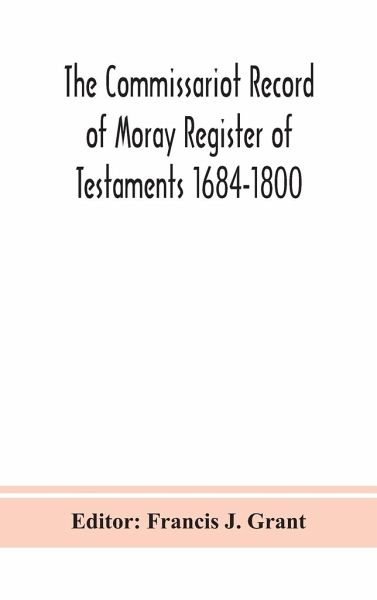
Step through the silent corridors of Scottish history: every page of The Commissariot Record Of Moray Register Of Testaments 1684-1800 opens a window into the lives, legacies, and last wishes of Moray's people across two centuries. For family history enthusiasts and genealogists, this is an indispensable resource-a meticulously compiled register of 17th-century wills and 18th-century testaments, drawn from the authentic Scottish legal documents that shaped inheritance and kinship in 1684-1800 Scotland. Each entry is a thread in the fabric of Moray's past, illuminating the bonds of family, property, and tradition. Francis J. Grant, a renowned authority on Scottish archives, presents these historical testament records with clarity and scholarly care. Beyond its value as a genealogical reference book, this collection stands as a touchstone for Moray historical research and Scottish heritage studies. Whether you are tracing ancestors, exploring the evolution of local customs, or seeking a deeper understanding of Scottish legal and social history, this volume offers both detail and insight. Republished by Alpha Editions in a careful modern edition, this volume preserves the spirit of the original while making it effortless to enjoy today - a heritage title prepared for readers and collectors alike. More than a reference, it is a cultural artefact: a bridge between the present and the Scotland of centuries past, and an essential addition to the Francis J Grant collection.