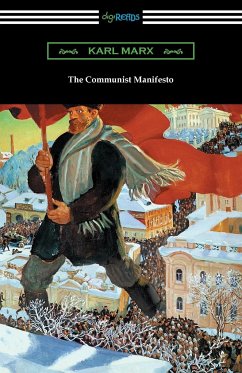
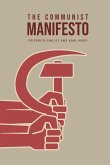
First published in 1848, "The Communist Manifesto" is a political pamphlet by German philosophers Karl Marx and Friedrich Engels, which initiated in one of the greatest movements of political change that the world has ever seen. At the heart of the economic writings of Marx and Engels is the materialist conception of history, or that productive capacity is the primary organizing factor of society. This conception gives rise to the fundamental inequality that exists between the socioeconomic classes. By controlling the means of production, the wealthy, or "bourgeoisie", gain a power over the…mehr
First published in 1848, "The Communist Manifesto" is a political pamphlet by German philosophers Karl Marx and Friedrich Engels, which initiated in one of the greatest movements of political change that the world has ever seen. At the heart of the economic writings of Marx and Engels is the materialist conception of history, or that productive capacity is the primary organizing factor of society. This conception gives rise to the fundamental inequality that exists between the socioeconomic classes. By controlling the means of production, the wealthy, or "bourgeoisie", gain a power over the working class, or "proletariat". The writings of Marx and Engels would brilliantly expose the causes of the vast division between socioeconomic classes that had existed throughout history. From its initial publication "The Communist Manifesto" was intended to help unite the working class in a common goal of forming a political party based on the philosophies of communism. To that aim, it was very successful and helped to unleash a wave of sweeping political change across the globe. This edition is printed on premium acid-free paper.
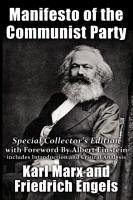
Karl Marx (1818-1883) Karl Marx was a German philosopher, revolutionary, historian, sociologist, economist, and political theorist. Perhaps the most zealous intellectual advocate of communism, Marx was a proponent of ideas that were considered too radical for the time he lived in. Due to his political works, he was exiled from Germany and rendered stateless. Thereafter, he moved to London with his family, and continued to collaborate with Engels on path-breaking works, such as The Communist Manifesto and Das Kapital. Marx advocated for the socialist mode of production, as opposed to the capitalist mode, where the means of production is controlled by the ruling class. He believed that the working class could topple the capitalist system through a proletariat revolution that would establish a classless, communist society. While Marx's ideologies have been both appreciated and criticized, there is no doubt that his works and ideas have heavily influenced subsequent economic and political thought and history. Friedrich Engels (1820-1895) Friedrich Engels was a German philosopher, revolutionary, socialist, historian, political theorist, activist, as well as economist. Along with Karl Marx, he developed the principles of what is now known as Marxism. He was a staunch critic of the capitalist society, and instead saw a space for a just and equal society in socialism. His works are a critical commentary on social structures, such as religion, and systems of governance, which thrive as a result of the oppression of marginalized sections in society. In The Condition of Working Class in England, Engels studies the condition of the working class that worsened due to the Industrial Revolution (1760-1840). The work deeply influenced British historians of the time. Although he co-authored several texts with Marx, he edited and compiled Marx's unfinished works as well, while also continuing to publish his own.
Es gelten unsere Allgemeinen Geschäftsbedingungen: www.buecher.de/agb
Impressum
www.buecher.de ist ein Internetauftritt der buecher.de internetstores GmbH
Geschäftsführung: Monica Sawhney | Roland Kölbl | Günter Hilger
Sitz der Gesellschaft: Batheyer Straße 115 - 117, 58099 Hagen
Postanschrift: Bürgermeister-Wegele-Str. 12, 86167 Augsburg
Amtsgericht Hagen HRB 13257
Steuernummer: 321/5800/1497
USt-IdNr: DE450055826