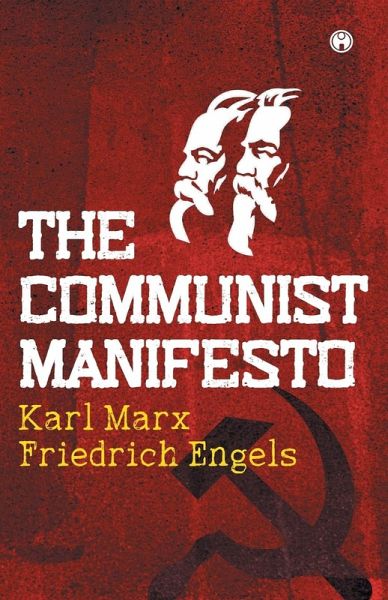
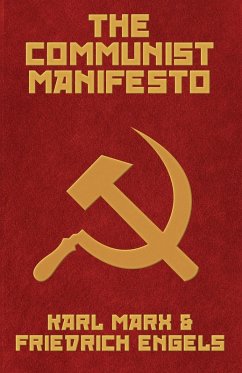
The Communist Manifesto, first published in 1848, is one of the most influential political documents in history, laying the foundation for modern socialism and communism. Written by Karl Marx and Friedrich Engels at the request of the Communist League, the manifesto serves as both a call to action and a theoretical framework for revolutionary movements aiming to dismantle capitalist societies. The text begins with the iconic declaration, "A spectre is haunting Europe - the spectre of Communism." In the chapters that follow, Marx and Engels provide a historical analysis of class struggles,…mehr
The Communist Manifesto, first published in 1848, is one of the most influential political documents in history, laying the foundation for modern socialism and communism. Written by Karl Marx and Friedrich Engels at the request of the Communist League, the manifesto serves as both a call to action and a theoretical framework for revolutionary movements aiming to dismantle capitalist societies. The text begins with the iconic declaration, "A spectre is haunting Europe - the spectre of Communism." In the chapters that follow, Marx and Engels provide a historical analysis of class struggles, tracing the evolution of social hierarchies from feudalism to capitalism. They argue that history is defined by the conflict between the oppressor and the oppressed - most notably, the bourgeoisie (capitalist class) and the proletariat (working class). Through sharp critique and persuasive rhetoric, the authors denounce capitalism for its exploitation of labor and accumulation of wealth in the hands of a few. They forecast the inevitable downfall of capitalist systems due to their internal contradictions and predict a global uprising of the working class. The manifesto concludes with a bold rallying cry: "Workers of the world, unite!" Although written in the 19th century, The Communist Manifesto continues to resonate in political, academic, and activist circles. Its core themes - economic inequality, class consciousness, and revolutionary change - remain central to discussions about social justice and systemic reform. More than a historical document, the manifesto is a revolutionary blueprint and a powerful expression of collective resistance against oppression and exploitation.
Karl Heinrich Marx (5 May 1818 - 14 March 1883) was a German philosopher, economist, historian, sociologist, political theorist, journalist and socialist revolutionary. Marx completed his doctoral thesis, titled The Difference Between the Democritean and Epicurean Philosophy of Nature, in 1841 and submitted it to the University of Jena. He was awarded a Ph.D. in April 1841. In 1844, Marx befriended Friedrich Engels, the German socialist and became a revolutionary communist. Marx's The Poverty of Philosophy was published in 1847. Marx and Engels published ""The Communist Manifesto"", a political pamphlet summarizing their theories about the nature of society and politics, in 1848. One of the most important political documents of the world, this monumental text is highly influential and continues to remain widely read. The first volume, Capital, Volume I, of his magnum opus Capital (Das Kapital) was published in 1867. Marx continued to work on the remaining two volumes which were published after his death by Engels. Capital, Volume II was published in 1885 and Capital, Volume III in 1894. Considered to be his masterwork, Capital has been translated into all the major languages.
Es gelten unsere Allgemeinen Geschäftsbedingungen: www.buecher.de/agb
Impressum
www.buecher.de ist ein Internetauftritt der buecher.de internetstores GmbH
Geschäftsführung: Monica Sawhney | Roland Kölbl | Günter Hilger
Sitz der Gesellschaft: Batheyer Straße 115 - 117, 58099 Hagen
Postanschrift: Bürgermeister-Wegele-Str. 12, 86167 Augsburg
Amtsgericht Hagen HRB 13257
Steuernummer: 321/5800/1497
USt-IdNr: DE450055826