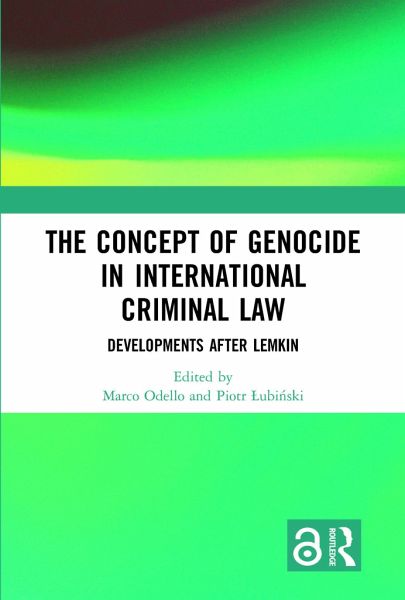
As a valuable contribution to the debate on the significance, meaning and application of the crime of genocide the book will be essential reading for students and academics working in the areas of Legal History, International Criminal Law, Human Rights and Genocide Studies.
As a valuable contribution to the debate on the significance, meaning and application of the crime of genocide the book will be essential reading for students and academics working in the areas of Legal History, International Criminal Law, Human Rights and Genocide Studies.
Marco Odello, PhD (Madrid), LLM (Nottingham), LLB (Rome), is Reader in Law at Aberystwyth University. Piotr ¿ubi¿ski, PhD, is Senior Lecturer at the Institute of Security and Civic Education, Pedagogical University, Krakow, Poland.
Inhaltsangabe
Introduction; PART I Theoretical and Historical Framework 1. Rafä Lemkin's Concept of Genocide vs. the Genocide Convention; 2. Crime of genocide in Ukraine (1932-1933); 3. Kingpins of Contention: Local-level Dynamics of Mobilization in the Rwandan Genocide; PART II International and National Legal Dimensions; 4. The crime of genocide in its (nearly) infinite domestic variety; 5. Responsibility of members of the government and other public officials pursuant to Article IV of the 1948 UN Convention on the Protection and Punishment of the Crime of Genocide; 6. Transnational Corporations' Liability for Genocide under International Law; PART III Challenges and New Developments; 7. Probing the Boundaries of the Genocide Convention: Children as a Protected Group; 8. Interaction between Genocide and Superior Responsibility - Conviction for a Special Intent Crime without Proving Special Intent!?; 9. "Kill Them All and Let God Sort Them Out" or Why Religiously Motivated Terrorism Should Not Be Confused with the Crime of Genocide 10. Blurring the Distinction between Ethnic Cleansing and Genocide; 11. Genocide and Culture: Revisiting their Relationship 70 years after the Genocide Convention; 12. Social Media Incitement to Genocide - ECHR countries perspective;
Introduction; PART I Theoretical and Historical Framework 1. Rafä Lemkin's Concept of Genocide vs. the Genocide Convention; 2. Crime of genocide in Ukraine (1932-1933); 3. Kingpins of Contention: Local-level Dynamics of Mobilization in the Rwandan Genocide; PART II International and National Legal Dimensions; 4. The crime of genocide in its (nearly) infinite domestic variety; 5. Responsibility of members of the government and other public officials pursuant to Article IV of the 1948 UN Convention on the Protection and Punishment of the Crime of Genocide; 6. Transnational Corporations' Liability for Genocide under International Law; PART III Challenges and New Developments; 7. Probing the Boundaries of the Genocide Convention: Children as a Protected Group; 8. Interaction between Genocide and Superior Responsibility - Conviction for a Special Intent Crime without Proving Special Intent!?; 9. "Kill Them All and Let God Sort Them Out" or Why Religiously Motivated Terrorism Should Not Be Confused with the Crime of Genocide 10. Blurring the Distinction between Ethnic Cleansing and Genocide; 11. Genocide and Culture: Revisiting their Relationship 70 years after the Genocide Convention; 12. Social Media Incitement to Genocide - ECHR countries perspective;
Es gelten unsere Allgemeinen Geschäftsbedingungen: www.buecher.de/agb
Impressum
www.buecher.de ist ein Internetauftritt der buecher.de internetstores GmbH
Geschäftsführung: Monica Sawhney | Roland Kölbl | Günter Hilger
Sitz der Gesellschaft: Batheyer Straße 115 - 117, 58099 Hagen
Postanschrift: Bürgermeister-Wegele-Str. 12, 86167 Augsburg
Amtsgericht Hagen HRB 13257
Steuernummer: 321/5800/1497
USt-IdNr: DE450055826