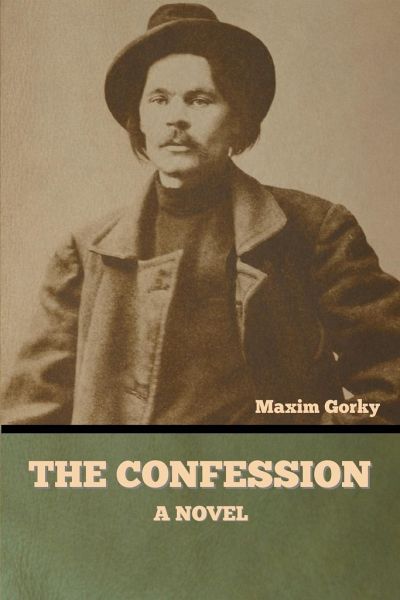
A Confession is a 1908 short novel by Maxim Gorky. It first appeared in the Znaniye compilation (book 23, Saint Petersburg) and almost simultaneously came out as a separate edition via the Ladyzhnikov Publishers in Berlin. The tale of Matvey, a pilgrim, was based upon the real-life story of a religious sectarian in Nizhny Novgorod, and an article on him by Bogdan-Stepanets, a tutor at the local seminary. Later, in a sketch called "On the Edge of the World", Gorky mentioned another source, the manuscript by a Levonty Pomorets, which the writer's friend S.G. Somov brought with him from his…mehr
A Confession is a 1908 short novel by Maxim Gorky. It first appeared in the Znaniye compilation (book 23, Saint Petersburg) and almost simultaneously came out as a separate edition via the Ladyzhnikov Publishers in Berlin. The tale of Matvey, a pilgrim, was based upon the real-life story of a religious sectarian in Nizhny Novgorod, and an article on him by Bogdan-Stepanets, a tutor at the local seminary. Later, in a sketch called "On the Edge of the World", Gorky mentioned another source, the manuscript by a Levonty Pomorets, which the writer's friend S.G. Somov brought with him from his Siberian exile. The novel, written in the times when Gorky became keenly interested in the new quasi-religious God-Building movement, horrified Vladimir Lenin who on several occasions criticized the attempts to unite Socialism and Christianity, mentioning A Confession. Gorky explained: "I am an atheist. In A Confession the idea was to show the means by which man could progress from individualism to the collectivist understanding of the world. The main character sees 'God-building' as an attempt to reconstruct social life according to the spirit of collectivism, the spirit of uniting the people on their way to one common goal: liberating man from slavery, within and without." (wikipedia.org)
Alexei Maximovich Peshkov, better known as Maxim Gorky, was a renowned Russian and Soviet writer and a strong advocate for socialism. Born on March 28, 1868, in Nizhny Novgorod, Russia, he became one of the most prominent figures in Russian literature during the late 19th and early 20th centuries. Gorky's works often reflected his deep concern for the oppressed and his belief in social justice, which made him a leading figure in the socialist movement. His literary contributions include novels, plays, and short stories that critiqued social inequality and the human condition. Gorky was nominated five times for the Nobel Prize in Literature, a testament to his influence and the impact of his writing. His personal life included a marriage to Yekaterina Peshkova, from 1896 to 1903, though he later separated from her. Maxim Gorky spent his later years in Gorki-10, Russia, where he died on June 18, 1936, at the age of 68. His legacy as a writer and a proponent of socialist ideals continues to be a significant part of Russian literary history.
Es gelten unsere Allgemeinen Geschäftsbedingungen: www.buecher.de/agb
Impressum
www.buecher.de ist ein Internetauftritt der buecher.de internetstores GmbH
Geschäftsführung: Monica Sawhney | Roland Kölbl | Günter Hilger
Sitz der Gesellschaft: Batheyer Straße 115 - 117, 58099 Hagen
Postanschrift: Bürgermeister-Wegele-Str. 12, 86167 Augsburg
Amtsgericht Hagen HRB 13257
Steuernummer: 321/5800/1497
USt-IdNr: DE450055826