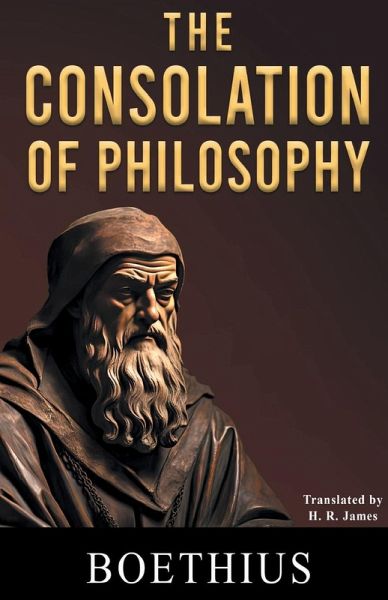
The Consolation of Philosophy, is a philosophical work by the Roman philosopher Boethius, written in the early 6th century while he was imprisoned and awaiting execution by the Ostrogothic King Theodoric. The work takes the form of a dialogue between Boethius and a personified figure of Philosophy, who arrives to comfort him during his imprisonment. The central theme explores the idea of true happiness and how it can be achieved, ultimately critiquing the fleeting nature of fortune and material success. At the start of the text, Boethius presents himself in a state of despair, lamenting the…mehr
The Consolation of Philosophy, is a philosophical work by the Roman philosopher Boethius, written in the early 6th century while he was imprisoned and awaiting execution by the Ostrogothic King Theodoric. The work takes the form of a dialogue between Boethius and a personified figure of Philosophy, who arrives to comfort him during his imprisonment. The central theme explores the idea of true happiness and how it can be achieved, ultimately critiquing the fleeting nature of fortune and material success. At the start of the text, Boethius presents himself in a state of despair, lamenting the misfortunes that have struck him after a period of great prosperity. Philosophy instruction on the nature of fortune and happiness, good and evil, fate and free will, restore his health and bring him to enlightenment. Boethius' The Consolation of Philosophy heavily influenced the philosophy of late antiquity, as well as Medieval and early Renaissance Christianity, It was extremely popular throughout medieval Europe.
Boethius, born in 480 AD, was a member of the influential Anicii family in Rome but lost his parents at a young age. He was adopted by the esteemed senator Symmachus, who provided him with a rich education in both Latin and Greek traditions. Rising quickly in Roman society, Boethius became consul in 510 AD and later gained prominence as an advisor to King Theodoric.A passionate scholar, Boethius aimed to unite classical Greek philosophy with Christian theology. He translated and commented on works by Plato and Aristotle, ensuring their preservation and influence in the West. His writings on subjects such as logic, music, and mathematics laid the foundation for medieval education and profoundly shaped the intellectual traditions of the Middle Ages.Boethius's political career ended in tragedy when he was accused of treason by Theodoric, likely due to his defense of the Senate and his opposition to corruption. Imprisoned in 523 AD, he wrote The Consolation of Philosophy, a reflection on fortune, suffering, and virtue. Executed in 524 AD, Boethius left behind a philosophical legacy that would resonate for centuries, cementing his role as a bridge between classical and medieval thought.
Es gelten unsere Allgemeinen Geschäftsbedingungen: www.buecher.de/agb
Impressum
www.buecher.de ist ein Internetauftritt der buecher.de internetstores GmbH
Geschäftsführung: Monica Sawhney | Roland Kölbl | Günter Hilger
Sitz der Gesellschaft: Batheyer Straße 115 - 117, 58099 Hagen
Postanschrift: Bürgermeister-Wegele-Str. 12, 86167 Augsburg
Amtsgericht Hagen HRB 13257
Steuernummer: 321/5800/1497
USt-IdNr: DE450055826