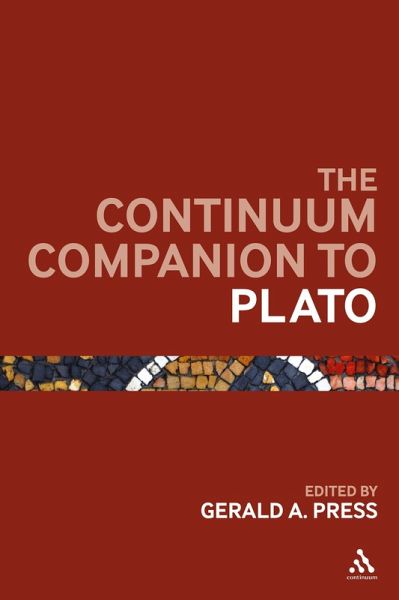
Plato, mathematician, philosopher and founder of the Academy in Athens, is, together with his teacher, Socrates, and his student, Aristotle, universally considered to have laid the foundations of Western philosophy. His philosophical dialogues remain among the most widely read and influential of all philosophical texts and his enduring influence on virtually every area of philosophical enterprise cannot be exaggerated. This comprehensive and accessible guide to Plato's life and times includes more than 140 entries, written by a team of leading experts in the field of ancient philosophy,…mehr
Plato, mathematician, philosopher and founder of the Academy in Athens, is, together with his teacher, Socrates, and his student, Aristotle, universally considered to have laid the foundations of Western philosophy. His philosophical dialogues remain among the most widely read and influential of all philosophical texts and his enduring influence on virtually every area of philosophical enterprise cannot be exaggerated. This comprehensive and accessible guide to Plato's life and times includes more than 140 entries, written by a team of leading experts in the field of ancient philosophy, covering every aspect of Plato's thought. The Companion presents details of Plato's life, historical, philosophical and literary context, synopses of all the dialogues attributed to Plato, a comprehensive overview of the various features, themes and topics apparent in the dialogues, and a thorough account of his enduring influence and the various interpretative approaches applied to his thought throughout the history of philosophy. This is an essential reference tool for anyone working in the field of ancient philosophy.
Gerald A. Press is Professor of Philosophy at Hunter College and the CUNY Graduate Center, USA, and has published widely on Plato.
Inhaltsangabe
List of Contributors Acknowledgements List of Abbreviations Introduction Part I: Plato's Life, Historical, Literary and Philosophic Context Life of Plato Aristophanes and intellectuals Education Eleatics Isocrates and Logography Orality and Literacy Poetry (epic and lyric) Presocratics Pythagoreans Rhetoric and speech-making Socrates (historical) Socratics other than Plato) Sophists Part II: The Dialogues The Platonic Corpus and Manuscript Tradition Alcibiades Apology Charmides Clitophon Cratylus Crito Dubious and spurious dialogues (Alcibiades II, Hipparchus, Minos, Rival Lovers, Axiochus, Definitions, On Justice, On Virtue, Demodocus, Eryxias, Sisyphus) Euthydemus Euthyphro Gorgias Hippias Major Hippias Minor Ion Laches Laws Letters Lysis Menexenus Meno Parmenides Phaedo Phaedrus Philebus Politicus (Statesman) Protagoras Republic Sophist Symposium Theaetetus Theages Timaeus-Critias Part III: Special Features of the Dialogues Anonymity Characters Drama History Humor Irony Language Literary composition Musical structure Myths and stories Pedagogical structure Pedimental structure Play and seriousness Proleptic composition Socrates (the character) Part IV: Concepts, Themes and Topics treated in the Dialogues Aesthetics Akrasia Antilogy and eristic Appearance and reality Art Beauty Being and becoming Causality Cave City Cosmos Daimon Death Desire Dialectic Divided Line Education Elenchus Epistemology Ethics Excellence Forms Friendship Goodness Happiness Image Imitation Inspiration Intellectualism Justice Language Law Logic logos Account Love Madness and possession Mathematics Medicine Method Music Myth Nature Non-propositional knowledge One, the Ontology Paederasteia Participation Perception and sensation Philosophy and the philosopher Piety Pleasure Poetry Reason Recollection Rhetoric Self-knowledge Sophists Soul Sun simile Theology Vision Women Writing Part V: Later Reception, Interpretation and Influence The Ancient World Ancient Hermeneutics Aristotle and Plato Academy of Athens, Ancient History of Ancient Jewish Platonism Neoplatonism and its diaspora The Middle Ages and Renaissance Medieval Islamic Platonism Medieval Jewish Platonism Medieval Christian Platonism Renaissance Platonism Cambridge Platonism Modern and Contemporary Philosophy Early modern philosophy: from Descartes to Berkeley Nineteenth-century idealisms Nineteenth Century Plato scholarship Developmentalism Compositional chronology Analytic approaches Vlastosian approaches Continental approaches Straussian approaches Plato's 'Unwritten doctrines' Esoterism The Tübingen Approach Anti-Platonism, ancient to modern Bibliography Index of Names (other than Plato and Socrates) Index of Topics
List of Contributors Acknowledgements List of Abbreviations Introduction Part I: Plato's Life, Historical, Literary and Philosophic Context Life of Plato Aristophanes and intellectuals Education Eleatics Isocrates and Logography Orality and Literacy Poetry (epic and lyric) Presocratics Pythagoreans Rhetoric and speech-making Socrates (historical) Socratics other than Plato) Sophists Part II: The Dialogues The Platonic Corpus and Manuscript Tradition Alcibiades Apology Charmides Clitophon Cratylus Crito Dubious and spurious dialogues (Alcibiades II, Hipparchus, Minos, Rival Lovers, Axiochus, Definitions, On Justice, On Virtue, Demodocus, Eryxias, Sisyphus) Euthydemus Euthyphro Gorgias Hippias Major Hippias Minor Ion Laches Laws Letters Lysis Menexenus Meno Parmenides Phaedo Phaedrus Philebus Politicus (Statesman) Protagoras Republic Sophist Symposium Theaetetus Theages Timaeus-Critias Part III: Special Features of the Dialogues Anonymity Characters Drama History Humor Irony Language Literary composition Musical structure Myths and stories Pedagogical structure Pedimental structure Play and seriousness Proleptic composition Socrates (the character) Part IV: Concepts, Themes and Topics treated in the Dialogues Aesthetics Akrasia Antilogy and eristic Appearance and reality Art Beauty Being and becoming Causality Cave City Cosmos Daimon Death Desire Dialectic Divided Line Education Elenchus Epistemology Ethics Excellence Forms Friendship Goodness Happiness Image Imitation Inspiration Intellectualism Justice Language Law Logic logos Account Love Madness and possession Mathematics Medicine Method Music Myth Nature Non-propositional knowledge One, the Ontology Paederasteia Participation Perception and sensation Philosophy and the philosopher Piety Pleasure Poetry Reason Recollection Rhetoric Self-knowledge Sophists Soul Sun simile Theology Vision Women Writing Part V: Later Reception, Interpretation and Influence The Ancient World Ancient Hermeneutics Aristotle and Plato Academy of Athens, Ancient History of Ancient Jewish Platonism Neoplatonism and its diaspora The Middle Ages and Renaissance Medieval Islamic Platonism Medieval Jewish Platonism Medieval Christian Platonism Renaissance Platonism Cambridge Platonism Modern and Contemporary Philosophy Early modern philosophy: from Descartes to Berkeley Nineteenth-century idealisms Nineteenth Century Plato scholarship Developmentalism Compositional chronology Analytic approaches Vlastosian approaches Continental approaches Straussian approaches Plato's 'Unwritten doctrines' Esoterism The Tübingen Approach Anti-Platonism, ancient to modern Bibliography Index of Names (other than Plato and Socrates) Index of Topics
Es gelten unsere Allgemeinen Geschäftsbedingungen: www.buecher.de/agb
Impressum
www.buecher.de ist ein Internetauftritt der buecher.de internetstores GmbH
Geschäftsführung: Monica Sawhney | Roland Kölbl | Günter Hilger
Sitz der Gesellschaft: Batheyer Straße 115 - 117, 58099 Hagen
Postanschrift: Bürgermeister-Wegele-Str. 12, 86167 Augsburg
Amtsgericht Hagen HRB 13257
Steuernummer: 321/5800/1497
USt-IdNr: DE450055826