
Andere Kunden interessierten sich auch für
 The Routledge Handbook of White-Collar and Corporate Crime in Europe45,99 €
 Organised Crime, Financial Crime, and Criminal Justice38,99 €
 The Global Architecture of Multilateral Development Banks40,99 €
 Managing the Work Situation38,99 €
") Corporate Crime in the Pharmaceutical Industry (Routledge Revivals)53,99 €
Corporate Crime in the Pharmaceutical Industry (Routledge Revivals)53,99 € Corporate Manslaughter and Regulatory Reform76,99 €
 Transformations of Contemporary Capitalism41,99 €



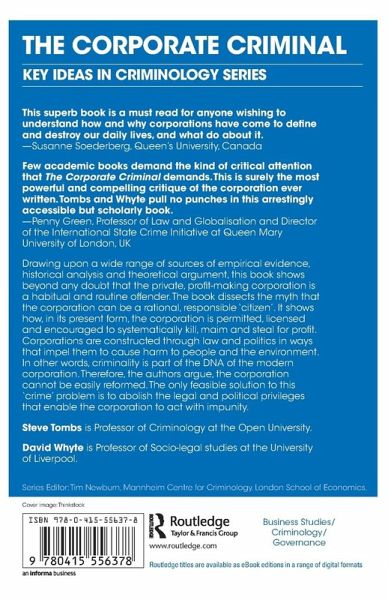
Treating the corporation as if it were a human person is ubiquitous in contemporary political, cultural and legal constructions of the corporation a " from the creation of 'brands' and the representation of the corporation in fiction, to statutory and common law rules of corporate liability. It dominates both academic approaches and popular representations of the corporation, from discussions of corporate citizenship, corporate social responsibility and 'corporate greed'. This book interrogates the concept of corporate 'personhood' to understand the nature of corporate criminality and the prospects for more effective corporate control. Linking debates in criminology to broader claims around corporate social responsibility, it provides an understanding of the key ideas that explain the role of the corporation in the global economy.
Drawing upon a wide range of sources of empirical evidence, historical analysis and theoretical argument, this book shows beyond any doubt that the private, profit-making, corporation is a habitual and routine offender. The book dissects the myth that the corporation can be a rational, responsible, 'citizen'. It shows how in its present form, the corporation is permitted, licensed and encouraged to systematically kill, maim and steal for profit. Corporations are constructed through law and politics in ways that impel them to cause harm to people and the environment. In other words, criminality is part of the DNA of the modern corporation. Therefore, the authors argue, the corporation cannot be easily reformed. The only feasible solution to this 'crime' problem is to abolish the legal and political privileges that enable the corporation to act with impunity.
Drawing upon a wide range of sources of empirical evidence, historical analysis and theoretical argument, this book shows beyond any doubt that the private, profit-making, corporation is a habitual and routine offender. The book dissects the myth that the corporation can be a rational, responsible, 'citizen'. It shows how in its present form, the corporation is permitted, licensed and encouraged to systematically kill, maim and steal for profit. Corporations are constructed through law and politics in ways that impel them to cause harm to people and the environment. In other words, criminality is part of the DNA of the modern corporation. Therefore, the authors argue, the corporation cannot be easily reformed. The only feasible solution to this 'crime' problem is to abolish the legal and political privileges that enable the corporation to act with impunity.