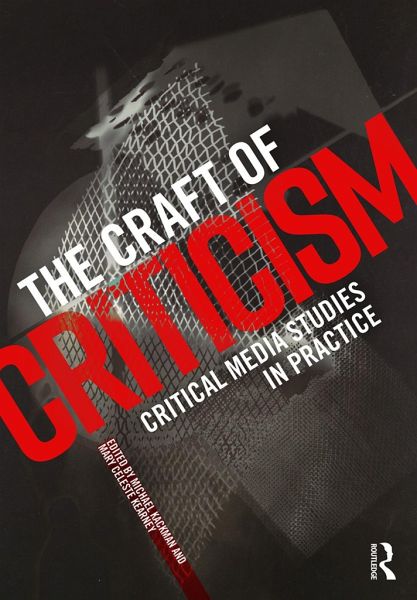
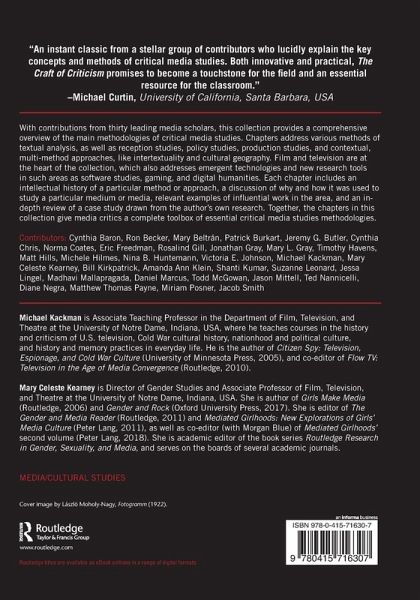
With contributions from 30 leading media scholars, this collection provides a comprehensive overview of the main methodologies of critical media studies. Together, the chapters in this collection give media critics a complete toolbox of essential critical media studies methodologies.
With contributions from 30 leading media scholars, this collection provides a comprehensive overview of the main methodologies of critical media studies. Together, the chapters in this collection give media critics a complete toolbox of essential critical media studies methodologies.
Michael Kackman is Associate Teaching Professor in the Department of Film, Television, and Theatre at the University of Notre Dame, where he teaches courses in the history and criticism of U.S. television, Cold War cultural history, nationhood and political culture, and history and memory practices in everyday life. He is the author of Citizen Spy: Television, Espionage, and Cold War Culture (University of Minnesota Press, 2005), and co-editor of Flow TV: Television in the Age of Media Convergence (Routledge, 2010). Mary Celeste Kearney is Director of Gender Studies and Associate Professor of Film, Television, and Theatre at the University of Notre Dame. She is author of Girls Make Media (Routledge, 2006) and Gender and Rock (Oxford, 2017). She is editor of The Gender and Media Reader (Routledge, 2011) and Mediated Girlhoods: New Explorations of Girls' Media Culture (Peter Lang, 2011), as well as co-editor (with Morgan Blue) of Mediated Girlhoods' second volume (Peter Lang, 2018). She is academic editor of the book series Routledge Research in Gender, Sexuality, and Media, and serves on the boards of several academic journals.
Inhaltsangabe
Foreword - Michele Hilmes Introduction, or How to Cook an Artichoke -Mary Celeste Kearney PART I PRIMARY METHODS 1 Ideology - Ron Becker 2 Discourse - Rosalind Gill 3 Narrative - Jason Mittell 4 Non-Fiction Media - Daniel Marcus 5 Visual Style - Jeremy Butler 6 Sound - Jacob Smith 7 Acting and Performance - Cynthia Baron 8 Representation - Mary Beltrán 9 Authorship and Auteurism - Cynthia Chris 10 Political Economy - Patrick Burkart 11 Media Policy - Bill Kirkpatrick 12 Psychoanalytic Criticism - Todd McGowan 13 Cognitivism - Ted Nannicelli 14 Ethnography - Jessa Lingel & Mary Gray PART II Synthetic/Multiperspectival Approaches 15 Audiences - Matt Hills 16 Genre - Amanda Ann Klein 17 Intertexts and Paratexts - Jonathan Gray 18 Stardom and Celebrity - Suzanne Leonard & Diane Negra 19 Cultural Geography - Victoria E. Johnson 20 National/Transnational/Global - Shanti Kumar 21 History and Historiography - Michael Kackman 22 Production - Timothy Havens PART III Emergent and Challenging Objects 23 Popular Music - Norma Coates 24 New Media - Madhavi Mallapragada 25 Games and Gaming - Matthew Thomas Payne & Nina B. Huntemann 26 Software - Eric Freedman 27 Digital Humanities - Miriam Posner Contributors' Biographies
Foreword - Michele Hilmes Introduction, or How to Cook an Artichoke -Mary Celeste Kearney PART I PRIMARY METHODS 1 Ideology - Ron Becker 2 Discourse - Rosalind Gill 3 Narrative - Jason Mittell 4 Non-Fiction Media - Daniel Marcus 5 Visual Style - Jeremy Butler 6 Sound - Jacob Smith 7 Acting and Performance - Cynthia Baron 8 Representation - Mary Beltrán 9 Authorship and Auteurism - Cynthia Chris 10 Political Economy - Patrick Burkart 11 Media Policy - Bill Kirkpatrick 12 Psychoanalytic Criticism - Todd McGowan 13 Cognitivism - Ted Nannicelli 14 Ethnography - Jessa Lingel & Mary Gray PART II Synthetic/Multiperspectival Approaches 15 Audiences - Matt Hills 16 Genre - Amanda Ann Klein 17 Intertexts and Paratexts - Jonathan Gray 18 Stardom and Celebrity - Suzanne Leonard & Diane Negra 19 Cultural Geography - Victoria E. Johnson 20 National/Transnational/Global - Shanti Kumar 21 History and Historiography - Michael Kackman 22 Production - Timothy Havens PART III Emergent and Challenging Objects 23 Popular Music - Norma Coates 24 New Media - Madhavi Mallapragada 25 Games and Gaming - Matthew Thomas Payne & Nina B. Huntemann 26 Software - Eric Freedman 27 Digital Humanities - Miriam Posner Contributors' Biographies
Es gelten unsere Allgemeinen Geschäftsbedingungen: www.buecher.de/agb
Impressum
www.buecher.de ist ein Internetauftritt der buecher.de internetstores GmbH
Geschäftsführung: Monica Sawhney | Roland Kölbl | Günter Hilger
Sitz der Gesellschaft: Batheyer Straße 115 - 117, 58099 Hagen
Postanschrift: Bürgermeister-Wegele-Str. 12, 86167 Augsburg
Amtsgericht Hagen HRB 13257
Steuernummer: 321/5800/1497
USt-IdNr: DE450055826