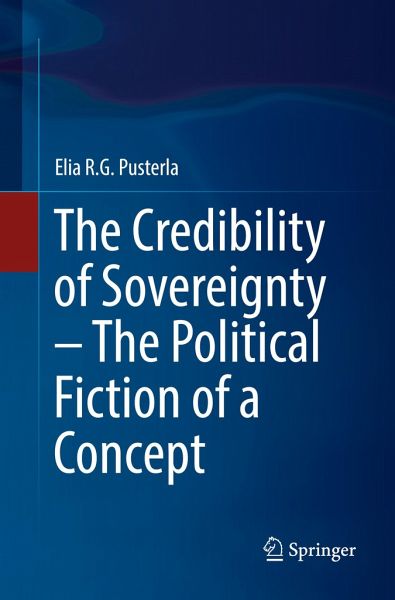
The book deeply analyses the bilateral relations between Switzerland and the European Union and their effect on the former's sovereignty in the context of Europeanisation. This touches on philosophical debates on the complexity of sovereignty. What sovereignty is at stake when talking about Swiss-EU relations? This issue not only faces the elusiveness of sovereignty as a concept, but also the proliferation of hypocrisy on its presence within states. The book encounters the deconstructionist hypothesis stating that there is nothing to worry about but the belief there is something to worry…mehr
The book deeply analyses the bilateral relations between Switzerland and the European Union and their effect on the former's sovereignty in the context of Europeanisation. This touches on philosophical debates on the complexity of sovereignty. What sovereignty is at stake when talking about Swiss-EU relations? This issue not only faces the elusiveness of sovereignty as a concept, but also the proliferation of hypocrisy on its presence within states. The book encounters the deconstructionist hypothesis stating that there is nothing to worry about but the belief there is something to worry about. Derrida's deconstruction of sovereignty allows indeed one to grasp the fictional essence of sovereignty based on the metaphysics of presence. The presence of self-positing sovereign ipseity is fictional since absent in the present, but spectrally present in the belief of its presence to come. Sovereignty is a matter of credibility, or the credible promise of a normative statement to come. Hence, the book challenges the realist/neorealist argument stating that states are credibly sovereign until proven otherwise and explains that the debate on state sovereignty calls for the unveiling of this hypocritical epistemology cunningly disguised as an objective presence. Swiss-EU relations thus become the cornerstone to not only theorise but also test sovereignty and deconstruct the two ontological and epistemological sides of the same coin, or the modern hypocrisy of sovereignty. This deconstruction constitutes the very problématique of any attempt to understand whether and how a state can be sovereign and solve the problem as to how to neutralise the différance and identify the difference between credible and incredible claims of sovereignty. This problématique connects the theory and practice of sovereignty innovatively, providing positivist evidence on the arguable credibility of the Swiss claim of sovereignty and confirming the presence of a theological dimension within politics.
Elia R.G. Pusterla is a postdoctoral researcher at the Free University of Bozen–Bolzano, where he leads a project in political philosophy that investigates the heuristic potential of postmodern thought in addressing the challenges posed by post-truth politics. He has previously held postdoctoral positions at the University of Applied Sciences and Arts of Southern Switzerland (SUPSI), the European Institute and the Centre for International Studies of the London School of Economics and Political Science (LSE), and the European University Institute (EUI). He also served as a Teaching Assistant at the University of Geneva and was a Visiting Researcher at LSE’s Department of International Relations. His research interests lie in political philosophy and political theory, with a particular focus on their application to international relations and European studies. He focuses on the concept of sovereignty and its entanglements with political ontology, engaging with authors from the continental tradition, including Derrida, Agamben, Arendt, Levinas, and Esposito. He is the author of ‘The Credibility of Sovereignty—The Political Fiction of a Concept’ (Springer, 2016) and several peer-reviewed articles. He currently serves as Associate Editor of the journal Political Research Exchange. Francesca Pusterla Piccin is a postdoctoral researcher at the Free University of Bozen–Bolzano, where she has developed two research projects that focus on the European Union’s humanitarian aid and a narrative approach to aid research. Additionally, she serves as a Visiting Senior Fellow at the European Institute of the London School of Economics and Political Science (LSE). Previously, she held positions as a Visiting Researcher at the Università della Svizzera italiana (USI), Research Associate at the School of Oriental and African Studies (SOAS), a Teaching Assistant at the University of Geneva, and a Visiting Researcher at St Antony’s College, University of Oxford. Her research interests primarily encompass humanitarian aid, development, and migration. Currently, she is examining the European Union’s narratives as persuasive stories and accounts that are crafted and deployed to convey its understanding of humanitarian aid and to influence beliefs, attitudes, and decisions related to humanitarian efforts at both national and international levels. She is the author of the monograph ‘The European Union and Humanitarian Crises—Patterns of Intervention’ (Routledge, 2015) and has published several peer-reviewed scientific articles.