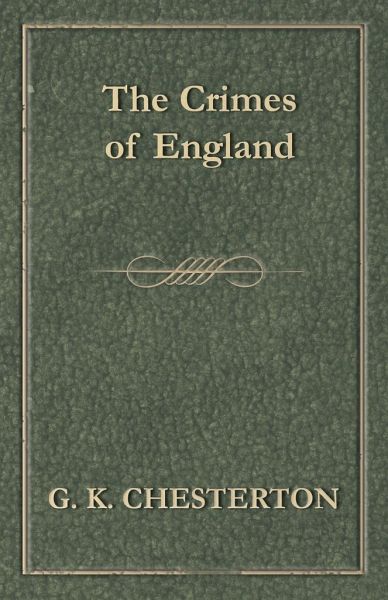
"The Crimes of England" is a 1915 work by G. K. Chesterton that explores the history and causes of the First World War, focusing on what he believes to be the partial culpability of England. Within it, Chesterton maintains that while Germany is clearly the main aggressor, England is also partially responsible for the horrors of the war due to having aided and abetted Prussia for centuries. Highly recommended for those with an interest in European history and the First World War. Contents include: "Some Words to Professor Whirlwind", "The Protestant Hero", "The Enigma of Waterloo", "The Coming…mehr
"The Crimes of England" is a 1915 work by G. K. Chesterton that explores the history and causes of the First World War, focusing on what he believes to be the partial culpability of England. Within it, Chesterton maintains that while Germany is clearly the main aggressor, England is also partially responsible for the horrors of the war due to having aided and abetted Prussia for centuries. Highly recommended for those with an interest in European history and the First World War. Contents include: "Some Words to Professor Whirlwind", "The Protestant Hero", "The Enigma of Waterloo", "The Coming of the Janissaries", "The Lost England", "Hamlet and the Danes", "The Midnight of Europe", "The Wrong Horse", "The Awakening of England", and "The Battle of the Marne". Gilbert Keith Chesterton (1874- 1936) was an English philosopher, theologian, writer, and literary and art critic. Other notable works by this author include: "Heretics, Project Gutenberg" (1905), "The Innocence of Father Brown" (1911), and "The Man Who Was Thursday" (1908). Read & Co. History is republishing this classic work now complete with a specially-commissioned new biography of the author.
Gilbert Keith Chesterton was an English author, philosopher, Christian apologist, and literary critic, born on May 29, 1874, in Kensington, London, to parents Marie and Edward Chesterton. He was educated at St. Paul's Juniors and University College London before studying at the Slade School of Fine Art. Chesterton's career was diverse, spanning across fiction, essays, and philosophical works. He was especially renowned for creating the fictional priest-detective Father Brown. His writings often explored themes of faith, society, and morality, deeply influenced by his Christian beliefs. His key works, such as Orthodoxy and The Everlasting Man, cemented his reputation as an important intellectual figure. Chesterton was close friends with fellow writer Hilaire Belloc and was influenced by philosophers like Thomas Aquinas and Charles Dickens. He married Frances Blogg in 1901, and the couple remained together until his death on June 14, 1936, at the age of 62 in Beaconsfield, United Kingdom. Chesterton's works, particularly the Father Brown stories, continue to inspire readers and remain significant in detective fiction and Christian apologetics.
Es gelten unsere Allgemeinen Geschäftsbedingungen: www.buecher.de/agb
Impressum
www.buecher.de ist ein Internetauftritt der buecher.de internetstores GmbH
Geschäftsführung: Monica Sawhney | Roland Kölbl | Günter Hilger
Sitz der Gesellschaft: Batheyer Straße 115 - 117, 58099 Hagen
Postanschrift: Bürgermeister-Wegele-Str. 12, 86167 Augsburg
Amtsgericht Hagen HRB 13257
Steuernummer: 321/5800/1497
USt-IdNr: DE450055826