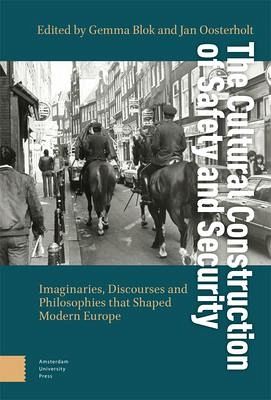
This volume analyses cultural perceptions of safety and security that have shaped modern European societies. The articles present a wide range of topics, from feelings of unsafety generated by early modern fake news to safety issues related to twentieth-century drug use in public space. The volume demonstrates how 'safety' is not just a social or biological condition to pursue but also a historical and cultural construct. In philosophical terms, safety can be interpreted in different ways, referring to security, certainty or trust. What does feeling safe and thinking about a safe society mean…mehr
This volume analyses cultural perceptions of safety and security that have shaped modern European societies. The articles present a wide range of topics, from feelings of unsafety generated by early modern fake news to safety issues related to twentieth-century drug use in public space. The volume demonstrates how 'safety' is not just a social or biological condition to pursue but also a historical and cultural construct. In philosophical terms, safety can be interpreted in different ways, referring to security, certainty or trust. What does feeling safe and thinking about a safe society mean to various groups of people over time? The articles in this volume are bound by their joint effort to take a constructionist approach to emotional expressions, artistic representations, literary narratives and political discourses of (un)safety and their impact on modern European society
Gemma Blok is a professor in the History of Mental Health and Culture at the Open University of the Netherlands. Her areas of expertise are the histories of psychiatry, addiction treatment, and drug use. She was a principal investigator in the HERA-funded project Governing the Narcotic City. Imaginaries, Practices and Discourses of Public Drug Cultures in European Cities from 1970 until Today. Jan Oosterholt is assistant professor at the Dutch Open University. He is specialised in nineteenth-century literature and has published books and articles on literary poetics, imagology and adaptations. His current research focuses on literary transfers and theatrical texts.
Inhaltsangabe
Introduction Gemma Blok and Jan Oosterholt Section 1: Philosophical conceptualisations of safety Chapter 1: Eddo Evink - Security Certainty Trust. Historical and Contemporary Aspects of the Concept of Safety Chapter 2: Ana Alicia Carmona Aliaga - Tolerance a Safety Policy in Pierre Bayle's Thought Chapter 3: Tom Giesbers - The Shackles of Freedom. The Modern Philosophical Notion of Public Safety Section 2: Security cultures in history Chapter 4: Beatrice de Graaf - The Invention of Collective Security after 1815 Chapter 5: Vincent Baptist - Criminal Cosmopolitan Commodified. How Rotterdam's Interwar Amusement Street the Schiedamsedijk Became a Safe Mirror Image of Itself Chapter 6: Gemma Blok Peter-Paul Bänzinger and Lisanne Walma - Tourists Dealers or Addicts. Security Practices in Response to Open Drug Scenes in Amsterdam Rotterdam and Zurich 1960-2000 Section 3: Narratives and imaginaries of safety Chapter 7: Nils Büttner - The 'Golden Age' Revisited. Images and Notions of Safety in Insecure Times Chapter 8: Frederik Van Dam - Safety as Nostalgia. Infrastructural Breakdown in Stefan Zweig's Beware of Pity (1938) Chapter 9: Roos van Strien - Brace for Impact. Spatial Responses to Terror in the Cities Belfast and Oslo Section 4: Narratives and imaginaries of unsafety Chapter 10: Sigrid Ruby - Safe at Home? The Domestic Space in Early Modern Visual Culture Chapter 11: Jan Oosterholt - The Transfer of Nineteenth-Century Representations of Unsafety. A Dutch Adaptation of Eugène Sue's Les Mystères de Paris Chapter 12: Femke Kok - Feeling Lost in a Modernising World. A Critique on Martha Nussbaum's Emotion Theory through an Analysis of Feelings of Unsafety in Magda Szabó's Iza's Ballad.
Introduction Gemma Blok and Jan Oosterholt Section 1: Philosophical conceptualisations of safety Chapter 1: Eddo Evink - Security Certainty Trust. Historical and Contemporary Aspects of the Concept of Safety Chapter 2: Ana Alicia Carmona Aliaga - Tolerance a Safety Policy in Pierre Bayle's Thought Chapter 3: Tom Giesbers - The Shackles of Freedom. The Modern Philosophical Notion of Public Safety Section 2: Security cultures in history Chapter 4: Beatrice de Graaf - The Invention of Collective Security after 1815 Chapter 5: Vincent Baptist - Criminal Cosmopolitan Commodified. How Rotterdam's Interwar Amusement Street the Schiedamsedijk Became a Safe Mirror Image of Itself Chapter 6: Gemma Blok Peter-Paul Bänzinger and Lisanne Walma - Tourists Dealers or Addicts. Security Practices in Response to Open Drug Scenes in Amsterdam Rotterdam and Zurich 1960-2000 Section 3: Narratives and imaginaries of safety Chapter 7: Nils Büttner - The 'Golden Age' Revisited. Images and Notions of Safety in Insecure Times Chapter 8: Frederik Van Dam - Safety as Nostalgia. Infrastructural Breakdown in Stefan Zweig's Beware of Pity (1938) Chapter 9: Roos van Strien - Brace for Impact. Spatial Responses to Terror in the Cities Belfast and Oslo Section 4: Narratives and imaginaries of unsafety Chapter 10: Sigrid Ruby - Safe at Home? The Domestic Space in Early Modern Visual Culture Chapter 11: Jan Oosterholt - The Transfer of Nineteenth-Century Representations of Unsafety. A Dutch Adaptation of Eugène Sue's Les Mystères de Paris Chapter 12: Femke Kok - Feeling Lost in a Modernising World. A Critique on Martha Nussbaum's Emotion Theory through an Analysis of Feelings of Unsafety in Magda Szabó's Iza's Ballad.
Es gelten unsere Allgemeinen Geschäftsbedingungen: www.buecher.de/agb
Impressum
www.buecher.de ist ein Internetauftritt der buecher.de internetstores GmbH
Geschäftsführung: Monica Sawhney | Roland Kölbl | Günter Hilger
Sitz der Gesellschaft: Batheyer Straße 115 - 117, 58099 Hagen
Postanschrift: Bürgermeister-Wegele-Str. 12, 86167 Augsburg
Amtsgericht Hagen HRB 13257
Steuernummer: 321/5800/1497
USt-IdNr: DE450055826