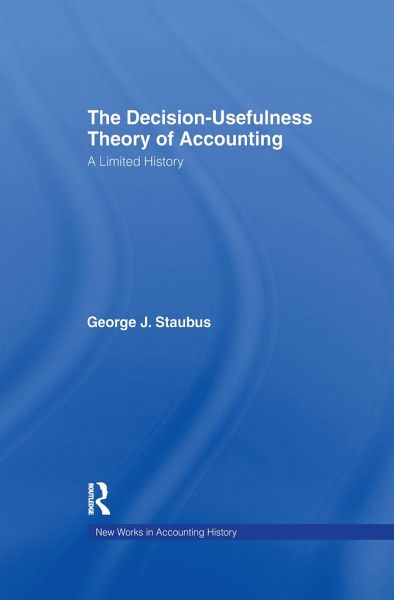
This book ties together selected contributions by George Staubus to the early development of the decision-usefulness theory of financial accounting--the theory that has become generally accepted accounting theory in the last half of the twentieth century and is the basis for the FASB's conceptual framework.
This book ties together selected contributions by George Staubus to the early development of the decision-usefulness theory of financial accounting--the theory that has become generally accepted accounting theory in the last half of the twentieth century and is the basis for the FASB's conceptual framework.
Preface I. In the Beginning: the Nineteen-Fifties Edition A. Commentary on Nineteen-Fifties Developments B. Diagrammatic Outline: Features of the Theory C. Excerpts from An Accounting Concept of Revenue (University of Chicago Dissertation 1954) D. The Residual Equity Point of View in Accounting The Accounting Review (January 1959) E. A Theory of Accounting to Investors Chapters I III IV VI (University of California Press 1961) II. Maturity of the Theory: The Nineteen-Seventies Edition A. Commentary B. Criteria for Making Accounting Choices 1. Introduction 2. The Multiple-Criteria Approach to Making Accounting Decisions Accounting and Business Research (Autumn 1976) 3. Effects via Other Parties section of Chapter III Making Accounting Decisions (Scholars Book Co. 1977) 4. Introduction Economic Consequences (Financial Accounting Standards Board 1978) C. The Evidential Approach to Measurement of Cash Flow Potential 1. Introduction 2. The Relevance of Evidence of Cash Flows from R.R. Sterling ed. Asset Valuation and Income Determination (Scholars Book Company 1971) 3. Summary of Relevance Appraisals Section of Chapter VII Making Accounting Decisions 4. The Magnate/Financio Case from Chapter VIII Making Accounting Decisions D. Historical Cash Flows 1. Introduction 2. Alternative Asset Flow Concepts The Accounting Review (July 1966) 3. Cash Flow Accounting and Liquidity: Cash Flow Potential and Wealth Accounting and Business Research (Spring 1989) Accounting Chapter IX Making Accounting Decision III. Summary of the Decision-Usefulness Theory of Accounting to Investors IV. Impact V. Publications of George J. Staubus
Preface I. In the Beginning: the Nineteen-Fifties Edition A. Commentary on Nineteen-Fifties Developments B. Diagrammatic Outline: Features of the Theory C. Excerpts from An Accounting Concept of Revenue (University of Chicago Dissertation 1954) D. The Residual Equity Point of View in Accounting The Accounting Review (January 1959) E. A Theory of Accounting to Investors Chapters I III IV VI (University of California Press 1961) II. Maturity of the Theory: The Nineteen-Seventies Edition A. Commentary B. Criteria for Making Accounting Choices 1. Introduction 2. The Multiple-Criteria Approach to Making Accounting Decisions Accounting and Business Research (Autumn 1976) 3. Effects via Other Parties section of Chapter III Making Accounting Decisions (Scholars Book Co. 1977) 4. Introduction Economic Consequences (Financial Accounting Standards Board 1978) C. The Evidential Approach to Measurement of Cash Flow Potential 1. Introduction 2. The Relevance of Evidence of Cash Flows from R.R. Sterling ed. Asset Valuation and Income Determination (Scholars Book Company 1971) 3. Summary of Relevance Appraisals Section of Chapter VII Making Accounting Decisions 4. The Magnate/Financio Case from Chapter VIII Making Accounting Decisions D. Historical Cash Flows 1. Introduction 2. Alternative Asset Flow Concepts The Accounting Review (July 1966) 3. Cash Flow Accounting and Liquidity: Cash Flow Potential and Wealth Accounting and Business Research (Spring 1989) Accounting Chapter IX Making Accounting Decision III. Summary of the Decision-Usefulness Theory of Accounting to Investors IV. Impact V. Publications of George J. Staubus
Es gelten unsere Allgemeinen Geschäftsbedingungen: www.buecher.de/agb
Impressum
www.buecher.de ist ein Internetauftritt der buecher.de internetstores GmbH
Geschäftsführung: Monica Sawhney | Roland Kölbl | Günter Hilger
Sitz der Gesellschaft: Batheyer Straße 115 - 117, 58099 Hagen
Postanschrift: Bürgermeister-Wegele-Str. 12, 86167 Augsburg
Amtsgericht Hagen HRB 13257
Steuernummer: 321/5800/1497
USt-IdNr: DE450055826