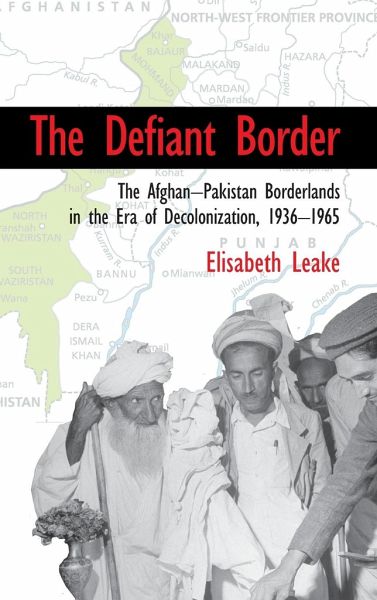
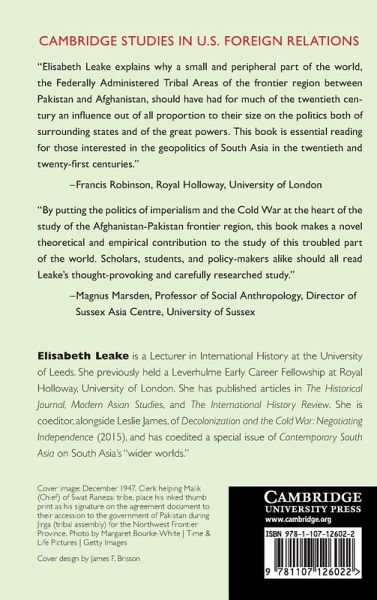
The Defiant Border explores why the Afghan-Pakistan borderlands have remained largely independent of state controls from the colonial period into the twenty-first century. This book looks at local Pashtun tribes' modes for evading first British colonial, then Pakistani, governance; the ongoing border dispute between Pakistan and Afghanistan; and continuing interest in the region from Indian, US, British, and Soviet actors. It reveals active attempts by first British, then Pakistani, agents to integrate the tribal region, ranging from development initiatives to violent suppression. The Defiant…mehr
The Defiant Border explores why the Afghan-Pakistan borderlands have remained largely independent of state controls from the colonial period into the twenty-first century. This book looks at local Pashtun tribes' modes for evading first British colonial, then Pakistani, governance; the ongoing border dispute between Pakistan and Afghanistan; and continuing interest in the region from Indian, US, British, and Soviet actors. It reveals active attempts by first British, then Pakistani, agents to integrate the tribal region, ranging from development initiatives to violent suppression. The Defiant Border also considers the area's influence on relations between Pakistan, Afghanistan, and India, as well as its role in the United States' increasingly global Cold War policies. Ultimately, the book considers how a region so peripheral to major centers of power has had such an impact on political choices throughout the eras of empire, decolonization, and superpower competition, up to the so-called 'war on terror'.
Elizabeth Leake is a Leverhulme Early Career Fellow at RoyalHolloway, University of London, UK.
Inhaltsangabe
Introduction. 'A doughty and honorable opponent': historicizing the Afghan-Pakistan borderlands 1. The Pashtun tribes 2. Geopolitics and state-building 3. Book structure Part I. 'Using a Crowbar to Swat Wasps': The Frontier Tribal Area in Imperial Defense: 4. India in interwar British imperial strategy 5. Indian nationalism, the Indian army, and regional relations 6. The 1936-7 revolt and its aftermath 7. Indian nationalists, the subcontinent's defense, and the war effort 8. The Pashtuns and the war effort 9. Conclusion Part II. The 'Opening of Sluice Gates': Plan Partition and the Frontier: 10. The end of war, imperial decline, and plan partition 11. Reconciling independent South Asia and imperial defense 12. The NWFP and the 1945-6 elections 13. British policy towards the frontier tribal area 14. Nehru's visit to the frontier and the local decline of the congress 15. Afghanistan, regional relations, and India's Pashtuns 16. The NWFP referendum and the future of the tribal zone 17. Independence and evolving tribal identity 18. Pakistan and the frontier tribal area 19. Conclusion Part III. 'We are One People and Ours is a Land': The Demand for Pashtunistan, 1948-52: 20. Britain, the emerging Cold War, and the Kashmir conflict 21. Kashmir in Indio-Pakistan relations 22. The development of independent Pakistan 23. The rise of Afghan-Pakistan tensions 24. Pakistan and the frontier tribal area 25. Pashtunistan in regional and international relations 26. Conclusion Part IV. A 'Friendly Point of Return': Pakistan and the Global Cold War: 27. The emergence of the United States-Pakistan alliance 28. The impasse in Afghan-Pakistan relations 29. The frontier tribal area and the one unit plan 30. Renegotiating Afghan-Pakistan relations in the Cold War 31. Conclusion Part V. An 'Eye for an Eye': Mohammad Ayub Khan and the Collapse of Regional Relations: 32. India and the United States: democracies reunited 33. Ayub Khan's ascendancy 34. Domestic change and integrating borderlands 35. Daud and Afghan modernization 36. Violence returns to the borderlands 37. The 1960 Afghan-Pakistan rupture 38. The failure of US mediation 39. The aftermath of the encounter 40. Conclusion Part VI. Conclusion. 'Religion, Land, Lineage, and Honour': The Afghan-Pakistan Borderlands Then and Now: 41. Pashtunistan then and now.
Introduction. 'A doughty and honorable opponent': historicizing the Afghan-Pakistan borderlands 1. The Pashtun tribes 2. Geopolitics and state-building 3. Book structure Part I. 'Using a Crowbar to Swat Wasps': The Frontier Tribal Area in Imperial Defense: 4. India in interwar British imperial strategy 5. Indian nationalism, the Indian army, and regional relations 6. The 1936-7 revolt and its aftermath 7. Indian nationalists, the subcontinent's defense, and the war effort 8. The Pashtuns and the war effort 9. Conclusion Part II. The 'Opening of Sluice Gates': Plan Partition and the Frontier: 10. The end of war, imperial decline, and plan partition 11. Reconciling independent South Asia and imperial defense 12. The NWFP and the 1945-6 elections 13. British policy towards the frontier tribal area 14. Nehru's visit to the frontier and the local decline of the congress 15. Afghanistan, regional relations, and India's Pashtuns 16. The NWFP referendum and the future of the tribal zone 17. Independence and evolving tribal identity 18. Pakistan and the frontier tribal area 19. Conclusion Part III. 'We are One People and Ours is a Land': The Demand for Pashtunistan, 1948-52: 20. Britain, the emerging Cold War, and the Kashmir conflict 21. Kashmir in Indio-Pakistan relations 22. The development of independent Pakistan 23. The rise of Afghan-Pakistan tensions 24. Pakistan and the frontier tribal area 25. Pashtunistan in regional and international relations 26. Conclusion Part IV. A 'Friendly Point of Return': Pakistan and the Global Cold War: 27. The emergence of the United States-Pakistan alliance 28. The impasse in Afghan-Pakistan relations 29. The frontier tribal area and the one unit plan 30. Renegotiating Afghan-Pakistan relations in the Cold War 31. Conclusion Part V. An 'Eye for an Eye': Mohammad Ayub Khan and the Collapse of Regional Relations: 32. India and the United States: democracies reunited 33. Ayub Khan's ascendancy 34. Domestic change and integrating borderlands 35. Daud and Afghan modernization 36. Violence returns to the borderlands 37. The 1960 Afghan-Pakistan rupture 38. The failure of US mediation 39. The aftermath of the encounter 40. Conclusion Part VI. Conclusion. 'Religion, Land, Lineage, and Honour': The Afghan-Pakistan Borderlands Then and Now: 41. Pashtunistan then and now.
Es gelten unsere Allgemeinen Geschäftsbedingungen: www.buecher.de/agb
Impressum
www.buecher.de ist ein Internetauftritt der buecher.de internetstores GmbH
Geschäftsführung: Monica Sawhney | Roland Kölbl | Günter Hilger
Sitz der Gesellschaft: Batheyer Straße 115 - 117, 58099 Hagen
Postanschrift: Bürgermeister-Wegele-Str. 12, 86167 Augsburg
Amtsgericht Hagen HRB 13257
Steuernummer: 321/5800/1497
USt-IdNr: DE450055826