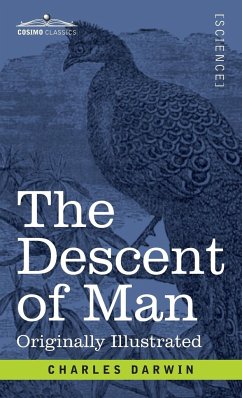
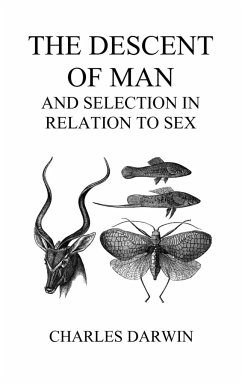
"It has often and confidently been asserted, that man's origin can never be known: but ignorance more frequently begets confidence than does knowledge: it is those who know little, and not those who know much, who so positively assert that this or that problem will never be solved by science." -Charles Darwin, The Descent of Man, (1871) The Descent of Man, and Selection in Relation to Sex (1894 edition) with original illustrations by T.W. Wood reveals Charles Darwin's theories of human evolution with particular focus on the argument that sexual competition is the means for natural selection…mehr
"It has often and confidently been asserted, that man's origin can never be known: but ignorance more frequently begets confidence than does knowledge: it is those who know little, and not those who know much, who so positively assert that this or that problem will never be solved by science." -Charles Darwin, The Descent of Man, (1871) The Descent of Man, and Selection in Relation to Sex (1894 edition) with original illustrations by T.W. Wood reveals Charles Darwin's theories of human evolution with particular focus on the argument that sexual competition is the means for natural selection rather than an animal's physical and biological environment. Originally published in 1871, the book was an instant success. It remains a foundation for present-day research as an in-depth exploration noting the differences between the sexes. This book is a must-read for those interested in biology and Darwin's theories of evolution.
Charles Robert Darwin was an English naturalist, geologist, and biologist whose work transformed the understanding of life on Earth. Born on February 12, 1809, in Shrewsbury, United Kingdom, to Robert Darwin and Susannah Wedgwood, he studied at Christ's College, Cambridge, where his early interest in natural history developed into a lifelong pursuit of scientific inquiry. His landmark research proposed that all species evolve over time through natural selection, a process by which organisms best adapted to their environments survive and reproduce. This idea, articulated in his major works, established a unifying theory for biology and profoundly influenced modern science and philosophy. Darwin's careful observation, experimentation, and documentation across geology, botany, and zoology demonstrated his commitment to empirical evidence. His contributions earned him honors such as the Copley Medal and the Royal Medal, while his ideas inspired generations of scientists and thinkers. He died on April 19, 1882, in Downe, United Kingdom, leaving a legacy that continues to shape evolutionary thought and the study of natural history.
Es gelten unsere Allgemeinen Geschäftsbedingungen: www.buecher.de/agb
Impressum
www.buecher.de ist ein Internetauftritt der buecher.de internetstores GmbH
Geschäftsführung: Monica Sawhney | Roland Kölbl | Günter Hilger
Sitz der Gesellschaft: Batheyer Straße 115 - 117, 58099 Hagen
Postanschrift: Bürgermeister-Wegele-Str. 12, 86167 Augsburg
Amtsgericht Hagen HRB 13257
Steuernummer: 321/5800/1497
USt-IdNr: DE450055826