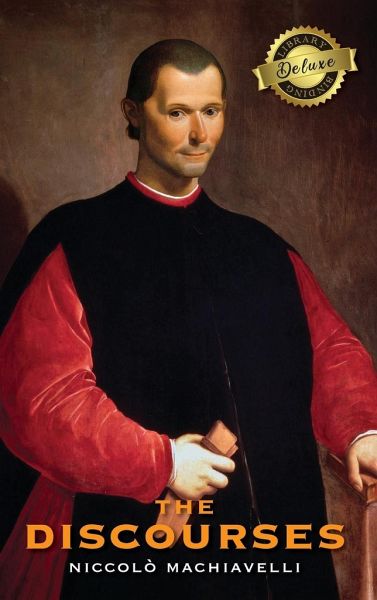
The Discourses is a work of political history and philosophy. The work is an analysis of the first ten books of Livy's Ab urbe condita, which describe the expansion of Rome through the end of the Third Samnite War in 293 BCE. Machiavelli also discusses what can be learned from many other eras including contemporary politics. He describes Romans and other ancient peoples as superior models for his contemporaries, but he also describes political greatness as something which comes and goes amongst peoples, in cycles. Written in the early 16th century, The Discourses were published posthumously…mehr
The Discourses is a work of political history and philosophy. The work is an analysis of the first ten books of Livy's Ab urbe condita, which describe the expansion of Rome through the end of the Third Samnite War in 293 BCE. Machiavelli also discusses what can be learned from many other eras including contemporary politics. He describes Romans and other ancient peoples as superior models for his contemporaries, but he also describes political greatness as something which comes and goes amongst peoples, in cycles. Written in the early 16th century, The Discourses were published posthumously with papal privilege in 1531. The text comprises a dedication letter and three books with 142 numbered chapters. Many scholars have studied the coincidence that Livy's history also contained 142 books in addition to its introduction as well as other numerological curiosities that turn up in Machiavelli's writings. The Discourses is often said to have paved the way of modern republicanism. While the book is primarily a discussion of the classical history of early Ancient Rome, it strays very far from this subject matter and uses contemporary political examples to illustrate points.
Niccolò Machiavelli (1469-1527) was an Italian political thinker, historian, and writer, best known for The Prince, a guide on power and leadership. Living during the turbulent Italian Renaissance, he worked as a diplomat for the Republic of Florence before being exiled when the ruling government changed. His writings, often seen as pragmatic and even ruthless, explored politics, war, and human nature. Though controversial, his ideas remain influential in political science, strategy, and leadership today.
Inhaltsangabe
The DiscoursesPreface Introduction by Bernard Crick So Many Machiavellis The Prince and The Discourses Republics as Mixed Government The Mixture as Adaptability The Value of Conflict Factors of Social Class The Conditions for Republican Rule Theory and Method Politics and Morality The Letter to Vettori Suggestions for Further Reading THE DISCOURSES OF NICCOLÒ MACHIAVELLI Table of Contents The Text Notes
The DiscoursesPreface Introduction by Bernard Crick So Many Machiavellis The Prince and The Discourses Republics as Mixed Government The Mixture as Adaptability The Value of Conflict Factors of Social Class The Conditions for Republican Rule Theory and Method Politics and Morality The Letter to Vettori Suggestions for Further Reading THE DISCOURSES OF NICCOLÒ MACHIAVELLI Table of Contents The Text Notes
Es gelten unsere Allgemeinen Geschäftsbedingungen: www.buecher.de/agb
Impressum
www.buecher.de ist ein Internetauftritt der buecher.de internetstores GmbH
Geschäftsführung: Monica Sawhney | Roland Kölbl | Günter Hilger
Sitz der Gesellschaft: Batheyer Straße 115 - 117, 58099 Hagen
Postanschrift: Bürgermeister-Wegele-Str. 12, 86167 Augsburg
Amtsgericht Hagen HRB 13257
Steuernummer: 321/5800/1497
USt-IdNr: DE450055826