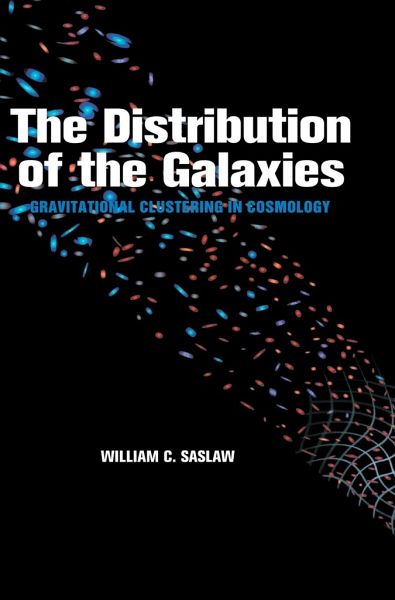
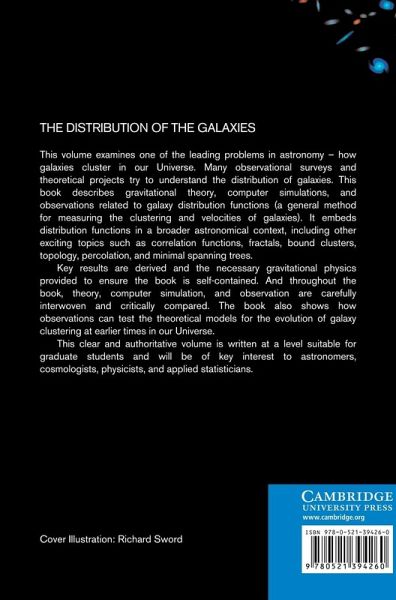
This topical volume examines one of the leading problems in astronomy - how galaxies cluster in our Universe. This book, first published in 2000, describes gravitational theory, computer simulations and observations related to galaxy distribution functions. It embeds distribution functions in a broader astronomical context, including other exciting contemporary topics such as correlation functions, fractals, bound clusters, topology, percolation and minimal spanning trees. Key results are derived and the necessary gravitational physics provided to ensure the book is self-contained. Throughout…mehr
This topical volume examines one of the leading problems in astronomy - how galaxies cluster in our Universe. This book, first published in 2000, describes gravitational theory, computer simulations and observations related to galaxy distribution functions. It embeds distribution functions in a broader astronomical context, including other exciting contemporary topics such as correlation functions, fractals, bound clusters, topology, percolation and minimal spanning trees. Key results are derived and the necessary gravitational physics provided to ensure the book is self-contained. Throughout the book, theory, computer simulation and observation are carefully interwoven and critically compared. The book also shows how future observations can test the theoretical models for the evolution of galaxy clustering at early times in our Universe. This clear and authoritative volume is written at a level suitable for graduate students, and will be of key interest to astronomers, cosmologists, physicists and applied statisticians.
Prologue Part I. Historical: 1. Cosmology myths and primitive notions 2. First qualitative physics: the Newton-Bentley exchange 3. Glimpses of structure 4. Number counts and distributions 5. Seeds of grand creation 6. Clusters versus correlations 7. The expanding search for homogeneity Part II. Descriptions of Clustering: 8. Patterns and illusions 9. Percolation 10. Minimal spanning trees 11. Topology 12. Fractals 13. Bound clusters 14. Correlation functions 15. Distribution functions Part III. Gravity and Correlation Functions: 16. The growth of correlations: I. A fluid description 17. The growth of correlations: II. A particle description 18. General correlation properties 19. Computer simulations 20. Simulations and observations of two-particle correlations Part IV. Gravity and Distribution Functions: 21. General properties of distribution functions 22. Dynamics of distribution functions 23. Short review of basic thermodynamics 24. Thermodynamics and gravity 25. Thermodynamic formulation of the cosmological many-body problem 26. The functional form of b(n,T) 27. Derivation of the spatial distribution function 28. Properties of the spatial gravitational quasi-equilibrium distribution 29. The velocity distribution function 30. Evolution of the GQED Part V. Computer Experiments for Distribution Functions: 31. Spatial distribution functions 32. Velocity distribution functions Part VI. Observations of Distribution Functions: 33. Observed spatial distribution functions 34. Observed peculiar velocity distribution functions 35. Observed evolution of distribution functions Part VII. Future Unfoldings: 36. Galaxy merging 37. Dark matter again 38. Initial states 39. Ultimate fates 40. Epilogue Bibliography Index.
Es gelten unsere Allgemeinen Geschäftsbedingungen: www.buecher.de/agb
Impressum
www.buecher.de ist ein Internetauftritt der buecher.de internetstores GmbH
Geschäftsführung: Monica Sawhney | Roland Kölbl | Günter Hilger
Sitz der Gesellschaft: Batheyer Straße 115 - 117, 58099 Hagen
Postanschrift: Bürgermeister-Wegele-Str. 12, 86167 Augsburg
Amtsgericht Hagen HRB 13257
Steuernummer: 321/5800/1497
USt-IdNr: DE450055826